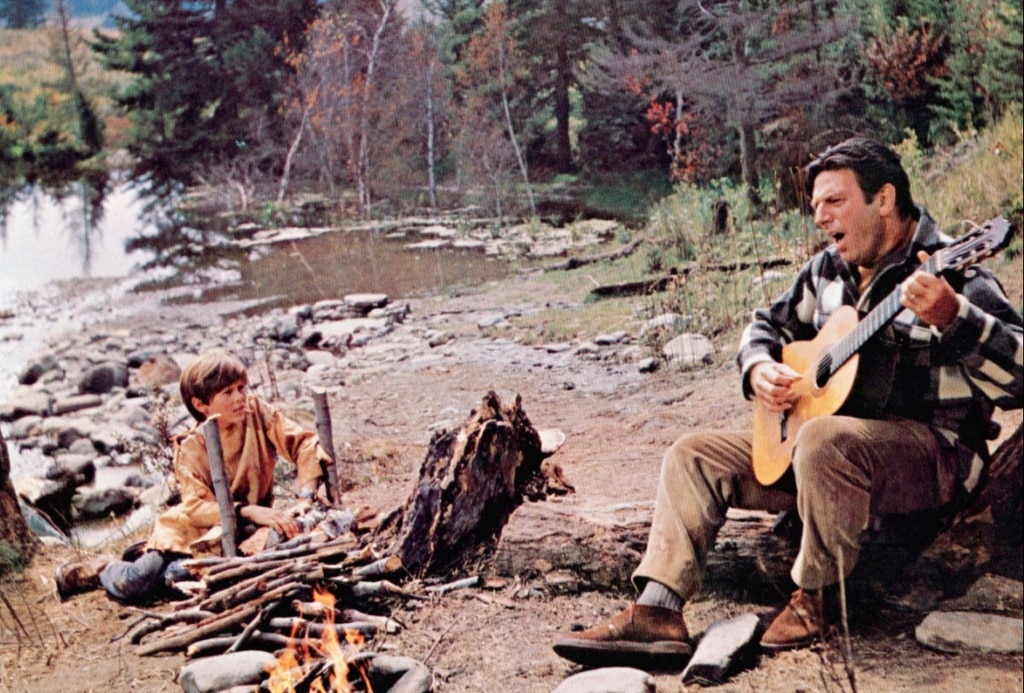
My Side of the Mountain (1969) wasn't produced by Disney but you wouldn't immediately be able to tell. This Paramount production has all the earmarks of a Disney live-action, late sixties movie: Precocious kid in the lead, trusty animal sidekick (a raccoon named Gus), a wilderness adventure, and a folk singer to boot (the magnificent Theodore Bikel). It also has the death of someone close to the lead, another Disney trademark. But it is not Disney and in many ways, that is also obvious from the entire setup which involves a 12 year old, going on 13, leaving the safety and security of his home in Canada to live in the wild. It was based on the bestselling book of the same name by Jean Craighead George that became a sensation in 1959. Today, it would be called YA (Young Adult) fiction but back then, they just called such things "children's books."
The boy, Sam Gribley (Teddy Eccles), worships at the altar of Henry David Thoreau and wants to see if he too can live off of the land. Despite his young age, and lack of real world experience, he heads off to the wilderness (without letting his parents know) to live off the land and does an extraordinarily good job of doing it. He takes his pet raccoon, Gus, with him and the two eat Sam's many algae based foodstuffs. He meets up with both a librarian (Tudi Wiggins) and a drifter (Bikel) who enrich his lonely existence. He takes an interest in falconry and raises a chick he swiped from a nest, based on what he learns in books supplied by the librarian.
If all of this seems a little hard to believe for a 13 year old venturing out on his own for the first time, that's because it is. Young Adult fiction, like any other kind, can be fanciful and this one is no exception. The fact that Sam struggles so little in his adventures firmly plants this tale in the category of safe and sound children's movies. There's never any real doubt as to the safety of Sam, even if there is danger all around him.
In the forties and fifties, there was a renewed interest in self-reliance and survivalism, and books like My Side of the Mountain and Kon-Tiki fed into that desire to see independent spirits launch out on their own in an effort to live on their wits and instincts. My Side of the Mountain simply made the hero a little younger than most.
The movie adaptation, coming ten years on the heels of the book, was directed by James Clark, one of classic Hollywood's greatest editors. He was Oscar-nominated for the John Ford classic, How Green was My Valley (1941) and spent the next two decades continuing his editing work on such diverse movies as I was a Male War Bride (1949), The Desert Fox (1951), and An Affair to Remember (1957). When he turned to directing, he became something of an expert on live-action animal movies. He directed A Dog of Flanders (1960), The Sad Horse (1959), Misty (1961), and Flipper (1963), all before this one which also features animals prominently.
The lead actor, Teddy Eccles, does the admirable and difficult job of carrying a film as a youth, though he does get solid help from the great Theodore Bikel. Eccles' career as an actor didn't pan out in features and throughout the seventies he mainly did sporadic tv work before turning to directing himself. As for Bikel, he not only did his own singing as the wandering folk singer, Bando, but actually wrote the songs, too! And not because he necessarily wanted to, the production asked him too and he gamely went along.
My Side of the Mountain hasn't lived on with the reputation of a work like Kon-Tiki but it still makes a strong statement about self-reliance and independence for children and young teens. As a YA adventure, it still holds up.
Director: James Clark
Producer: Robert B. Radnitz
Writers: Joanna Crawford, Jane Klove, Ted Sherdeman
Music: Wilfred Josephs
Cinematography: Denys N. Coop
Film Editing: Alastair McIntyre, Peter Thornton
Art Direction: George Lack
Cast: Ted Eccles (Sam Gribley), Theodore Bikel (Bando), Tudi Wiggins (Miss Turner), Paul Hébert (Hunter), Cosette Lee (Apple Lady)
By
Greg Ferrara
My Side of the Mountain
by Greg Ferrara | December 13, 2017
SIGN UP FOR OUR NEWSLETTERS

CONNECT WITH TCM