The 1945 stage musical Carousel and its 1956 movie adaptation are arguably the best-known versions of Hungarian playwright Ferenc Molnar's 1909 stage play Liliom, the supernatural tale of a carnival barker named Liliom who falls in love, dies and returns to earth to help his widow and daughter. By doing so, he also achieves his own redemption.
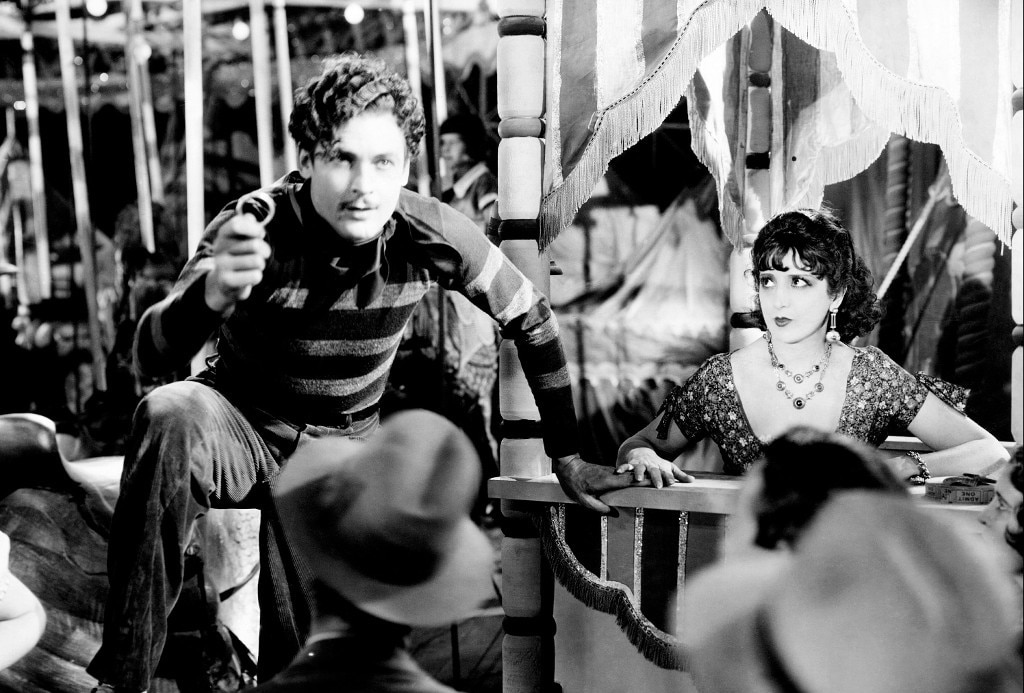
There were several film versions of Liliom made in Europe and the U.S., including a 1919 Hungarian silent directed by Michael Curtiz that was never finished because Curtiz abruptly left Hungary for political reasons. One early film adaptation was American, made in 1930 by the great romantic director Frank Borzage. It starred Charles Farrell and Rose Hobart, and featured that director's lush visual style. Fritz Lang's 1934 version of Liliom, made in France, is less sentimental than both the play and Borzage's film. Comic and tender-hearted, it is also an anomaly in Lang's career and style.
Born in Vienna, Lang had built a notable career in Germany with a wide variety of impressive films, including the five-hour heroic epic Die Nibelungen (1924), the science fiction classic Metropolis (1927) and his first sound film, the 1931 thriller M, starring a young Peter Lorre as a creepy child killer. But as the Nazis rose to power, it became clear that Lang, whose mother was Jewish, would have to leave Germany. He did so in 1934, later embellishing a dramatic story that he fled just before the Gestapo planned to arrest him. Lang's first stop was Paris, where he made his only French film, Liliom, for German producer and fellow exile Erich Pommer.
According to Lang biographer Patrick McGilligan, Pommer offered Lang a choice of two projects: Liliom and a detective story. The latter would seem to be a better fit based on Lang's European successes. But Lang chose the supernatural romance (the thriller, Man Stolen, was directed by Max Ophuls, who became known for his romantic dramas). Lang's decision turned out be a wise one, and he proved skillful in his handling of Liliom's turbulent nature and the problematic love story, as well as in the pacing of a script that includes comedy, romance and fantasy as well as melodrama.
Lang also drew a multifaceted performance from Charles Boyer, whose good looks, bedroom eyes and seductive voice inevitably led him to be typecast in romantic roles. There's plenty of romance in Liliom, but the film is robust, earthy, humorous and ultimately poignant, and Boyer is far from the clichéd continental "come with me to the Casbah" seducer that came to define his screen image. It was not until Boyer aged out of those Latin Lover roles that he was able to show once again his skill and versatility as one of the great actors of international cinema. In Liliom, Boyer manages to be both affecting and swaggering as the character requires, in spite of an unflattering, tightly-curled hairdo and too much eye makeup. Lang is at the top of his game, managing to imbue both the fantasy sequences and the realist ones with visual and emotional resonance.
Boyer's costar Madeleine Ozeray was a well-respected stage actress with the theater company of Louis Jouvet. She earned some success with prestige films in France in the mid-1930s but focused more on theater thereafter, particularly in the works of playwright Jean Girardoux. Ozeray returned to the screen in the 1970s, playing character roles in several French films of that era.
Polish-born cinematographer Rudolph Maté had begun his career as an assistant cameraman for director Alexander Korda and had shot several of Carl Theodor Dreyer's most important films, including 1928's The Passion of Joan of Arc. Maté went on to great success as a cinematographer in Hollywood, earning five Academy Award nominations for his work. Beginning in the late 1940s, he became a director of less prestigious but popular films.
Lang, of course, had an illustrious career in Hollywood. His most highly-regarded films were powerful dramas such as Fury (1936) and You Only Live Once (1937), and tough-as-nails thrillers like Scarlet Street (1945) and The Big Heat (1953). But in a 1965 interview with film historian and future director Peter Bogdanovich, Lang mused about the reasons Liliom failed at the box office and expressed his enduring fondness for the film. "It was shown in a French movie house and the audience went along with the picture in a way you can only hope for, but the moment it started to be comic--when the heavenly messengers brought Liliom into heaven--they turned against it. I made the heaven, I think, very funny...But the audience--because they really felt with Liliom and his wife--wanted to have a drama and suddenly they found a tragicomedy. I liked it." Near the end of his life, he told students at the American Film Institute the same thing: "LiliomI always liked very much. Today I almost like Liliom best of all."
Director: Fritz Lang
Producer: Erich Pommer
Screenplay: Robert Liebmann
Cinematography: Rudolf Mate, Louis Nee
Costume Design: Rene Hubert
Art Direction: Andre Daven
Music: Jean Lenoir, Franz Waxman
Principal Cast: Charles Boyer (Liliom Zadowski), Madeleine Ozeray (Julie), Robert Arnoux (Strong Arm), Roland Toutain (Sailor), Alexandre Rignault (Hollinger), Henri Richard (the Commissioner), Antonin Artaud (the Knife Grinder), Florelle (Mme. Moscat),
85 minutes
by Margarita Landazuri
Liliom
by Margarita Landazuri | December 13, 2017
SIGN UP FOR OUR NEWSLETTERS

CONNECT WITH TCM