The tidal wave of Filipino horror and action films that swept worldwide theaters (especially drive-ins) throughout the 1960s and '70s drew inspiration from many familiar popular British and American books and films. However, when it came to monster movies, few had a bigger impact than H.G. Wells' controversial 1896 anti-vivisectionist novel, The Island of Doctor Moreau. One of the most shocking and memorable pre-Code Universal horror films, Island of Lost Souls (1932), was directly based on the book and became a monster kid favorite thanks to its inventive variety of beast makeup effects.
The story obviously had a tremendous impact on producer Eddie Romero, a very prolific filmmaker in the Philippines who also acted as screenwriter and director on numerous films. In the late '50s he became a major player in the influx of American production money pouring into the country, which would reach an apex when Roger Corman and his compatriots became involved the following two decades. Romero was instrumental in crafting the first English-language Filipino horror film to really break out in America, Terror Is a Man (1959), which alters the names of Wells' characters but sticks as close to the plot as possible without skirting into outright plagiarism (or crosses over it, depending on whom you believe). The film (also reissued as Blood Creature) was a massive success and spawned more "Blood Island" films (with less overt Wells lifts), Mad Doctor of Blood Island and Brides of Blood (both 1968).
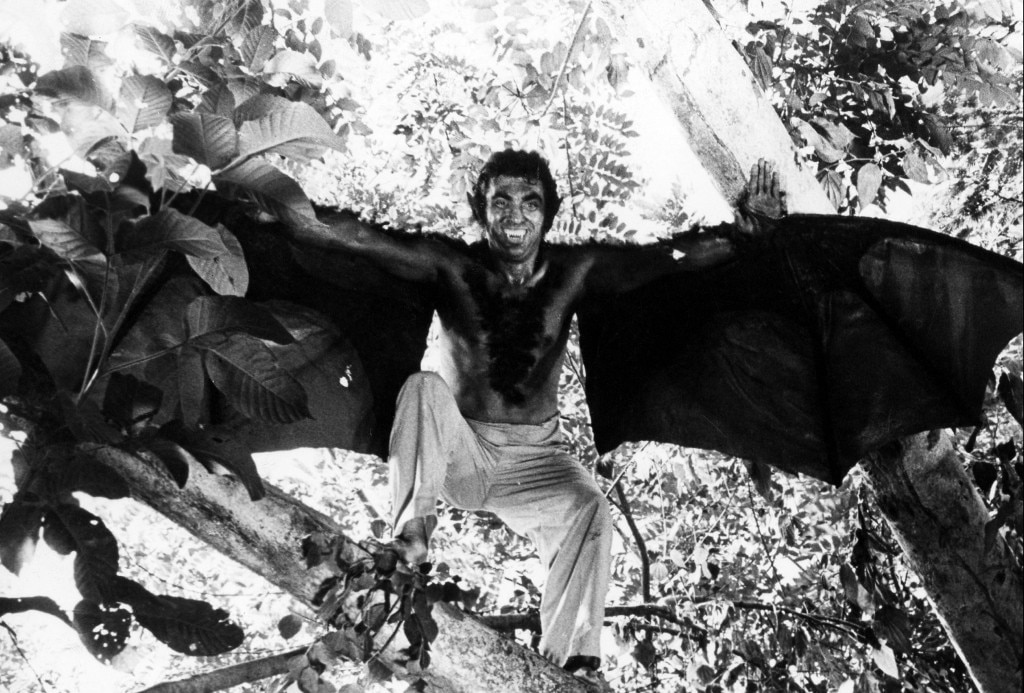
Still not done with milking the Moreau story for all it was worth, Romero returned to it one last time in 1972 with The Twilight People, which made the wise decision to cast a young Pam Grier as the obligatory human-panther woman hybrid. Still starting off her career, Grier donned a fake nose to play Ayesa, one of the mutants created on a remote island by the unethical former SS physician, Dr. Gordon (Charles Macaulay). She's really more of a supporting character here, but Grier was already starting to break out thanks to her other films made in the Philippines around the same time for producer Roger Corman and director Jack Hill, The Big Doll House (1971) and The Big Bird Cage (1972).
In fact, The Twilight People was an actual Corman film during production for his usual company, New World Pictures, but the involvement of producer Lawrence Woolner (who had successfully imported many Italian genre films in the 1960s) became tricky when the two split their partnership. As a result The Twilight People wound up one of the inaugural titles released by Woolner's new Dimension Pictures, which became a busy 1970s distributor of exploitation films including Kingdom of the Spiders (1977), Black Shampoo (1976), and Ruby (1977). Like Terror Is a Man, The Twilight People turned out to be quite popular, particularly as a regular entry in double and triple bills at drive-ins, and it proved to be a lucrative programming title for several years to come. Evidently American filmmakers must have taken notice by this point, as this would prove to be the swan song for Filipino Moreau adaptations. An American version starring Burt Lancaster would follow in 1977, oddly the first to actually bear the original title of Wells' novel, with another, far more ill-fated one directed by John Frankenheimer and starring Marlon Brandon and Val Kilmer becoming an oddball cult sensation of sorts in 1996. However, no other adaptation (official or unofficial) quite captures the same atmosphere as this Eddie Romero offering as it also serves now as a snapshot of an international partnership between the Philippines and the U.S. that would turn out to be very healthy and incredibly productive for many years to come.
By Nathaniel Thompson
The Twilight People
by Nathaniel Thompson | November 28, 2017
SIGN UP FOR OUR NEWSLETTERS

CONNECT WITH TCM