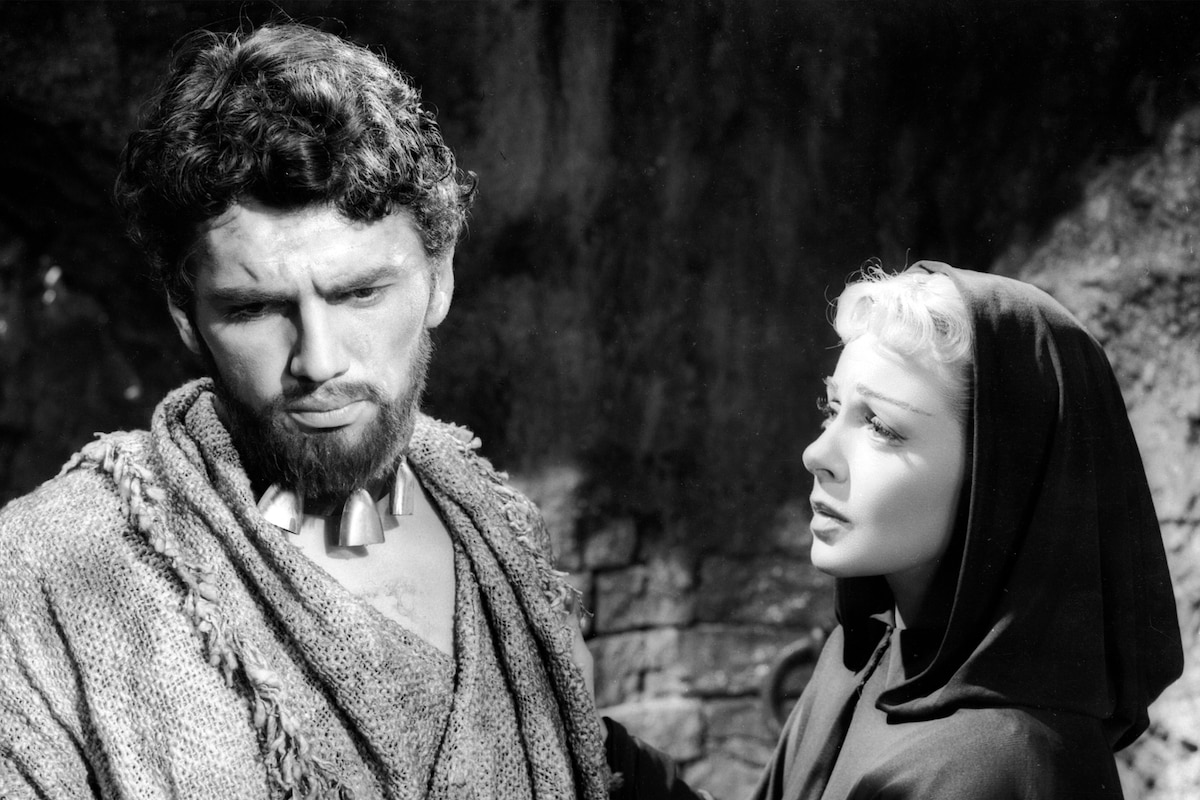
"I can never belong to any one man," Lana Turner asserts in The Prodigal (1955). "I belong to--all men." The campiness of that line was as obvious upon the film's release as it is today. Absurdly overblown and elaborate, The Prodigal was made in Eastmancolor and CinemaScope on a near $3 million budget, MGM's biggest release of the year. Its script was based on the short biblical story of the prodigal son, which includes a declaration that he wasted his wealth "on riotous living" before going home repentant. As envisioned by MGM, that meant cavorting with a barely-clad Lana Turner in pagan Damascus circa 70 B.C. (The story had also been filmed by Raoul Walsh in his 1925 film The Wanderer.)
In fact, The Prodigal is best seen today simply for the chance to gaze in wonder at the entire production, including Lana Turner. She had no desire to be in this film, finding the whole idea ridiculous. According to her daughter Cheryl Crane, Turner told makeup artist and friend Del Armstrong "If they're going to make me do this, I'm going to do it naked." Portraying Samarra, the High Priestess of Astarte, Turner wears beads and jewels attached with strings and metal plates, and, as Crane wrote, "she had all of the flesh-colored netting ripped out so that there was actual flesh on display."
As garish as the film's hundreds of costumes are, costume designer Herschel McCoy was actually in the midst of an auspicious career. He had started at Twentieth Century-Fox in 1936 and signed with MGM in 1951, earning two Oscar nominations along the way. He was 42 years old when he worked on The Prodigal, but it was to be his last film: he died suddenly, soon afterwards.
Young leading man Edmund Purdom had appeared in two other costume pictures--Julius Caesar (1953) and The Egyptian (1954)--but according to an internal MGM newsletter, he got the role here "because of his outstanding performance in The Student Prince (1954)."
The production was directed by Richard Thorpe and produced by Charles Schnee, who had written some excellent film noir dramas and one of the best films of Lana Turner's career, The Bad and the Beautiful (1952). But The Prodigal created a different, more unfortunate kind of magic, the kind that inspired critics in 1955 to blast the film as "overblown" and "neither thought-provoking nor heart-moving." Years later it inspired film scholar Jeanine Basinger to deem Turner's role "one of the silliest in film history."
"The design of The Prodigal," Basinger wrote, "gives the impression of various departments struggling with how to create the world of 70 B.C.--and forgetting to communicate with each other."
SOURCES:
Jeanine Basinger, Lana Turner
Cheryl Crane with Cindy De La Hoz, Lana: The Memories, The Myths, The Movies
Lou Valentino, The Films of Lana Turner
By Jeremy Arnold
The Prodigal (1955)
by Jeremy Arnold | November 15, 2017
SIGN UP FOR OUR NEWSLETTERS

CONNECT WITH TCM