No portrait in black, or any other color, plays a significant part in Michael Gordon's movie of that title. But plenty of paintings are on view in the background, thanks to the conspicuous wealth and posh decorating tastes of certain main characters, whose sumptuous home abounds with expensive furnishings, splendid views of San Francisco Bay, and classy pictures on the walls. Most of Portrait in Black (1960) takes place within that splendid residence, as its many housebound settings indicate. The film is based on a Broadway play, adapted for the screen by the playwrights - and since this is a noir-style murder mystery - its overprivileged occupants are dogged by trouble from its melodramatic beginning to its surprisingly downbeat finale.
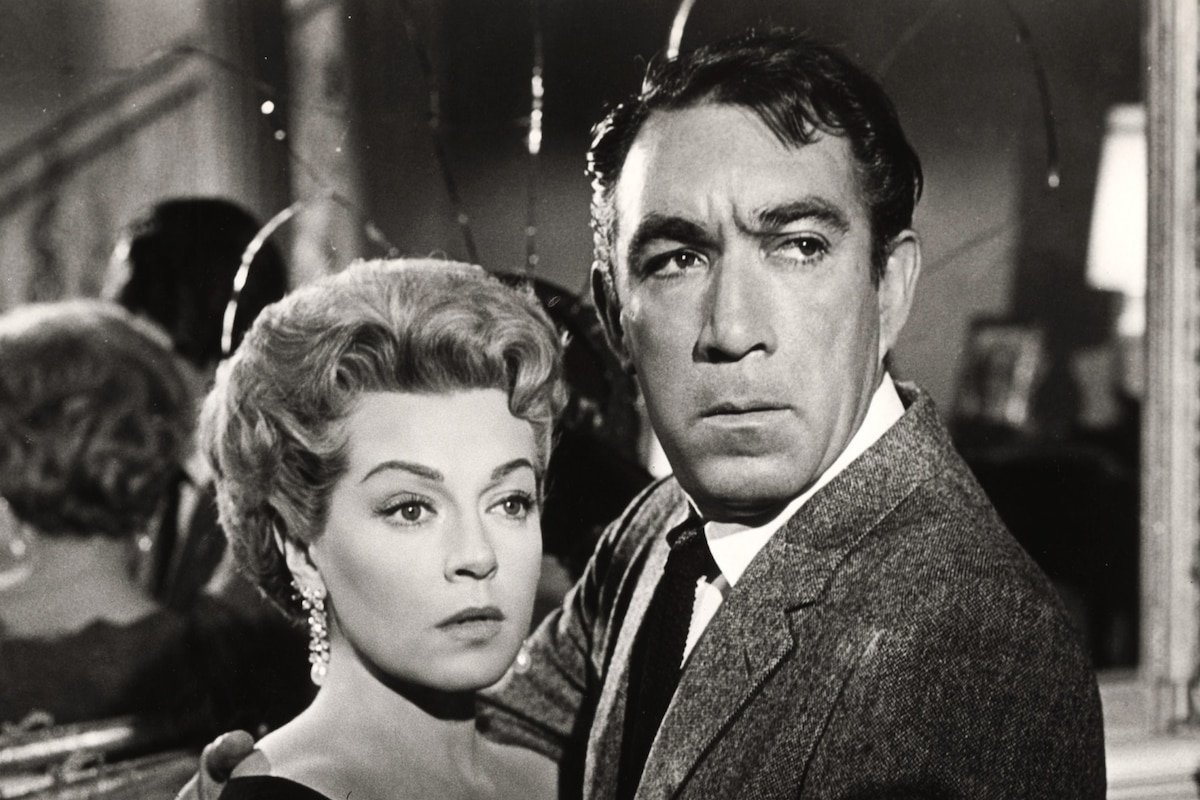
Lloyd Nolan plays Matthew S. Cabot, the sick and grumpy owner of a successful shipping company. Lana Turner plays his wife, Sheila Cabot, whose marital misery has led her into a love affair with her husband's physician, David Rivera, played by Anthony Quinn with a mixture of pugnacity and charm. Several others are on the scene as well: Richard Basehart as Howard Mason, the magnate's assistant; Sandra Dee as Cathy Cabot, the magnate's daughter by a previous wife; John Saxon as Blake Richards, the magnate's smalltime rival and Cathy's boyfriend; and Ray Walston as Cobb, the Cabot family's chauffeur. The supporting cast also includes the marvelous Chinese-American actress Anna May Wong, playing a housekeeper named Tawny after more than a decade's absence from the screen, and Virginia Grey as Miss Lee, a lovelorn secretary with the shipping firm.
Simultaneously enticed and repelled by fantasies of killing his patient Matthew and having Sheila for his own wife, David is on the verge of succumbing to despair, leaving America behind, and taking a new job as chief of a Swiss hospital. At the last minute, he seizes what he regards as his only chance for happiness, however, and murders Matthew by injecting an air bubble into a vein with Sheila's help. It seems like a perfect crime - David had injected Matthew with painkillers every day, and air bubbles can't be traced - until a terrifying letter arrives in the mail, bearing a single sentence printed in block letters: "Congratulations on the success of your murder." The identity and intentions of the sender are unknown, but the message fills the recipients with dread. Deciding that Howard is the person most likely to know what they've done, David and Sheila work out a plan to eliminate him, bringing about further complications in the already tangled narrative. Subplots concern a canceled shipping contract, an impending longshoremen's strike, and Cobb's escalating indebtedness to his bookie.
After directing several crime thrillers in the 1940s and taking a hiatus from Hollywood during the years of the scurrilous anticommunist blacklist, Gordon reinvented himself as a comedy director with the Doris Day vehicle Pillow Talk in 1959 and stayed quite loyal to that genre for the rest of his career. Portrait in Black was the major exception, and while its story is anything but comic, it has the stylish look and sleek performances found in most ultra-glossy entertainments of the period. The picture was originally slated for director Carol Reed, who bowed out because of creative differences with Universal, causing the first of many delays that kept the 1946 stage play from becoming a movie until 1960.
It's tempting to say that Universal was the auteur of Portrait in Black, since some pivotal elements were clearly designed to capitalize on a recent hit from the studio. Most obvious is the pairing of Turner and Dee as step-mother and daughter, a similar relationship to what they had in Douglas Sirk's hugely popular Imitation of Life (1959), another melodrama produced by Ross Hunter. In addition, Turner's glamorous outfits had garnered such acclaim in the 1959 picture that Hunter decked her out even more fabulously here, draping her Jean Louis gowns with jewelry worth well over a million dollars. The cinematographer, Russell Metty, was another Imitation of Life veteran, as were the film editor, art director, and set decorator. The picture's San Francisco settings recall Alfred Hitchcock's moody Vertigo, which had lost money for Paramount in 1958, but the harrowing drive along a cliffside road recalls Hitchcock's dynamic North by Northwest, which had earned a bundle for MGM in 1959. (It's probably just coincidence that Quinn and Basehart had appeared together in Federico Fellini's great Italian classic La Strada in 1954.)
Critics found much to criticize when Portrait in Black premiered. "The screenplay is incomplete and frequently preposterous," the Variety review opined, adding that Gordon's directing is "at least an equal partner in the deficiencies of the enterprise." The picture might have worked more persuasively if other actors considered for the top male roles - Laurence Harvey, Richard Burton, Peter Finch, Louis Jourdan - had landed them instead. And it would definitely have been better without Frank Skinner's corny music pumping away in scene after scene, even punctuating Wong's appearances with hackneyed faux-Asian sonorities.
These things said, however, Portrait in Black has some terrific moments, the best of which involves the aforementioned cliffside drive. Ordered to drive David's car in a sudden emergency, Sheila fearfully reminds him that she doesn't know how to drive! And then she drives anyway, groping for the right pedals as a storm unleashes torrents of pounding rain! This isn't the only effective scene in Portrait in Black, but it's good enough in itself to make the movie worth viewing.
Director: Michael Gordon
Producer: Ross Hunter
Screenplay: Ivan Goff and Ben Roberts, based on their play
Cinematographer: Russell Metty
Film Editing: Milton Carruth
Art Direction: Richard H. Riedel
Music: Frank Skinner
With: Lana Turner (Sheila Cabot), Anthony Quinn (Dr. David Rivera), Richard Basehart (Howard Mason), Sandra Dee (Cathy Cabot), John Saxon (Blake Richards), Ray Walston (Cobb), Virginia Grey (Miss Lee), Anna May Wong (Tawny), Dennis Kohler (Peter Cabot), Lloyd Nolan (Matthew S. Cabot)
Color-112m.
by David Sterritt
Portrait in Black
by David Sterritt | November 15, 2017
SIGN UP FOR OUR NEWSLETTERS

CONNECT WITH TCM