Once upon a time in Hollywood, George Segal was a star. He wasn't just a star, he was a bona fide romantic lead. He had none of the usual cliched physical qualities of such. Nothing about him reminded one of Cary Grant or Charles Boyer. And yet, there he was, a star. This is to Hollywood's never-ending credit. Segal was a star because he had charm, charisma, loads of talent, and an uncanny ability to connect to every co-star he ever had. People in showbiz talk about chemistry and how important it is between two stars. They also talk about how rare it is, too. Well, George Segal may be one of the only people in Hollywood history to have chemistry with every person with whom he ever made a movie. That's important to remember because his character in Blume in Love, the masterfully shot and narratively complex 1973 romantic dramady from Paul Mazursky, is a lout. A total lout. Stephen Blume, a divorce lawyer in California, falls in love with Nina (Susan Anspach), and once married, cheats on her in the most callous and cliched way imaginable: with his secretary. And she finds out when she comes home and rather than try to hide it, he simply says, "I brought my work home with me." Yeah, he's a lout. But Segal makes it work.
The opening of Blume in Love displays a fluidity in Paul Mazursky's movie making that he never had again. Oh, he made many more good movies, but Blume in Love has a look and feel, a non-linear narrative, that puts it on a whole different level than any other Mazursky work. Just telling a story non-linearly is hard enough but to do it as smoothly as Blume in Love is a real accomplishment. There's a rhythm that develops early on, both narratively with Segal's narration as Blume filling in the gaps, and visually as one shot leads to another. It works so well that Mazursky can take us effortlessly from Venice, Italy to Venice, California for a mere few seconds of flashback without confusing the audience. The story flashes back, and forward, and back again, and back from the flashbacks, with an ease that few movies can match. The story is a simple one, and that's probably for the best given the narrative style: Stephen Blume fell in love with Nina, lost her due to his infidelity, and wants her back.
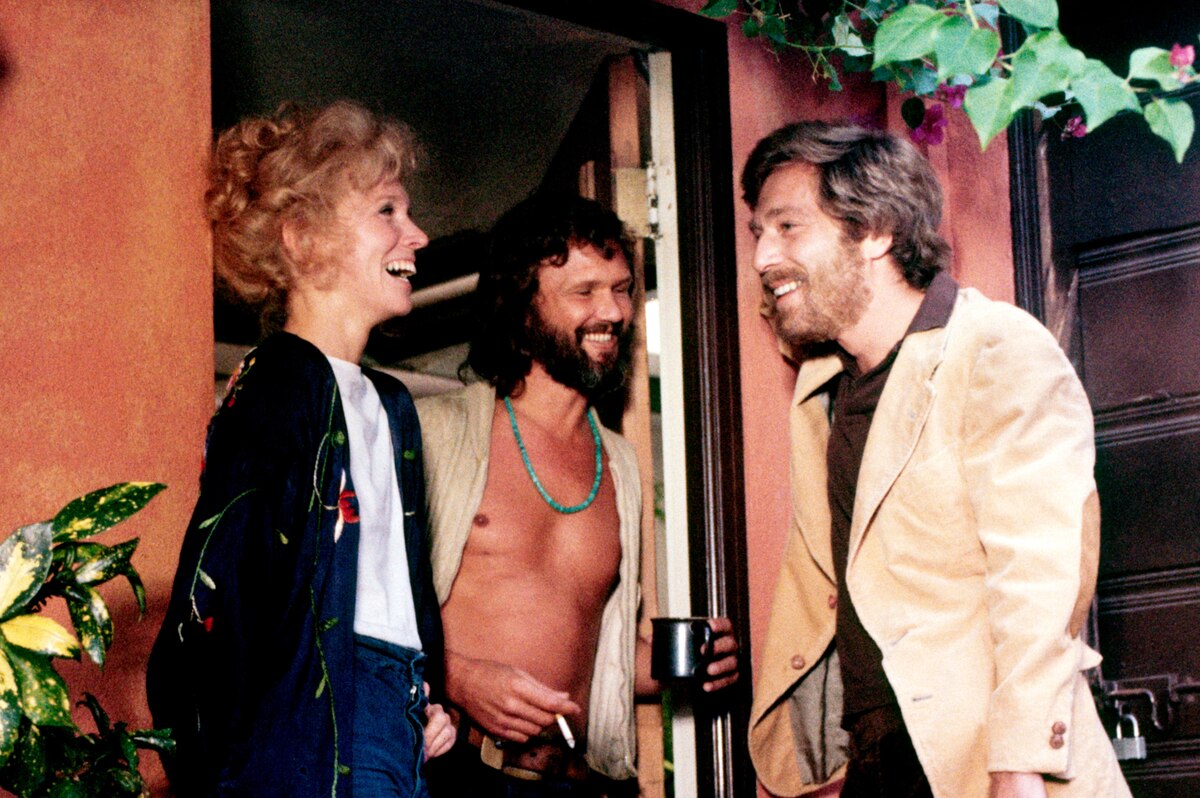
The movie opens with Blume musing about love and how Venice, Italy just makes people feel it more powerfully than anywhere else on earth. He skulks about staring at people and drinking espressos and longing for Nina who has since left him and lives with another man. That other man, a musician named Elmo (Kris Kristofferson), met Nina at the welfare office where she worked at the time. He was out of work and living in his truck. When Blume cheats on her, she hooks up with him and realizes that maybe she was with the wrong person all along. Elmo is kind, giving, generous, and talented. Making matters even worse, Blume likes him too! When they meet, Blume himself thinks Elmo just might be the right person for Nina. Still, his longing for Nina grows.
Blume in Love came out in 1973, a time when the studio system had collapsed into a heap of corporate takeovers and mergers, leaving actors and directors to their own choices, not beholden to studio dictates. From the late sixties through the mid-seventies, writers and directors had the power to get movies made with the cast they wanted to a far greater extent than ever before and movies like Blume in Love, with small but talented casts, shined in the new spotlight.
Paul Mazursky would go on to bigger, more successful movies, including the great An Unmarried Woman (1978), but probably never better than Blume in Love. Though not as celebrated as his bigger hits like Bob and Carol and Ted and Alice (1969), it hits every mark and the supporting players of Susan Anspach and Kris Kristofferson, while not as explosive as the Dyan Cannon and Elliott Gould in the aforementioned 1969 hit, have great chemistry with each other and, of course, with George Segal. Again, everyone had chemistry with George Segal. Including Marsha Mason and Shelley Winters, in smaller but important roles. For both Segal as an actor, and Mazursky as a writer and director, Blume in Love stands as their single greatest achievement.
Director: Paul Mazursky
Screenplay: Paul Mazursky
Producer: Paul Mazursky, Anthony Ray
Music: Bill Conti
Cinematography: Bruce Surtees
Film Editor: Donn Cambern
Art Director: Pato Guzman
Costume Design: Joel Schumacher
Cast: George Segal (Stephen Blume), Susan Anspach (Nina Blume), Kris Kristofferson (Elmo Cole), Marsha Mason (Arlene), Shelley Winters (Mrs. Cramer), Donald F. Muhich (Analyst), Paul Mazursky (Hellman), Annazette Chase (Gloria)
By
Greg Ferrara
Blume in Love
by Greg Ferrara | November 09, 2017
SIGN UP FOR OUR NEWSLETTERS

CONNECT WITH TCM