SYNOPSIS:
Detective Philip Marlowe is hired by ex-con Moose Malloy to find his vanished showgirl and lady friend Velma, who seems to have taken a permanent powder. A cynical knight operating by his own system of honor, Marlowe soon becomes embroiled in a scheme involving a stolen jade necklace owned by a gorgeous and flirtatious blonde, Helen Grayle, wife of the very rich Mr. Grayle. As Marlowe's involvement in all these shady dealings escalates, so does the danger. The detective's path intersects with Ann Grayle, the rich man's daughter, who is following her own secret agenda, and a group of thugs tied to the jewel theft, led by an aristocratic quack doctor, Amthor, who drugs and keeps Marlowe captive for days until the detective escapes to unravel the case.
Director: Edward Dmytryk
Producer: Adrian Scott
Screenplay: John Paxton
Based on the novel Farewell, My Lovely by Raymond Chandler
Cinematography: Harry J. Wild
Editing: Joseph Noriega
Art Direction: Albert S. D'Agostino, Carroll Clark
Music: Roy Webb
Cast: Dick Powell (Philip Marlowe), Claire Trevor (Velma/Mrs. Grayle), Anne Shirley (Ann), Otto Kruger (Amthor), Mike Mazurki (Moose Malloy), Miles Mander (Mr. Grayle), Esther Howard (Mrs. Florian)
BW-96m. Closed captioning.
Why MURDER, MY SWEET is Essential
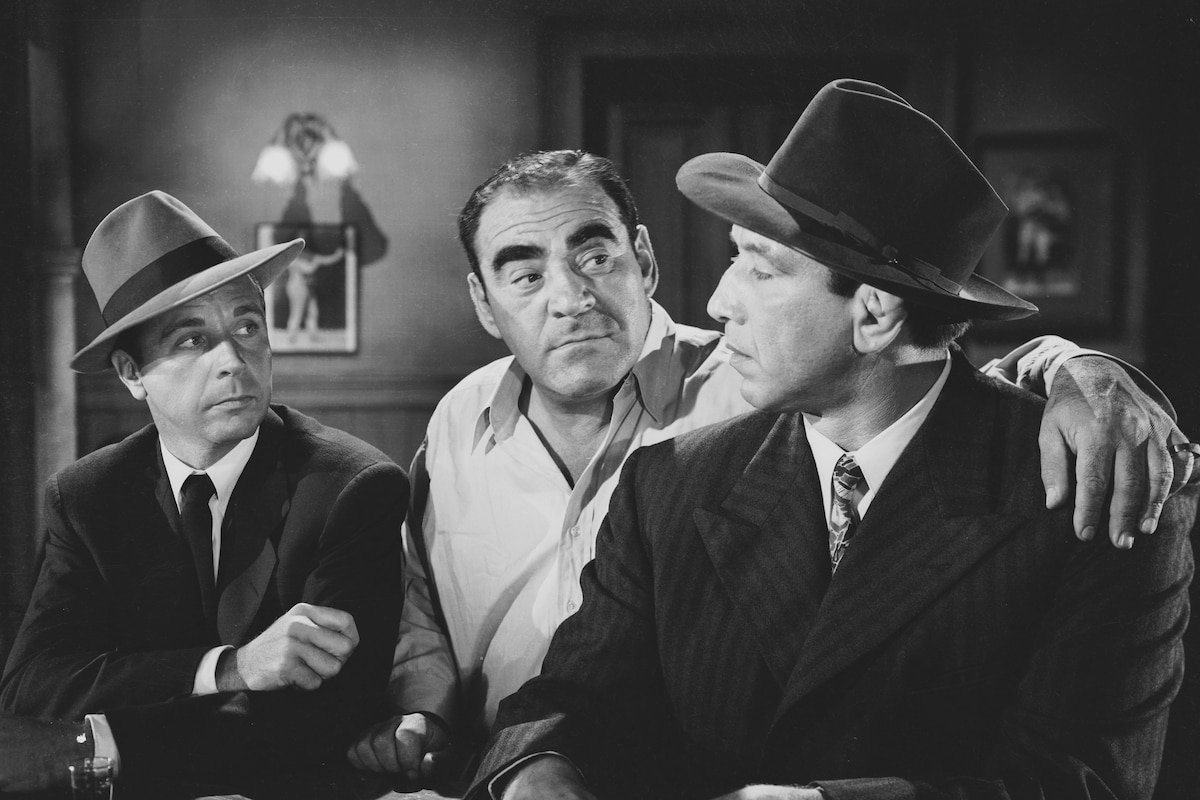
Murder, My Sweet is considered one of the first film noirs and a key influence on shaping the genre in its use of low-key black and white photography, its convoluted mystery plot and its depiction of a tough, cynical detective thrown into a world of corruption. Its box-office success helped establish the genre in Hollywood, inspiring generations of tough-talking gumshoes.
It was also the first film to feature Raymond Chandler's legendary private eye Philip Marlowe. Its success convinced Hollywood to try other adaptations of his novels, starting with The Big Sleep (1946), starring Humphrey Bogart and Lauren Bacall.
Most critics consider Murder, My Sweet to be the most faithful in both plot and spirit to Chandler's original novel.
A landmark film for both Dick Powell, who forever altered his choirboy image, and director Edward Dmytryk, who crossed-over from B-programmers like Captive Wild Woman (1943) to become a respected director of film noirs like Cornered (1945, which reunited Powell, producer Adrian Scott and screenwriter John
Paxton) and Crossfire (1947). Murder, My Sweet was Dmytryk and Scott's first major success as a producing/directing team; unfortunately, both of them would see their careers ruined by the Hollywood blacklist within two years. Dmytryk initially balked at the notion of casting Powell as a tough guy. "The idea of the man who had sung "Tiptoe Through the Tulips" playing a tough private eye was
beyond our imaginations," he noted of Powell. At the time, Powell's career had hit a creative dead-end and he was locked into that overgrown songster image. Anxious to break out of that stale typecasting, Powell had even campaigned for the featured tough-guy insurance agent role in Double Indemnity (1944), a role, ironically enough, awarded to the equally unlikely comedic actor Fred MacMurray. RKO's chief Charles Koerner wanted Powell under contract to star in his studio's musicals, but the only way Powell would agree to sign a contract was if he could play the lead in Murder, My Sweet as the first picture.
Powell was not the only actor to resist typecasting in Murder, My Sweet. Anne Shirley and Claire Trevor both conspired to do a little acting-against-type of their own, and petitioned for the proverbial good girl Anne to play the scheming fatale and for Claire, used to playing molls and floozies, to play the "good and dull" (as Anne put it) nice girl. But to no avail: conventional typecasting was followed and the actresses delivered expected versions of their usual screen personas.
Murder, My Sweet was originally delivered to theaters as Farewell, My Lovely, the original title of Chandler's 1940 novel. But audiences in the areas of its original release (New England and Minneapolis) were put off by the title, mistook Farewell for another Powell musical and stayed away, leading RKO executives to rechristen the film Murder, My Sweet. Farewell, My Lovely had been filmed once previously, as The Falcon Takes Over (1942) - and was remade in 1975 under Chandler's original title with Robert Mitchum as Marlowe.
Although he didn't get a penny for the film -- he had sold the rights to RKO years earlier -- Chandler considered Murder, My Sweet the best screen version of his work. He even noted that the film's success had made him the best-selling author of hard-boiled detective stories, eclipsing Dashiell Hammett, author of The Maltese Falcon.
by Frank Miller & Felicia Feaster
Murder My Sweet: The Essentials
by Frank Miller & Felicia Feaster | October 30, 2006
SIGN UP FOR OUR NEWSLETTERS

CONNECT WITH TCM