Little Women had been filmed in 1917, with Ruby Miller as Jo, and in 1918, with Dorothy Bernard. The latter version was actually filmed in Louisa May Alcott's Concord, Massachusetts, home. A stage version played Broadway in 1912, with revivals in 1916 and 1931. The latter production starred future film actresses Jessie Royce Landis as Jo and Lee Patrick as Meg.
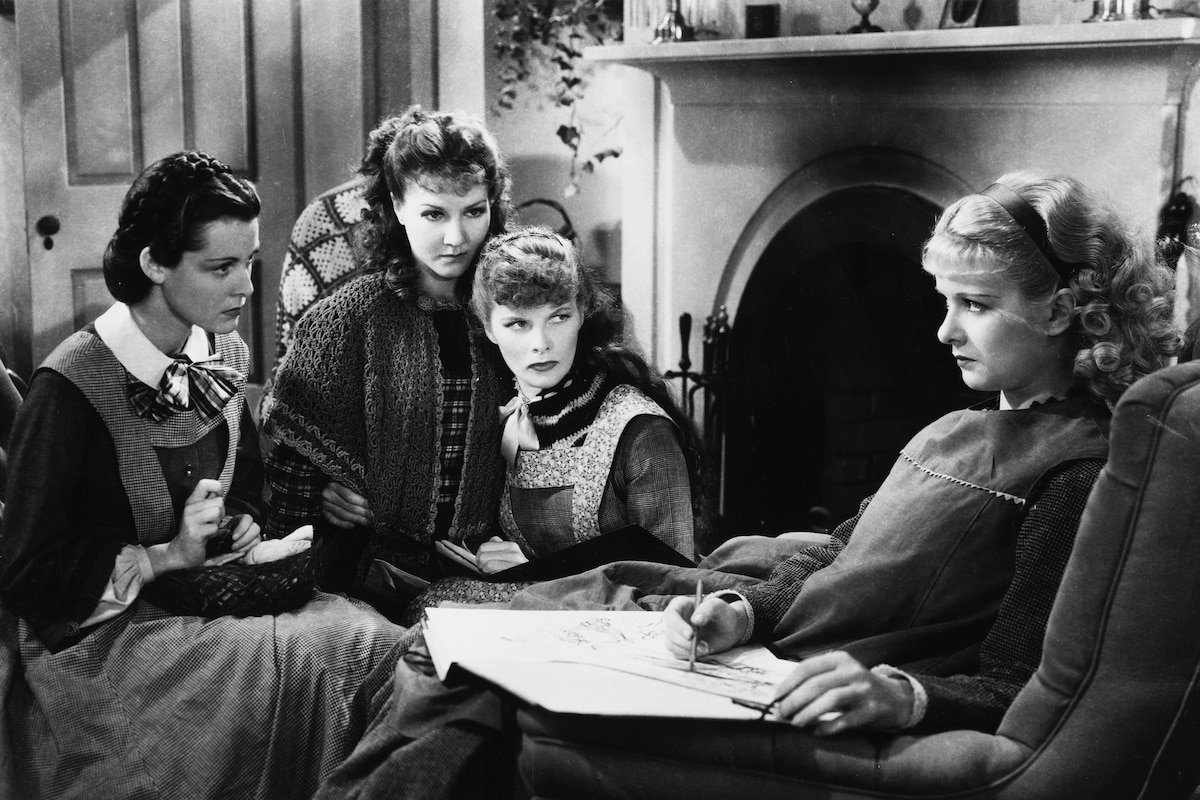
To capture the March family's frugality, Cukor and costume designer Walter Plunkett arranged to have dresses passed from older to younger sisters through the course of the film.
Hepburn accused Cukor of never having finished reading the novel, a claim he good-naturedly denied.
Little Women marked the feature debut of stage actress Spring Byington (she previously had starred in a 1930 Vitaphone short shot in New York). The role of Marmee was far removed from her usual run of flighty eccentrics, such as the ditzy mother in You Can't Take It with You (1938).
After one of Hepburn's most exuberant scenes, the crew lowered a large ham from the catwalk as a practical joke.
Hepburn was a regular guest at Cukor's Sunday afternoon parties, but never got along with another of his friends, Tallulah Bankhead. The feeling was mutual until Cukor arranged for Bankhead to screen some scenes from Little Women. After watching Hepburn's work, Bankhead went to the set, tears streaming down her face, and fell on her knees before the actress. Cukor quipped, "Tallulah, you're weeping for your lost innocence."
In 1948, Cukor was asked to take over the MGM remake of Little Women from Mervyn LeRoy. He refused, primarily because he remembered his own pain at having been replaced on Gone with the Wind (1939), but he also felt the remake was too slick and lacked the magic of the original.
Although she played Beth, the sister who dies while still young, Jean Parker actually outlived her three on-screen sisters, passing away November 30, 2005.
Douglass Montgomery, who played Laurie, had worked with Cukor in the director's upstate New York stock company. Like many actors from his theatre days, Montgomery was the beneficiary of Cukor's gratitude. Not only did he win one of the films' two major male roles, but when his career had faded, Cukor got him work filming screen tests for Gone with the Wind.
Newspaper ads for the film heralded, "The radiant Star of Morning Glory [1933] marches still deeper into your heart as the best loved heroine ever born in a book....See her...living...the immortal Jo.
FUN QUOTES FROM LITTLE WOMEN (1933)
"It's a dollar for each. Well, take them....Never mind thanking me. Just spend it wisely, that's all I ask. Although it's more than I can expect when you're so much like your father. Waltzing off to war and letting other folks look after his family." -- Edna May Oliver, as Aunt March, offering Katharine Hepburn, as Jo March, a Christmas gift and some unwanted advice.
"It's not preachers that's going to win this war. It's fighters" -- Oliver, as Aunt March.
"Christopher Columbus!"
"Jo, don't use such dreadful expressions. Here comes old Mr. Laurence. What if he should hear you?"
"I don't care. I like good strong words that mean something." -- Hepburn, as Jo March, defending her pet expression to Frances Dee, as Meg March.
"Oh, I detest rude, unladylike girls."
"And I hate affected, niminy piminy chicks!" -- Joan Bennett, as Amy March, quarreling with Hepburn, as Jo.
"Oh, wait until I become a famous author and make my fortune. Then we'll all ride in fine carriages and dress like Flo King, snubbing Amy's friends and telling Aunt March to go to the dickens." -- Hepburn.
"What richness!" -- Hepburn responding to the home of her neighbors the Laurences.
"It's as dull as tombs over here." -- Douglass Montgomery, as Laurie.
"I'll be prim as I can be and not get into any scrapes -- if I can help it." -- Hepburn, promising to behave at the party.
"She has an infirmity. She's shy....If it weren't for that she'd be simply fastidious." -- Bennett, as Amy, describing Jean Parker, as Beth March, to Henry Stephenson, as Mr. Laurence.
"Tell your mother I think all her daughters are simply fastidious." -- Stephenson, as Mr. Laurence.
"What a blunderbuss I am." -- Hepburn.
"There, I've done my best. If that won't do, I'll have to wait until I can do better." -- Hepburn, finishing a story.
"Oh, why do things always have to change just when they're perfect." -- Hepburn.
"When will you stop your childish, romping ways."
"Not until I'm old and stiff and have to use a crutch." -- Dee, as Meg March, arguing with Hepburn.
"I happened to be going past a barber shop, and I saw some tails of hair hanging in the window with the prices marked on them, and so I thought it'd do my brains good to have my mop cut off....Well, it's boyish, becoming and easy to keep in order" -- Hepburn, after she has sold her hair to help pay for her mother's trip to Washington.
"Stay here. I want to carry away a picture in my mind of my brave little women to take to father. Goodbye, my darlings." -- Byington, as Marmee, leaving for Washington.
"Oh, I beg your pardon, but you're such a dear, I couldn't help flying at you."
"Fly at me again. I rather liked it." -- Hepburn and Montgomery, as Laurie, in the throes of young love.
"If life's as hard as this, I don't see how we'll ever get through it." -- Hepburn.
"I know I'm not half good enough for you, but, well, if you love me you could make me anything you like."
"As though I'd change you, Laurie. Laurie, you should marry some lovely, accomplished girl who adores you. Someone who'd grace your beautiful house. I shouldn't. I loathe elegant society, and you like it. And you hate my scribblings, and I can't get on without it. And we should quarrel....And everything would be so horrid if we were ever foolish enough to....I'm so grateful to you. And so proud and fond of you. I don't know why I can't love you the way you want me to. I've tried, but I can't change the feeling, and it will be a lie to say, 'I do.'" -- Montgomery attempting unsuccessfully to propose to Hepburn.
"Mothers have to have sharp eyes. Especially when their daughters keep their troubles to themselves." -- Byington.
"He's a professor, see. You know, learning them how they talk in foreign countries. I don't know what good it does them when they're living right here." -- Nydia Westman, as Mamie, describing Paul Lukas as Professor Bhaer.
"If only I could write something like that. Something that would set other hearts on fire." -- Hepburn, responding to a song Lukas, as Professor Bhaer, has sung.
"Amy, you seem to forget waiting cabs cost money. That's the trouble with people who've never had anything -- easy come, easy go." -- Oliver, hurrying Bennett off to Europe.
"If I can't stand the truth, I'm not worth anything. I didn't think the stories were so very good. But you see, 'The Duke's Daughter' paid the butcher's bill. And 'The Curse of the Conventrys' was the blessing of the Marches, because it sent Marmee and Beth to the seashore." -- Hepburn, on Jo's stories.
"I say to you, 'Sweep mud on the street first before you are false to this talent.' Say to yourself, 'I will never write one single line which I have not heard in my own heart.' Say to yourself, 'While I am young, I will write the simple, beautiful things that I understand now. And maybe later, when I am a little bit older and I have felt life more, then I will write about those poor wretches. But I will make them live and breathe like my Shakespeare did.' Will you do that, my little friend?"
"Oh, yes, I'll try. But I don't think I'll ever be a Shakespeare. Do you?"
"But you can be a Josephine March, and I assure you, that is plenty." -- Lukas, as Bhaer, giving Hepburn some writing advice.
"Those of us that have been all over the old world can find many things in the new that are...beautiful and young." -- Lukas, betraying his feelings for Hepburn.
"Look at me world, I'm Jo March, and I'm so happy." -- Hepburn.
"Oh, poor Jo. You mustn't be afraid. Doesn't that sound funny? Me saying that to you, when you've always said it to me. You've always reminded me of a sea gull, Jo. Strong and wild. And fond of the wind and storms. And dreaming of flying far out to sea. And mother always said that I was like a little cricket, chirping contentedly on the hearth. Never able to bear the thought of leaving home. But now, it's different. I can't express it very well and shouldn't try to. To anyone but you, because I can't speak out to anyone but my Jo. I'm not afraid any more. I'm learning that I don't lose you. That you'll be more to me than ever, and nothing can part us, though it seems to. Oh, but Jo, I think I'll be homesick for you, even in heaven." -- Parker, on her deathbed.
"We mustn't cry. We must be glad she's well at last." -- Hepburn, comforting Byington after Parker's death.
"No, we never can be boy and girl again, Laurie. Those happy old times can never come back, and we shouldn't expect them to. We're man and woman now. We can't be playmates any longer, but we can be brother and sister, to love and help one another all the rest of our lives." -- Hepburn's reconciliation with Montgomery after he has married Bennett.
Compiled by Frank Miller
Trivia and Fun Facts on LITTLE WOMEN (1933)
by Frank Miller | December 18, 2006
SIGN UP FOR OUR NEWSLETTERS

CONNECT WITH TCM