The fact that Little Women achieved box office success while also following the classic novel closely helped producer David O. Selznick convince his bosses at MGM to approve a faithful adaptation of Charles Dickens' David Copperfield (1935), which was also directed by George Cukor.
With Little Women's box office success, RKO announced plans to re-team Katharine Hepburn, Joan Bennett, Edna May Oliver and Henry Stephenson in an adaptation of Pride and Prejudice. The project was abandoned, though Oliver would eventually star in MGM's 1940 version of the classic novel.
Independent producer Walter Wanger was so impressed with Bennett's performance he signed her to a personal contract. Under his guidance, she would make some of her best films, including Trade Winds (1938), Scarlet Street (1945) and The Reckless Moment (1949). He also would marry her.
A year after the success of Little Women, Mascot Pictures filmed Louisa May Alcott's sequel, Little Men, with Erin O'Brien-Moore as Jo and Ralph Morgan as Professor Bhaer. Other versions appeared in 1940, with Kay Francis, and in 1997, with Mariel Hemingway. As a miniseries, the story appeared on Japanese television in 1993 and on British television in 1998. Shirley Temple took on the role of Jo in a 1960 entry for her Shirley Temple's Storybook series co-starring Fernando Lamas as Professor Bhaer.
Hepburn would return to the role of Jo for a 1945 radio adaptation on Theatre Guild of the Air. She would reprise the production in 1947.
Little Women was adapted for television in 1946, with Margaret Hayes as Jo.
Selznick started work on a remake in 1946 as a vehicle for his protégée and later wife Jennifer Jones. Diana Lynn, Bambi Linn and Rhonda Fleming played her sisters, with Anne Revere as her mother, Charles Coburn as Mr. Laurence, and Constance Collier as Aunt March. Although they started work on the film, Selznick was so exhausted from producing Duel in the Sun (1946), he sold the project to MGM. Only director Mervyn LeRoy and actress Elizabeth Patterson, who played the family's maid, stayed with the production.
The lavish 1949 MGM remake starred June Allyson as Jo, with Elizabeth Taylor, Janet Leigh and Margaret O'Brien as her sisters, Mary Astor as Marmee, Lucile Watson as Aunt March, Peter Lawford as Laurie, C. Aubrey Smith as Mr. Laurence and Rossano Brazzi as Professor Bhaer. Although considered inferior to the 1933 version, it won the Oscar® for Best Art Direction.
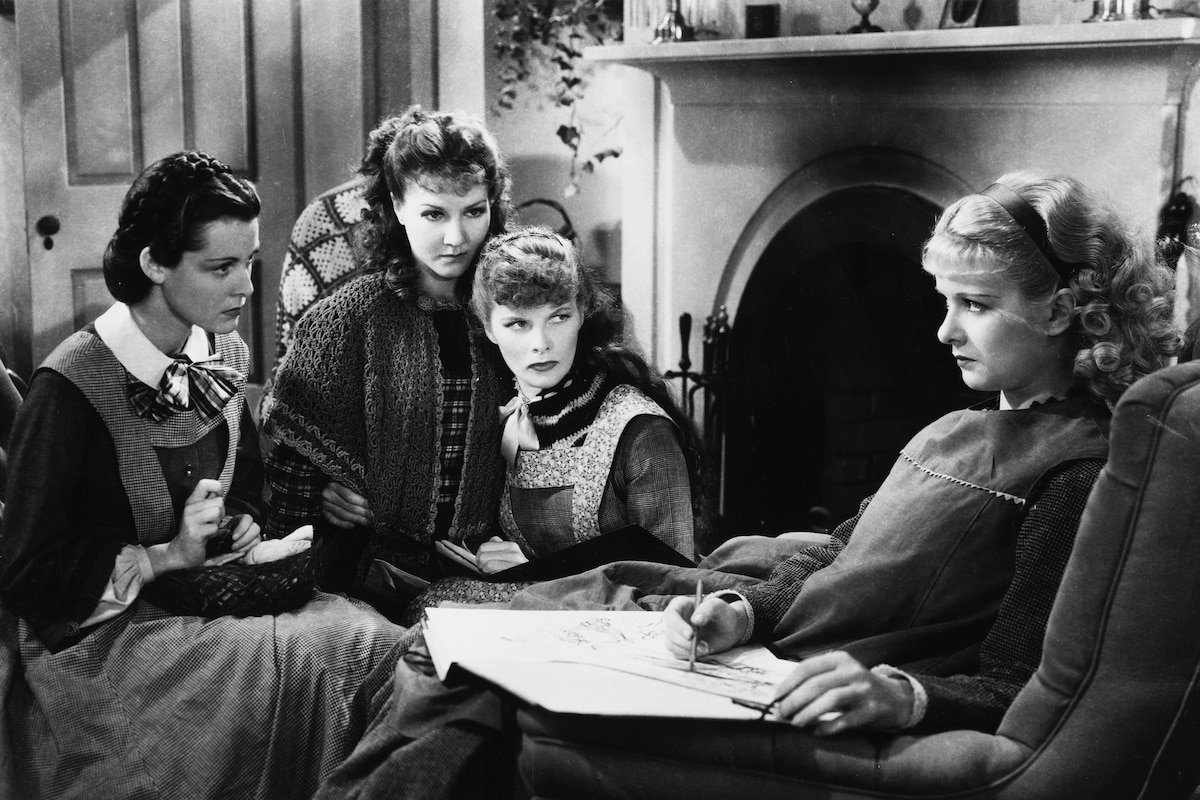
The MGM remake pushed the 1933 version out of the limelight for years, as did dismissals of the story as sentimental. In the '70s, however, the film was rediscovered by feminist critics who were impressed by Hepburn's portrayal of Jo as a character of strength and independence.
The novel Little Women inspired TV series in 1950, 1958 and 1979. The latter -- starring Jessica Harper as Jo, Dorothy McGuire as Marmee, Mildred Natwick as Aunt March and Robert Young as Mr. Laurence -- was inspired by an acclaimed 1978 miniseries starring McGuire and Young, but with Meredith Baxter Birney as Jo, Greer Garson as Aunt March and William Shatner as the Professor.
Other television versions include a 1958 musical starring Florence Henderson and Margaret O'Brien and a 1970 British miniseries.
The most recent film version of Little Women appeared in 1994 under the direction of Gillian Armstrong, with Winona Ryder as Jo, Susan Sarandon as Marmee, Gabriel Byrne as the Professor, Claire Danes as Beth, Kirsten Dunst as the young Amy, Christian Bale as Laurie, John Neville as Mr. Laurence, Eric Stoltz as John Brooke and Mary Wickes as Aunt March. It won Oscar® nominations for Ryder as Best Actress, the screenplay and the score As in the 1933 version, the design for the March house was modeled on Louisa May Alcott's own home in Massachusetts.
A new stage musical adapted from the novel opened on Broadway in 2005, with Sutton Foster as Jo and Maureen McGovern as Marmee. The songs were written by Jason Howland and Mindi Dickstein.
by Frank Miller
Pop Culture - POP CULTURE 101
by Frank Miller | December 18, 2006
SIGN UP FOR OUR NEWSLETTERS

CONNECT WITH TCM