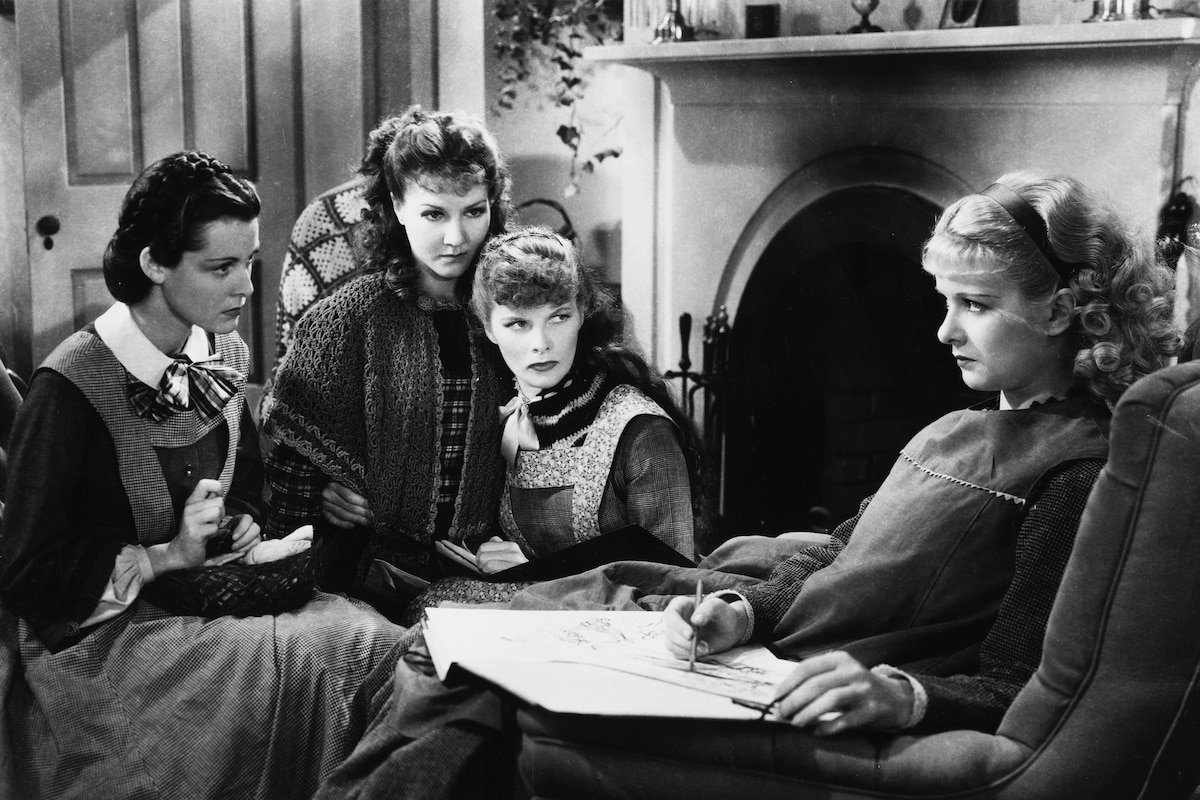
Little Women was RKO's most successful film to that time, grossing $2 million internationally on a cost of $424,000.
"Miss Hepburn steps up the ladder, if anything, by her interpretation of Jo. She talks rather fast at times, but one feels that Jo did, and after all one does not wish to listen to dialogue in which every word is weighed when the part is acted by a Katharine Hepburn." -- Mordaunt Hall, the New York Times.
"That Little Women attains so perfectly, without seeming either affected or superior, the courtesy and rueful wisdom of its original is due to expert adaptation by Sarah Y. Mason and Victor Heerman, to Cukor's direction and to superb acting by Katharine Hepburn....This picture, which critics last week pronounced the best that RKO has yet produced, is likely to place Katharine Hepburn near the top of the list of U.S. box-office favorites." -- Time Magazine
"It is, of course, the mood which is the important part of the work, and it is the unashamed straightforwardness of the writing, the unpatronizing shrewdness of George Cukor's direction and, above all, Miss Hepburn's beautiful playing which make Little Women an exquisite screen drama. It is one of the great feats of Mr. Cukor that he manages a screen play in which everyone is supposed to be charming all over the place and makes it all seem true." -- Mordaunt Hall, the New York Herald Tribune.
"A reminder that emotions and vitality and truth can be evoked from lavender and lace as well as from machine guns and precision dances." -- Thornton Delehanty, New York Post.
"There are small flaws - a few naive and cloying scenes, some obvious dramatic contrivances - but it's a lovely, graceful film, and surprisingly faithful to the atmosphere, the Victorian sentiments, and the Victorian strengths of the Louisa May Alcott novel...Directed by George Cukor, for the most part imaginatively and with unusual delicacy..." - Pauline Kael, 5001 Nights at the Movies (Henry Holt and Company).
"Surely the definitive version of Louisa May Alcott's novel, sweet, funny, perfectly cast, and exquisitely evocative in its New England period reconstruction...Cukor mines a rich vein of sentiment, never over-stepping the mark into slush, but it is Hepburn's Jo, making a subversive choice of what she wants her life to be, who ensures that the cosiness isn't everything." - Tom Milne, TimeOut Film Guide (Penguin).
"...a profoundly moving history of youth and in this celluloid transcription...its deeply spiritual values are revealed with a simple earnestness. Katharine Hepburn as Jo creates a new and stunningly vivid character; strips the Victorian boyden of her too syrupy goody-goodiness; and endows the role with awkwardly engaging youth energy that makes it the essence of flesh and blood reality." - Variety Movie Guide (Prentice Hall).
"Charming 'big picture' of its day, with excellent production and performances" - Halliwell's Film & Video Guide (HarperPerennial).
"Film offers endless pleasure no matter how many times you've seen it; a faithful, beautiful adaptation..." - Leonard Maltin's Classic Movie Guide (Plume).
AWARDS & HONORS
The National Board of Review listed Little Women as the Best Film of 1933.
Little Women placed eighth on the New York Times' ten best list. Another Cukor film, Dinner at Eight (1933), placed fifth.
Photoplay magazine gave Little Women its medal of honor for the year.
Sarah Y. Mason and Victor Heerman won the Academy Award® for Best Adapted Screenplay. Nominations also went to the film and George Cukor's direction.
Although not nominated for Little Women, Hepburn won the Oscar® that year, but for Morning Glory (1933).
Katharine Hepburn was named Best Actress at the Venice Film Festival for her performance.
Compiled by Frank Miller & Jeff Stafford
The Critics Corner - THE CRITICS' CORNER - LITTLE WOMEN (1933)
by Frank Miller & Jeff Stafford | December 18, 2006
SIGN UP FOR OUR NEWSLETTERS

CONNECT WITH TCM