Why LITTLE WOMEN is Essential
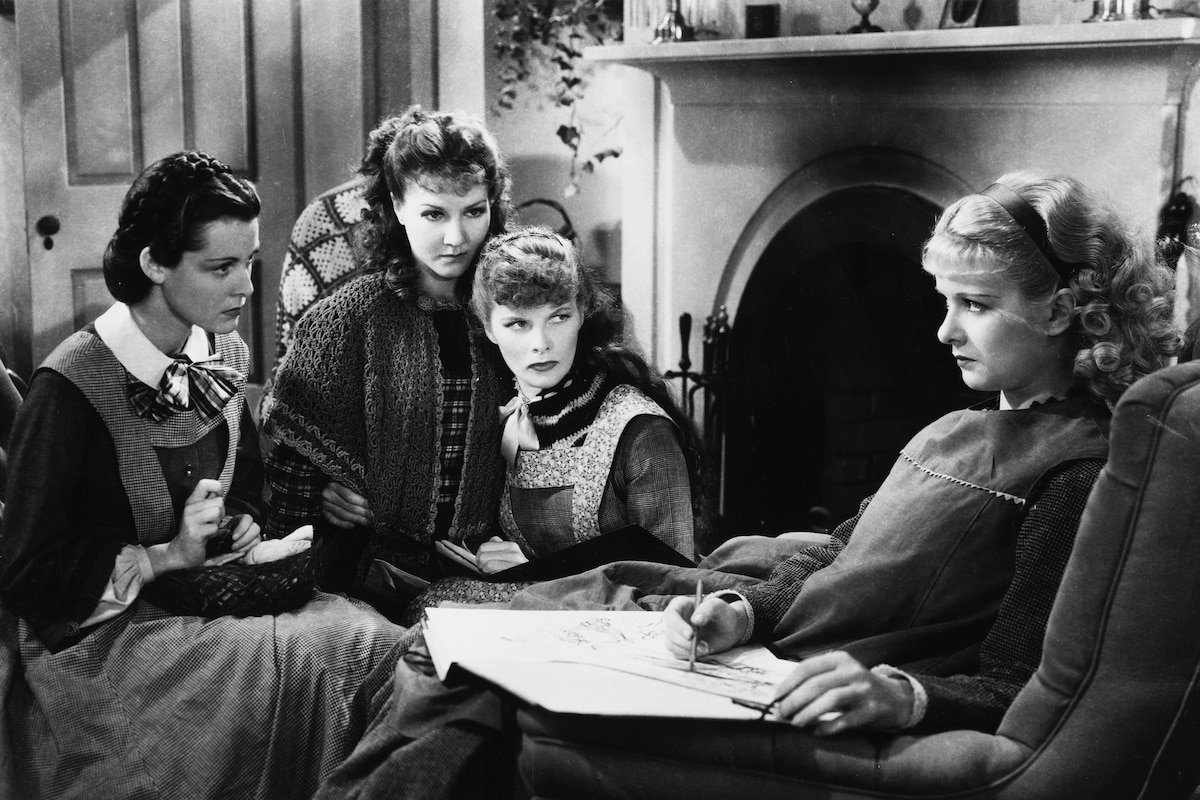
The role of Jo March was a perfect match for the young Katharine Hepburn's flinty, New England independence. While some of her other films of the period would establish a fluttery, affected screen image that eventually led to her being declared "box office poison" in the late '30s, Little Women would show just how fine an actress she could be and provide fans with the perfect embodiment of her brisk, New England strength.
Little Women was one of the first classic adaptations to become a hit while also staying true to its source material. Hollywood thinking at the time held that even the best-known literary sources had to be completely re-written to make them more commercial. RKO production chief David O. Selznick, however, had always contended that audiences went to film adaptations to see a faithful treatment of a favorite novel. After the picture's proven success, he was able to convince MGM brass to finance and distribute screen adaptations of David Copperfield and A Tale of Two Cities (both 1935). He would also take the same approach as an independent producer and score his greatest success with Gone with the Wind (1939).
Little Women marked a breakthrough for director George Cukor in terms of visual style. For the first time, he worked closely with an art director (Hobe Erwin) to create the perfect look for the film, establishing a tradition of quality that would mark most of his mature works.
Although he had directed Hepburn's screen debut, A Bill of Divorcement (1932), Cukor and the actress did not become close friends until they teamed for Little Women. The film's success would lead to a lifelong relationship during which he would direct her in eight feature films (including The Philadelphia Story (1940) and Adam's Rib, 1949) and two television pictures, including her Emmy-winning Love Among the Ruins (1975).
The success of Little Women the same year he made Dinner at Eight, made Cukor one of Hollywood's top directors.
Nominated for three Academy Awards - Best Picture, Best Director, and Best Adapted Screenplay - Little Women won only the latter for the writing team of Victor Heerman and Sarah Y. Mason. Heerman was a director in the teens and twenties. He turned to writing, usually with his wife, Sarah Y. Mason, after directing his best-known film, the Marx Brothers' Animal Crackers (1930). Many of the couple's scripts were adaptations of novels, such as The Age of Innocence (1934), Magnificent Obsession (1935), and Stella Dallas (1937). The first of these was Little Women and this version was considered by most critics to be the best, and the most faithful to the book.
According to Cukor and star Katharine Hepburn, there were several earlier versions of the screenplay by various writers, and none of them worked. The reason Heerman and Mason's script worked so well, Hepburn recalled in her autobiography, was that it was "simple and true and naive but really believable. Mason and Heerman believed the book. So did I. The others didn't." Cukor called the script "something quite original for the time. It wasn't slicked up. The construction was very loose, very episodic, like the novel. Things happen, but they're not all tied together...the writers believed in the book, they understood its vitality, which is not namby-pamby in any way."
Little Women was the final film David O. Selznick supervised as head of production at RKO, and it had his usual superb production values: authentic period sets; costumes by Walter Plunkett, who would later design costumes for Gone with the Wind; sensitive direction by George Cukor; and a first-rate cast. Little Women was a hit, out-grossing most of the films in release at the time.
Producer: Merian C. Cooper
Director: George Cukor
Screenplay: Victor Heerman; Sarah Y. Mason
Based on the novel by Louisa May Alcott
Cinematography: Henry W. Gerrard
Costume Design: Walter Punkett
Film Editing: Jack Kitchin
Original Music: Max Steiner
Cast: Katharine Hepburn (Jo), Joan Bennett (Amy March), Paul Lukas (Professor Fritz Bhaer), Frances Dee (Meg), Jean Parker (Beth), Edna May Oliver (Aunt March), Henry Stephenson (Mr. Laurence), Spring Byington (Marmee March), Samuel S. Hinds (Mr. March), John Lodge (John Brooke).
BW-116m. Closed captioning. Descriptive video.
by Frank Miller, Margarita Landazuri & Jeff Stafford
The Essentials - LITTLE WOMEN (1933) - THE ESSENTIALS
by Frank Miller | December 18, 2006
SIGN UP FOR OUR NEWSLETTERS

CONNECT WITH TCM