In spite of Frankenheimer's insistence that much of the credit for The Manchurian Candidate's success was due to Axelrod's writing, the script actually contained very few camera directions. The imaginative depiction of the brainwashing sequence, with its intercutting between different perspectives and fantasies, the playing out of the assassination scene, and such touches as the use of TV screens in the press conference, were all worked out by Frankenheimer.
The brainwashing sequence was filmed three times in its entirety (the garden club ladies, the black soldier's viewpoint, and the Communist captors) against three different sets constructed so the camera could turn completely around in each. The parts were then edited together to convey the shifting perspectives.
The assassination sequence was filmed first over a period of four days in an empty Madison Square Garden in New York with Laurence Harvey walking between vast rows of vacant seats and arriving at the booth high up in the arena. The rest of the sequence was filmed in the far smaller Olympic Auditorium in Los Angeles with tight shots of crowds at the fictional convention, edited together to give the impression that the original location was now filled with thousands of people.
Production Designer Richard Sylbert created most of the interiors in the studio.
Frankenheimer and cinematographer Lionel Lindon chose to use a lot of hand-held cameras to give many scenes their bizarre, disorienting feel.
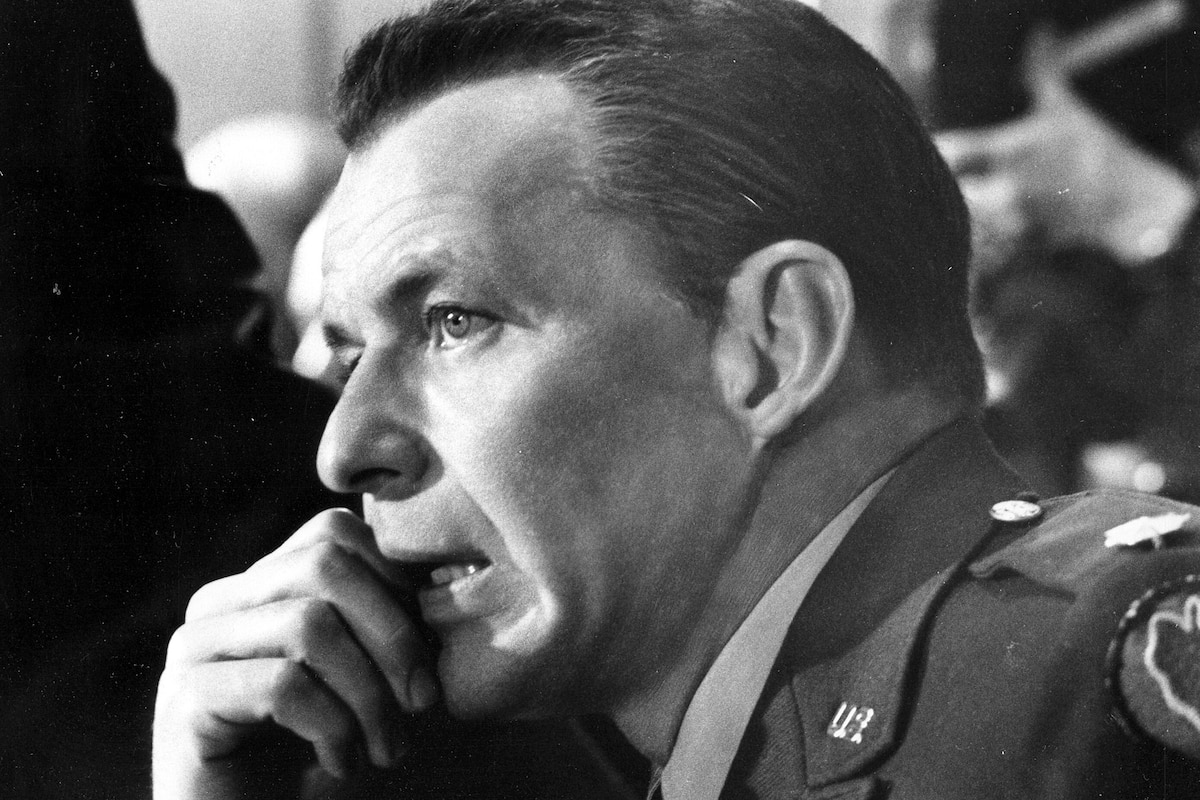
Sinatra told the press he was more excited to do The Manchurian Candidate than any movie he had ever worked on. He was particularly taken with having to say things in the script "I've never had to speak on screen before...long, wild speeches." Axelrod said he thought it was terrific "to have that marvelous, beat-up Sinatra face giving forth long, incongruous speeches."
In spite of his reputation, Sinatra turned out to be, for the most part, a hard worker and pleasant and cooperative on the set. Frankenheimer called him "one of the most charming human beings I have ever met." Janet Leigh was friends with the actor before filming began but still nervous about stories she heard from others who worked with him. She found him to be "a caring, giving actor, willing to rehearse indefinitely, taking direction, contributing ideas to the whole." Axelrod said he was "a dream to work with" and called him "one of the best screen actors in the world...lyrically sensitive...magic." Most people agreed that Sinatra's attitude could be attributed largely to the fact that he had tremendous respect for his director and enthusiasm for the project.
Axelrod did, however, note some demands Sinatra made. All his scenes had to be scheduled up front and shot in 15 days. Before he left the set, he announced that he would have to see every bit of footage he was in. Frankenheimer told him he could see it all except the complex, multi-perspective brainwashing sequence, which had not yet been edited, but Sinatra insisted "in a voice where you felt kneecaps were going to be broken," Axelrod said. To accommodate the star, Axelrod and editor Ferris Webster went through the shooting script and noted where all the cuts should be, then Webster put it together so Sinatra could see it. According to Axelrod, the sequence as cut for that purpose made it into the finished film unchanged.
One other problem involving Sinatra concerned the memorably harrowing sequence where he confronts Raymond with an entire pack of the Queen of Hearts trigger cards. Sinatra went through the scene without a hitch and was very effective in his close-ups. But when Frankenheimer viewed the rushes, he noticed that the camera was out of focus on Sinatra's face. He told the actor the scene would have to be shot again. Sinatra was crushed, on the verge of tears, according to the director, because he knew that his best work was always on the first take. Reshooting the scene proved Sinatra to be right. So Frankenheimer decided to use the out-of-focus shots. Audiences and reviewers thought the scene brilliant and assumed the askew focus was meant to show Raymond's fuzzy perspective on Marco.
Janet Leigh found the role of Rosie one of the most difficult she had done because "the character was plunked down in the middle of the script, with no apparent connection to anyone, transmitting non sequiturs while sending meaningful rays through her eyes." But she was proud of her work and credited Sinatra and Frankenheimer with helping her achieve it.
The scene where Laurence Harvey jumps in Central Park Lake was shot on the coldest day in 30 years. The foot-thick ice on the lake had to be broken with a bulldozer before the scene could be shot.
The Manchurian Candidate was shot in 39 days.
by Rob Nixon
Behind the Camera
by Rob Nixon | August 14, 2006
SIGN UP FOR OUR NEWSLETTERS

CONNECT WITH TCM