Director William Wyler had seen Jezebel on stage and recommended it to his home
studio at the time, Universal, as a vehicle for Margaret Sullavan. He also thought it
might make a good musical.
Stage actress Fay Bainter, who had only recently come to Hollywood, was paid $2,000 a
week for playing Aunt Belle, the same fee Davis got for the film's starring
role.
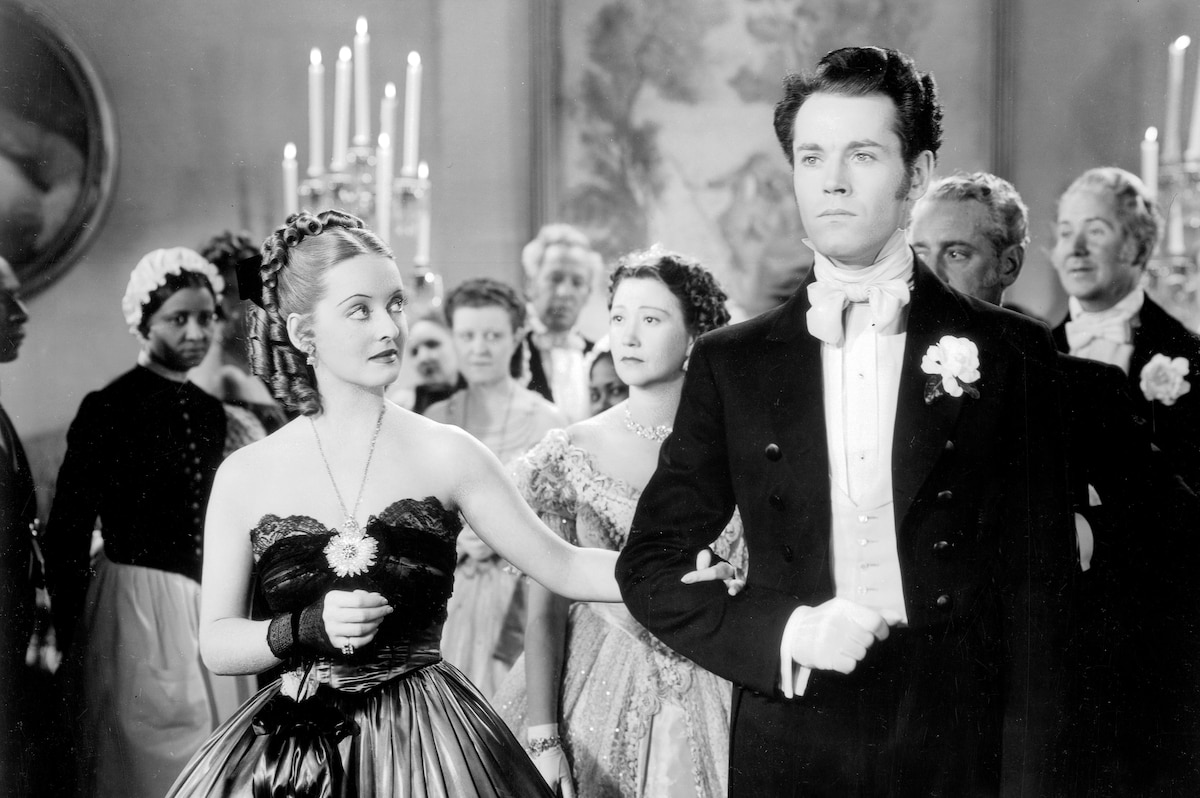
For the red dress that scandalized New Orleans society, costume designer Orry-Kelly
created a rust-colored gown that would look red in black and white.
The yellow fever epidemic that struck New Orleans in 1853 claimed 8,000
victims.
When Fonda and Wyler realized they were both signed with agent Leland Hayward, who had
just married the ex-wife of both men, actress Margaret Sullavan, they decided to play
a practical joke on him. Each called him demanding he come to the set. Separately,
Fonda told him he wanted to quit the film because he couldn't work with Wyler, and
Wyler told him he wanted to fire Fonda, even though almost all of his scenes had been
completed. After much persuasion, Hayward got them both together on the set to talk
out their problems, at which point a photographer snapped a quick picture of them they
would label "The Maggie Sullavan Club."
When Fonda's daughter, Jane, was born shortly after he finished his scenes for the
film, he sent Wyler a telegram from the newborn Jane looking for acting work. Wyler
wired back, offering his condolences on her poor choice of a father and offering to
give her a screen test as soon as possible.
During filming, Wyler and Davis discussed the possibility of her starring in his
planned film version of Wuthering Heights (1939). Unfortunately, Jack Warner
wasn't interested in buying the Ben Hecht-Charles MacArthur script. When Wyler's
boss, Samuel Goldwyn, decided to make the film himself, he saw it as a vehicle for his
own contract star, Merle Oberon.
Davis hated the film's ad line, "She's meanest when she's lovin' most." When she
complained about it to co-star George Brent, he quipped, "But ain't it the truth about
you." Davis threw her drink in his face. A year later, they would have an
affair.
Davis' competition at the Oscars® included co-star Fay Bainter, who had starred in
White Banners (1938). Bainter was the first actress nominated for both a Best
Actress and Best Supporting Actress Oscar® in the same year and set a precedent by
winning in the supporting category for Jezebel. That precedent held true for
Teresa Wright, who won Best Supporting Actress for Mrs. Miniver (1942) the same
year she was nominated for Best Actress for The Pride of the Yankees; Barry
Fitzgerald, who won the supporting award for Going My Way (1944) while also
nominated for Best Actor for the same film; and Jessica Lange, who lost her bid for
Frances (1982) while winning for her supporting role in Tootsie. The
precedent finally ended when Sigourney Weaver was nominated for both Gorillas in
the Mist and Working Girls (both 1988) and lost in both categories.
The morning after Davis won the Oscar® for Jezebel, Miriam Hopkins
celebrated with a temper tantrum during which she trashed the drawing room of her New
York apartment.
Davis' Oscar® for Jezebel turned up on the auction block at Christie's in
2001. Director Steven Spielberg bought it for $578,000 and returned it to the
Academy® to prevent its commercial exploitation. A year later he bought her first
Oscar®, for Dangerous (1935), for the comparative bargain price of
$207,500.
Famous Quotes from JEZEBEL
"Why do you treat me like a child?"
"Because you act like one. A spoiled one."
"You used to say you liked me like that once. You never wanted me to change.
Remember?" -- Bette Davis, as Julie Marsden, quarreling with Henry Fonda, as Preston
Dillard.
"Child, you're out of your mind. You know you can't wear red to the Olympus
Ball."
"Can't I? I'm goin' to. This is 1852, dumplin', 1852, not the Dark Ages. Girls
don't have to simper around in white just because they're not married." -- Fay
Bainter, as Aunt Belle, cautioning Davis, as Julie Marsden.
"You never saw an unmarried girl in anything but white."
"Then you're gonna see one tomorrow night." -- Fonda, as Preston Dillard, objecting to
Davis, as Julie.
"I like my convictions like my whiskey, undiluted." -- George Brent as Buck
Cantrell.
"Julie, child, I'm so sorry."
"For heaven's sakes, don't be gentle with me now. Do you think I wanna be wept over.
I've got to think, to plan, to fight."
"But you can't fight marriage."
"Marriage, is it. To that washed-out little Yankee thing? Pres is mine. He's always
been mine. And if I can't have him..." -- Bainter, as Aunt Belle, trying to comfort
Davis about Fonda's marriage.
"How is Miss Julie?"
"Miss Julie? Why she's just Miss Julie."
"Just the same?"
"Well I reckon princesses, they just naturally grows up to be queens, that's all." --
Fonda, as Preston, returning home and questioning Lew Payton, as Uncle Cato.
"Pres, I can't believe it's you here. I've dreamed about it so long. A lifetime...No,
longer than that. I put on this white dress for you. To help me tell ya how humbly I
ask you to forgive me." -- Davis, greeting Fonda on his return.
"Nobody ever made me cry but you. And that was only twice. Do you remember?" --
Davis, trying to win back Fonda.
"I'm thinking about a woman called Jezebel, who did wrong in the sight of God." --
Bainter, chiding Davis for her behavior.
"Amy, of course it's your right to go, you're his wife. But are you fit to go?
Lovin' him isn't enough. If you gave him all your strength, would it be enough?...Do
you know the Creole word for fever powder -- for food and water?...His life and yours
will hang on just things like that -- and you'll both surely die." -- Davis, begging
to accompany Fonda into quarantine.
Compiled by Frank Miller
Trivia - Jezebel - Trivia & Fun Facts About JEZEBEL
by Frank Miller | December 30, 2011
SIGN UP FOR OUR NEWSLETTERS

CONNECT WITH TCM