Even though the Warner Bros. executives were happy with John Huston's draft of the screenplay, they put restrictions on the first-time director's production by allotting him only six weeks to shoot the film with a $300,000 budget. If Huston happened to go over budget, Warner Bros. warned him that he would be looking for a job elsewhere. But Huston left nothing to chance. He tailored the screenplay to include shot-by-shot instructions for him and his crew, detailing the set-up of each and every scene. The final screenplay was so finely laid out that one could read the script and perfectly visualize the finished film. This method was used by Huston only for The Maltese Falcon. Other directors, like Alfred Hitchcock and later Steven Spielberg, would employ this method more frequently throughout their career.
Aside from sticking close to the novel and providing visual and written instructions for each scene breakdown, John Huston also defied conventional Hollywood production procedure by shooting much of The Maltese Falcon in sequence, with the exception of a few exterior shots. This method helped not only the novice director, but also gave the actors a continuity that strengthened their performances amid the densely plotted mystery.
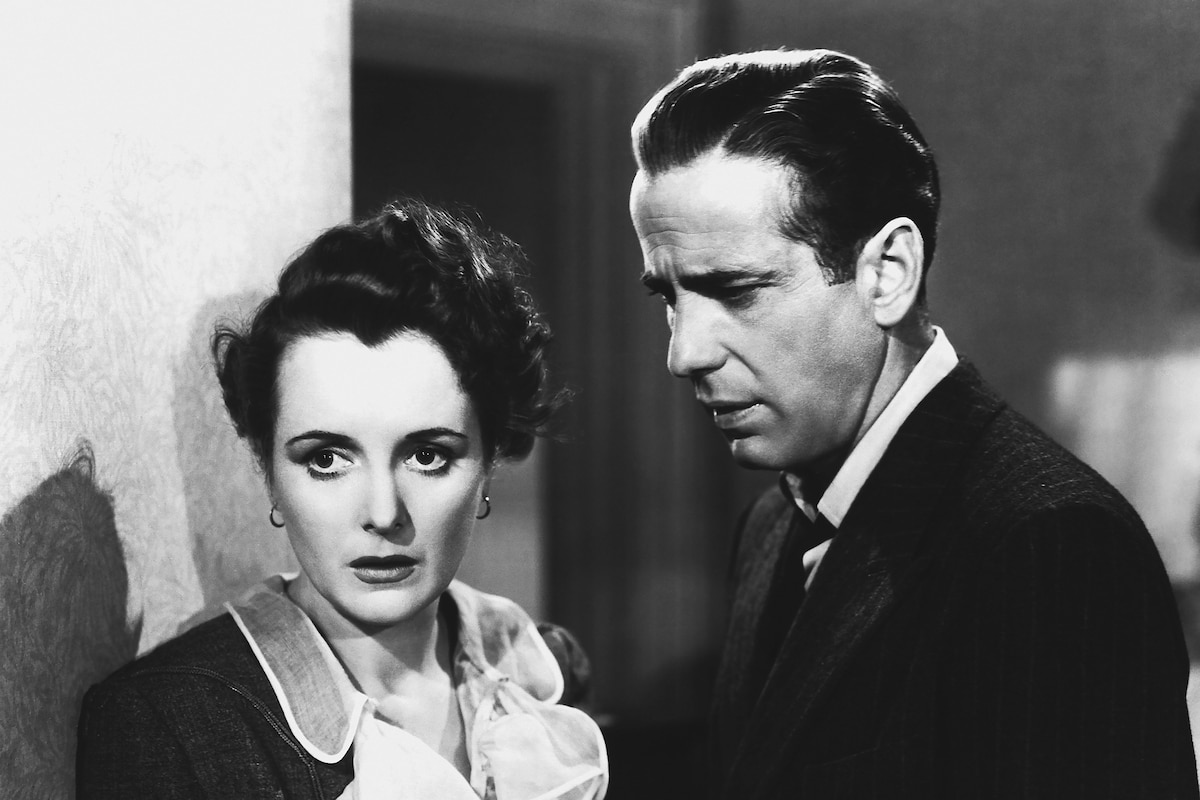
John Huston instructed Mary Astor to run around the set several times before appearing in a scene so as to give her character a nervous, out-of-breath appeal. In fact, the director worked very closely with Astor on her characterization of the amoral Brigid O'Shaughnessy. Very closely. Except for Huston's closest friends (like Hollywood director William Wyler), no one knew that Huston and Astor were having a romantic affair during filming. And speaking of William Wyler, Huston showed many of his production sketches to Wyler, who made some important suggestions that Huston eventually incorporated. But it was producer Henry Blanke who gave John Huston what he recalled as the single greatest piece of advice he would ever receive as a director: "Shoot each scene as if it was the most important scene in the film."
A few of the principal actors became close friends during the shooting of The Maltese Falcon. Humphrey Bogart, Peter Lorre, Ward Bond, and Mary Astor would often join John Huston at the Lakeside Country Club for drinks, buffet supper, and good conversation, usually until midnight. Bogart always considered Lorre and Huston great pals, mostly because they met two principal criteria: they weren't boring and they could drink like fish.
John Huston's father, veteran character actor Walter Huston, wanted to appear in his son's directorial debut picture for good luck. But what was intended as a sentimental gesture soon turned into a hilarious practical joke. Walter's walk-on part, as the wounded ship captain who staggers into Spade's office holding the bundled-up Maltese Falcon, was such an easy scene to shoot, that it should have required only two or three takes to successfully complete. And given John Huston's tight production schedule and budget, multiple retakes for frivolous scenes were not encouraged or even possible. Nevertheless, John Huston shot the scene over and over again, holding back his laughter when the elder Huston complained, "Didn't expect to have to put in a day's work!" John Huston came up with myriad reasons why his father would have to re-do the scene: he missed his mark, he staggered too much, he overacted, technical difficulties, and so on. By the time the scene was printed, Walter Huston left the set in a foul mood and covered in bruises sustained from falling down dead so much. However, his son wasn't finished with him just yet. The next day, the director had Mary Astor, whom the elder Huston had co-starred with in Dodsworth (1936), call his father. Pretending to be John Huston's secretary, the director had Mary say, "Mr. Huston is sorry, but something happened to the film in the lab and we'll have to retake your sequence this afternoon. Could you be ready to shoot at one o'clock?" Walter Huston vehemently replied, "You tell my son to get another actor or go to hell! He made me take twenty falls, and I'm sore all over, and I'm not about to take twenty more." John made it up to his father several years later, after directing him in an Academy Award-winning performance in Treasure of the Sierra Madre (1948).
Huston and company tickled themselves with a number of other on-set jokes. As Mary Astor recounted in her autobiography, the cast and crew had a system, whereby Huston would signal for a certain practical joke to be played for visitors to the set. For the benefit of visiting star-struck social clubwomen, the "No. 5" had Bogart going into a prepared act with Sydney Greenstreet. He'd start yelling and cursing at him, calling him a fat old fool. "Who the hell do you think you are? You upstaged me, and I'm telling you I'm not having any--," at which point Huston would jump into the act, holding back Bogart's mock rage. Very quickly, the embarrassed and disillusioned ladies would shuffle towards the nearest exit. Meanwhile, the "No. 10" had Peter Lorre coming out of Mary Astor's dressing room at the appropriate moment, adjusting his fly and saying, "See you later Mary."
by Scott McGee
Behind the Camera - The Maltese Falcon
by Scott McGee | May 29, 2013
SIGN UP FOR OUR NEWSLETTERS

CONNECT WITH TCM