SYNOPSIS
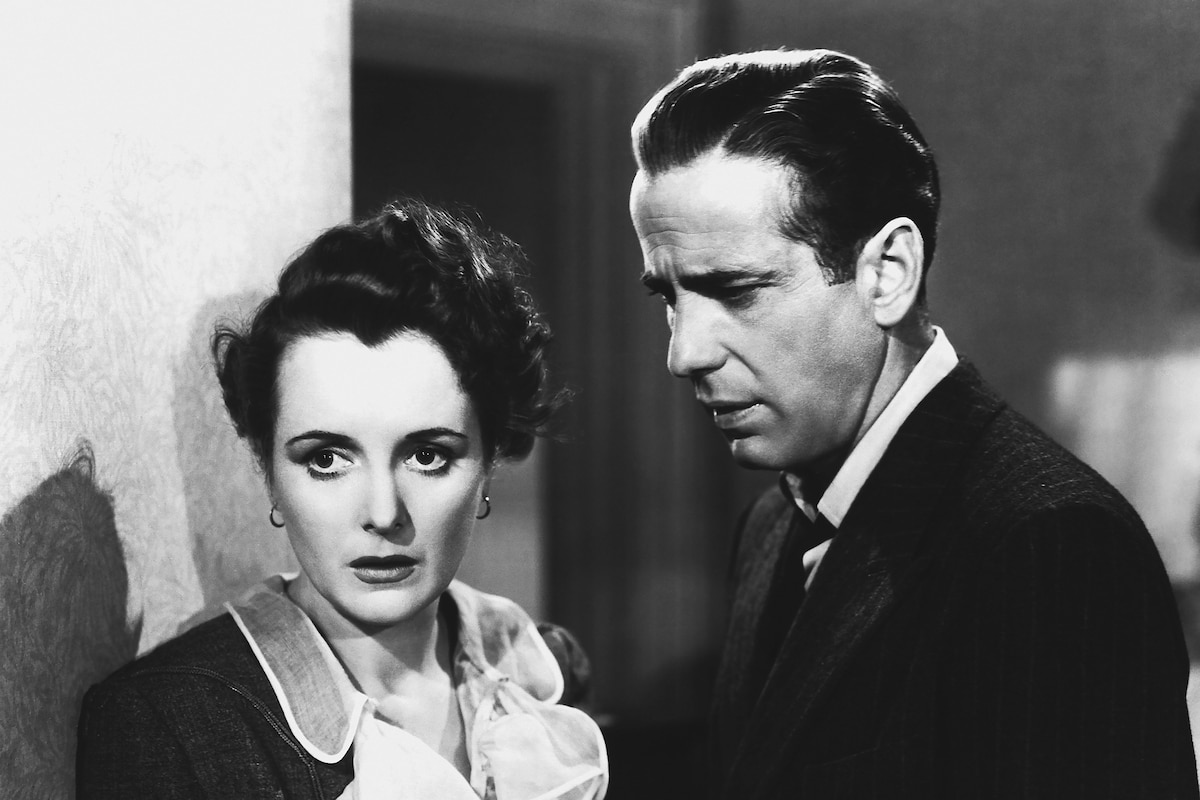
After his partner is murdered while trailing a suspect named Thursby, detective Sam Spade vows to avenge his friend. He soon discovers that Thursby had also threatened a Miss Wonderly, an alias for Brigid O'Shaughnessy. As Spade digs deeper into the mystery, he learns that Ms. O'Shaughnessy is in cahoots with some sinister characters, all of them desperate to retrieve a priceless figurine containing rare gems. Using his wits, Spade expertly turns the conspirators against each other, eventually learning the true killer of his partner.
Director: John Huston
Producer: Hal B. Wallis, Henry Blanke
Screenplay: John Huston, based on the novel by Dashiell Hammett
Cinematography: Arthur Edeson
Editing: Thomas Richards
Art Direction: Robert Haas
Music: Adolph Deutsch
Cast: Humphrey Bogart (Sam Spade), Mary Astor (Brigid O'Shaughnessy), Peter Lorre (Joel Cairo), Sydney Greenstreet (Kasper Gutman), Barton MacLane (Detective Lieutenant Dundy), Ward Bond (Detective Tom Polhaus), Elisha Cook, Jr. (Wilmer Cook).
BW-101m. Closed captioning. Descriptive Video.
Why THE MALTESE FALCON is Essential
Today, many film scholars refer to The Maltese Falcon as the first official film noir. To Huston's credit, he did not change one line of dialogue, and he only dropped one short scene when he realized he could substitute a phone call instead. Bogart's role in this film elevated him to cult status, and Ingrid Bergman studied him as Sam Spade to judge how to interact with him in Casablanca one year later.
During production on The Maltese Falcon, the cast and crew had the feeling they were shooting something exciting and tried to deter any unwanted visitors from coming to the set. The publicity people once brought a group of priests to the set. Before shooting began, Astor looked down at her legs and said, "Hold it a minute, I've got a g**damn run in my stocking" while the publicity man quickly ushered the priests off the set. Despite the numerous practical jokes his cast and crew played, however, Huston proved himself to be the consummate professional and was so efficient at his job that the crew often finished shooting for the day early, well ahead of schedule. On one of these days, Huston had set aside an entire day to shoot one elaborate moving camera sequence. The sequence lasted about seven minutes, and they nailed it perfectly in one take; the rest of the day was spent at the golf club. It was because of days like this that production finished two days ahead of schedule and $54,000 under budget.
The cast couldn't have been better. Mary Astor was an inspired Brigid O'Shaughnessy and Peter Lorre turned in an excellent performance, as usual, as Joel Cairo. Sydney Greenstreet earned a Best Supporting Actor nomination for his first ever film role, as Kasper Gutman. The other Academy Award nominations included Best Picture and Best Screenplay. To this day, it is considered one of the quintessential detective thrillers and has attracted a loyal cult following.
For Humphrey Bogart, the experience of The Maltese Falcon was the tops. He later said, "It was practically a masterpiece. I don't have many things I'm proud of but that's one." Bogart so respected Huston and the Sam Spade character that he searched until the end of his life for a script that recaptured the excitement he found in The Maltese Falcon. A few years before his death, Bogart revealed that he had purchased a book to be adapted into a film for he and his wife, Lauren Bacall. "We might do it," he told a radio interviewer, "in association with John Huston...It's a little on the order of The Maltese Falcon."
Warner Bros. had the bright idea of casting contract player George Raft in John Huston's The Maltese Falcon, and he was scheduled to report to the set only four days before shooting began. Raft, a veteran of 1930s gangster and tough guy pictures, just like Humphrey Bogart, had other ideas though. He did not think The Maltese Falcon was a very important picture, and as he reminded Jack Warner in a June 6, 1941 memo, his contract gave him veto power over films that he thought were not worthy of his name. Raft also chaffed at the idea of working with a novice director. That's how Humphrey Bogart got the role. He had just scored a hit in High Sierra (1941), another picture Raft turned down. In fact, Raft continued to advance Bogart's career through his own inability to recognize potential hits: the actor reportedly turned down the lead in Casablanca (1942) as well.
With Raft out of the picture, Warner Bros. briefly flirted with the idea of Edward G. Robinson in the role, but cooler heads prevailed and Humphrey Bogart was taken off suspension for refusing to appear in Bad Men of Missouri (1941) and given the lead. When John Huston was informed of who was to be his leading man, "I thanked God. It was a blessing!" It was also divine providence that the studio allowed Huston a good deal of leeway in the casting, particularly in the case of Sydney Greenstreet. The sixty-one year old actor made his film debut in The Maltese Falcon, all 285 pounds of him, after a long career as a stage actor. Huston had discovered Greenstreet in a Los Angeles play called There Shall Be No Night, co-starring Alfred Lunt and Lynn Fontanne.
Ironically, Sydney Greenstreet was a nervous wreck when it came time for his very first scene. Despite his years of stage experience in front of a live audience, Greenstreet implored Mary Astor before a scene, "Mary dear, hold my hand, tell me I won't make an ass of meself!" As Greenstreet performed his first scene flawlessly, John Huston held his breath, a nervous tic that stayed with him throughout his career as a director.
Warner Bros. executives initially wanted to offer the Brigid O'Shaughnessy part to contract player Geraldine Fitzgerald until freelance actress Mary Astor read the script. Fitzgerald cost a great deal less than Astor, and she was also eight years younger than Astor, whose career at the studio dated back to the silent days when she was a teenage leading lady opposite such heartthrobs as John Barrymore. The only problem was that Fitzgerald had no interest in starring in a low-budget whodunit with a novice director and a B-movie leading man, Humphrey Bogart. Having reportedly hailed the script as "a humdinger," Astor did not have to be talked into taking the role. She found Brigid O'Shaughnessy to be a ripe and juicy role. As she wrote in her memoir, A Life on Film, Brigid "was attractive, charming, appealingly feminine and helpless, and a complete liar and murderess." The girl next door, Brigid O'Shaughnessy was not.
Between shooting films in Hollywood, Elisha Cook, Jr. lived alone up in the High Sierra hills, where he spent his days fishing for golden trout. When his services were requested for a new film, producers would send word up to his mountain cabin via courier. He would come down for the shoot, then retreat as soon as production wrapped. Interestingly enough, Cook had last shared billing with Humphrey Bogart on Broadway in the play Chrysalis.
by Scott McGee & Sarah Heiman
The Maltese Falcon: The Essentials
by Scott McGee & Sarah Heiman | December 15, 2006
SIGN UP FOR OUR NEWSLETTERS

CONNECT WITH TCM