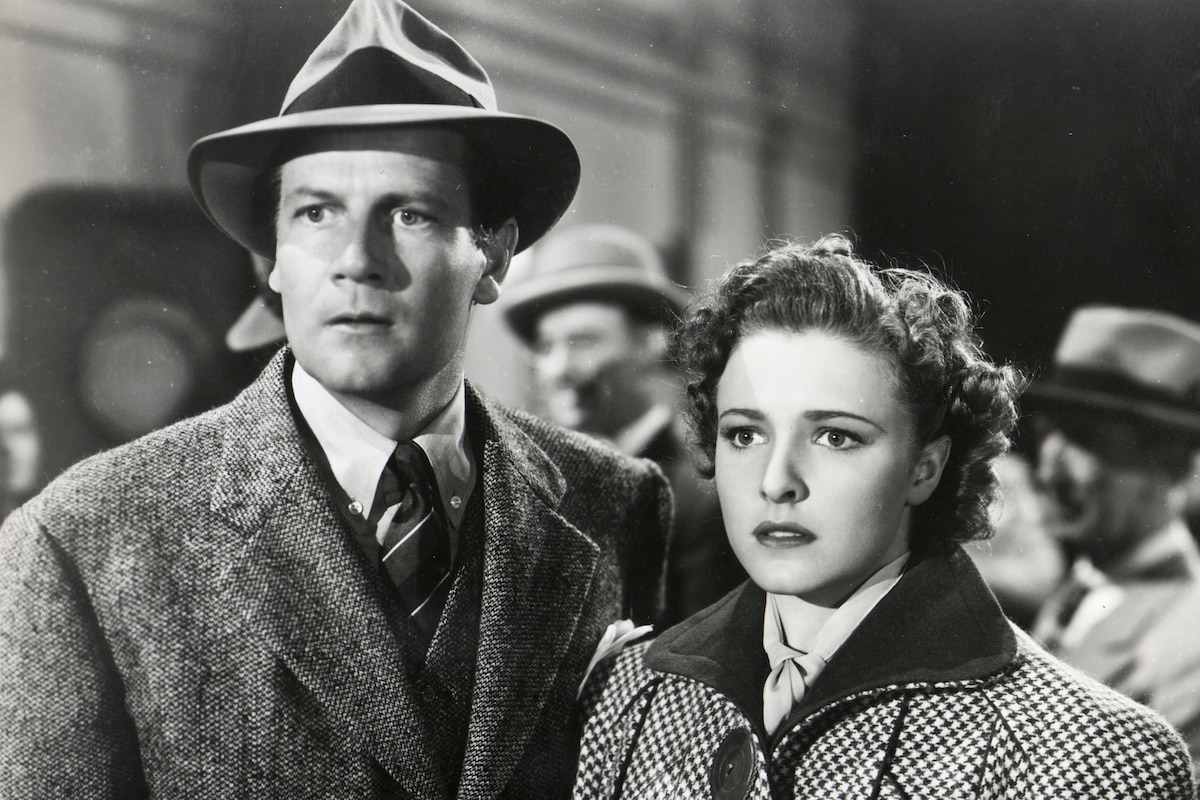
"Walter Wanger's FOREIGN CORRESPONDENT shows how an extroverted young New York police reporter bags a scoop of international proportions on his first assignment abroad. He gets the girl, too, by overcoming nothing more formidable than the lady's instinctive coyness. As the film ends, the viewer is convinced that the hero will stride to one journalistic triumph after another, dragging his bride along over the dusty news beats of the world. Although 'Foreign Correspondent' originally was supposed to be based on 'Personal History,' the rotund Britisher Alfred Hitchcock has scuttled every vestige of the book and its author with as spine-tingling and hair-raising a melodrama as might be found in the censor-muddied waters of the European struggle. ...Joel McCrea proves to be a likable and credible citizen in the leading role. Laraine Day gets by nicely in her most ambitious part to date as Carol Fisher. Herbert Marshall appears to be thoroughly miscast as the big peace man who turns out to be something more than that. Robert Benchley carries off the acting honors as a broken-down American journalist in London - by acting himself. George Sanders, Albert Basserman, and Eduardo Ciannelli add much to the film. And despite occasional tedium; the direction of Hitchcock has brightened the shield he earned with 'Rebecca.'" - Newsweek, August 26, 1940.
"Foreign Correspondent will confuse cinemaddicts who may have heard that it began as a filming of Vincent Sheean's Personal History. ...Fourteen writers and $1,500,000 away from Personal History, it has nothing to do with Sheean and is easily one of the year's finest pictures....Best reporter in Foreign Correspondent is Hitchcock's camera. When a diplomat is shot, his camera is in the right place, looking at his face. When a man is about to drop from a tower, it watches a hat making the plunge first. When a wounded Clipper is hurtling down toward the sea, it is peering anxiously from the pilot's seat. It has, too, the supreme reporter's gift of not telling everything. Director Hitchcock, who claims to dislike actors and probably does, ordered several retakes of the wreck of the Clipper because it pleased him to see Actors McCrea and Sanders floundering in the water. ...As surprising a Hitchcock Trilby as was Joan Fontaine in Rebecca is Laraine Day (nee Johnson), a 19-year-old Mormon whose father was the first mayor of Roosevelt, Utah. In the excitement of making Foreign Correspondent, Hitchcock forgot his invariable signature, had to retake a scene in a railway station to get himself into the picture." - Time, September 2, 1940.
"Despite the now rather embarrassing propagandistic finale, with McCrea urging an increase in the war effort against the Nazis, Hitchcock's espionage thriller is a thoroughly enjoyable affair, complete with some of his most memorable set pieces. ...Something of a predecessor of the picaresque chase thrillers like Saboteur and North by Northwest, its main source of suspense comes from the fact that little is what it seems to be: a camera hides an assassin's gun, sails of a windmill conceal a sinister secret, and the sanctuary of Westminster Cathedral provides an opportunity for murder. Not one of the director's greatest - there's little of his characteristic cruelty or moral pessimism - but still eminently watchable." Geoff Andrew, Time Out Film Guide.
"Hitchcock appears to have concocted this spy thriller out of all the breathtaking climaxes he'd been hoarding; there's the assassination with the gun concealed by a newsman's camera, the Dutch windmill going against the wind, and a tremendous finale aboard a transatlantic plane from London on the very day war is declared. The plot that links all this is barely functional, and the jaunty reporter-hero (Joel McCrea) is held down a bit when he has to attend to the ever-busy heroine (Laraine Day), but the movie intermittently first-rate, and the topnotch supporting cast includes George Sanders, Albert Bassermann, Herbert Marshall, Edmund Gwenn, Martin Kosleck, Eduardo Ciannelli, Barbara Pepper, and Robert Benchley, who also had a hand in the dialogue." - Pauline Kael, 5001 Nights at the Movies.
Awards and Honors:
Foreign Correspondent was nominated for an Oscar®? in 1941 in six categories:
Best Picture
Best Original Screenplay: Charles Bennett, Joan Harrison
Best Actor in a Supporting Role: Albert Bassermann
Best Art Direction, Black-and-White: Alexander Goliten
Best Cinematography, Black-and-White: Rudolph Mate
Best Special Effects: Paul Eagler, Thomas T. Moulton
Compiled by John M. Miller
Critics Corner-Foreign Correspondent
by John M. Miller | August 01, 2006
SIGN UP FOR OUR NEWSLETTERS

CONNECT WITH TCM