Although his first American film, Rebecca (1940), was an enormous popular and critical success, Alfred Hitchcock was anxious to veer away from the lush approach of that film and make a more briskly paced vehicle in the style of his earlier British suspense pictures. He also found the close supervision of David O. Selznick stifling, and was thrilled that Selznick was equally anxious to loan out his new star director to another studio. Finally, Hitchcock was looking for a way to help the British war effort, indirectly if not directly. Independent producer Walter Wanger had been in development on a project for years which would prove to be a timely outlet for Hitchcock's interests. The producer had the film rights to a best-selling memoir, Personal History, by Vincent Sheean. Wanger paid $10,000 for the 1936 book. John Russell Taylor described the property in his biography, Hitch: "The background to the book, that of a politically conscious correspondent in disastrously unsettled Europe, with a major war looming, was appealing and dramatic. Unfortunately there was no foreground in sharp focus - no coherent narrative, no telling characters, no specific incidents that lent themselves to filming."
Wanger was unsatisfied with the preproduction he had already put into Personal History. Initially, the setting was to be the Spanish Civil War, and Wanger intended the film to be directed by William Dieterle, with the stars Charles Boyer and Claudette Colbert. Screenwriter John Howard Lawson got this initial assignment, but Wanger brought in more writers to flesh out his work, including John Meehan and John Lay, writers from the March of Time newsreel series. Wanger was determined to keep the political angle on his film as up-to-date as possible, but this proved difficult since events were rapidly changing in Europe. The war in Spain ended in 1939, so Wanger was forced to rethink the property. He focused on hiring Hitchcock after the director completed his first American film, and he agreed to David O. Selznick's stiff weekly fee of $7,500 for Hitchcock's services. (Selznick paid Hitchcock $2,500 a week, giving the mogul a profit of $5,000 a week). The producers anticipated a 12-week schedule for the film, three or four weeks for script development, and eight or nine weeks of shooting; these estimates would prove to be quite optimistic.
After he signed on to Wanger's project, Hitchcock hired two trusted writers he had worked with in the past, Charles Bennett and Joan Harrison. As was typical with Hitchcock, he let the setting help dictate the actions of the characters; he also thought in terms of "set pieces." Years later, during an interview with French director Francois Truffaut, Hitchcock admitted that the whole film grew from a few visual ideas of his own, "We started out with the idea of the windmill sequence and also the scene of the murderer escaping through the bobbing umbrellas. We were in Holland and so we used windmills and rain. Had the picture been done in color, I would have worked in a shot I've always dreamed of: a murder in a tulip field. Two characters: the killer, a Jack-the-Ripper type, behind the girl, his victim. As his shadow creeps up on her, she turns and screams. Immediately, we pan down to the struggling feet in the tulip field. We would dolly the camera up to and right into one of the tulips, with the sound of the struggle in the background. One petal fills the screen, and suddenly a drop of blood splashes all over it. And that would be the end of the killing."
Wanger, Hitchcock, and the screenwriters had to tread somewhat carefully in fashioning the story, lest they raise the ire of the US State Department. The official stance of the United States was strict neutrality, so while the script for Foreign Correspondent name-dropped Hitler in general terms in an early scene, the country of origin of the spy ring depicted in the film is never mentioned. That detail is left to the imagination of the audience, although the logical answer is obvious to all. Several other writers were brought in on the picture, including novelist James Hilton (Lost Horizon) and humorist Robert Benchley, who was also cast in the film in a supporting role. Hilton and Benchley are credited in the film's credits for contributing dialogue.
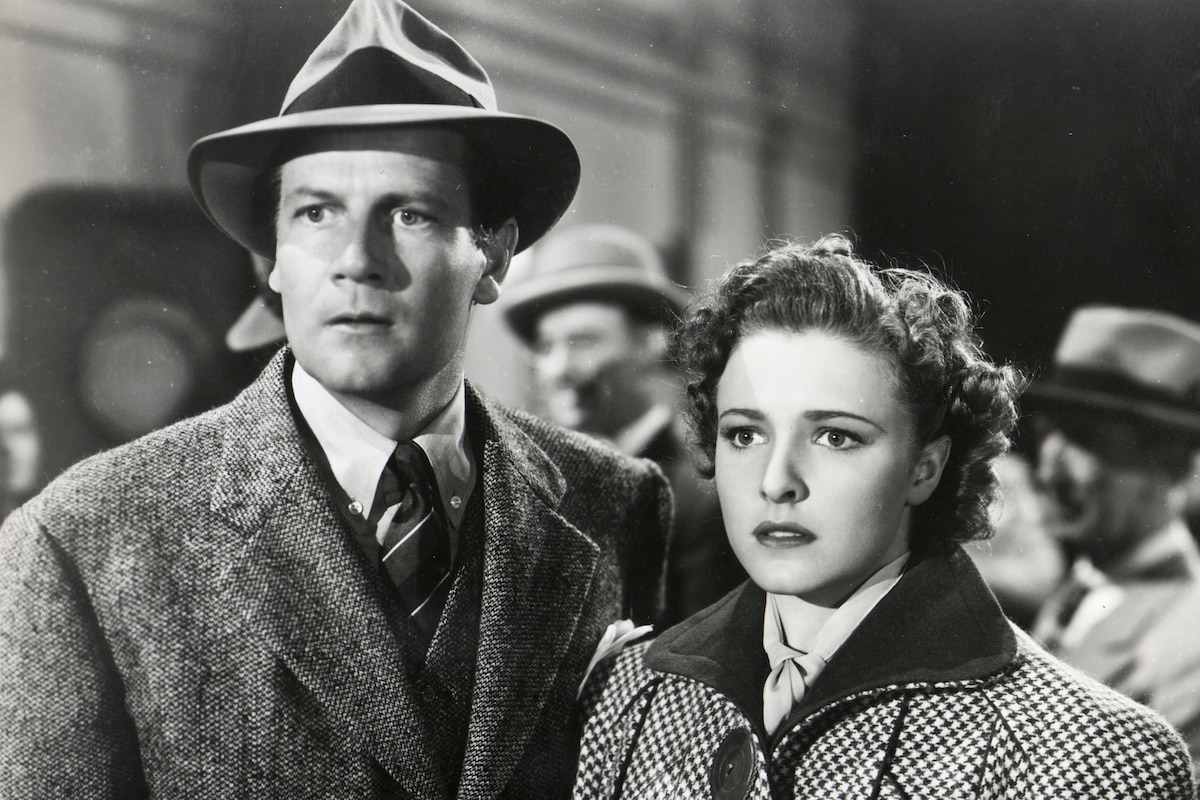
Casting the lead roles for the picture proved to be difficult for Hitchcock. The director preferred stars, feeling that there was a shorthand in characterization when the audience is already familiar with a popular, appealing actor. Hitchcock did not get his first choice for the male lead role in Foreign Correspondent. As he later told Truffaut, "I went to Gary Cooper with it, but because it was a thriller, he turned it down. This attitude was so commonplace when I started to work in Hollywood that I always ended up with the next best - in this instance, with Joel McCrea. Many years later Gary Cooper said to me, 'That was a mistake. I should have done it.'" Similarly, Hitchcock wanted Joan Fontaine for the lead female role. Selznick also held her contract, and as she had just made a huge impression in Rebecca, Selznick wanted to save her for bigger roles. (Fontaine would appear in Hitchcock's Suspicion (1941) the following year, and win the Best Actress Oscar® as well). Instead, the part was filled by Laraine Day, then known primarily for her recurring role as Nurse Mary Lamont in MGM's Dr. Kildare series of pictures.
by John M. Miller
The Big Idea-Foreign Correspondent
by John M. Miller | August 01, 2006
SIGN UP FOR OUR NEWSLETTERS

CONNECT WITH TCM