When director John Milius scored a major box office hit in the summer of 1982 with Conan the Barbarian and made a star of bodybuilder Arnold Schwarzenegger in his first major studio role, it was inevitable that the sequels and imitations would soon follow. Indeed, it only took two years for Schwarzenegger to wield his sword again for Conan the Destroyer (1984), a lighter, hokier, PG-rated adventure directed by Hollywood veteran Richard Fleischer. The New York-born filmmaker had proven to be versatile in a number of genres for almost every major studio, most famously with 20,000 Leagues under the Sea (1954) and a string of exceptional crime thrillers stretching from Violent Saturday (1955) through Mr. Majestyk (1974).
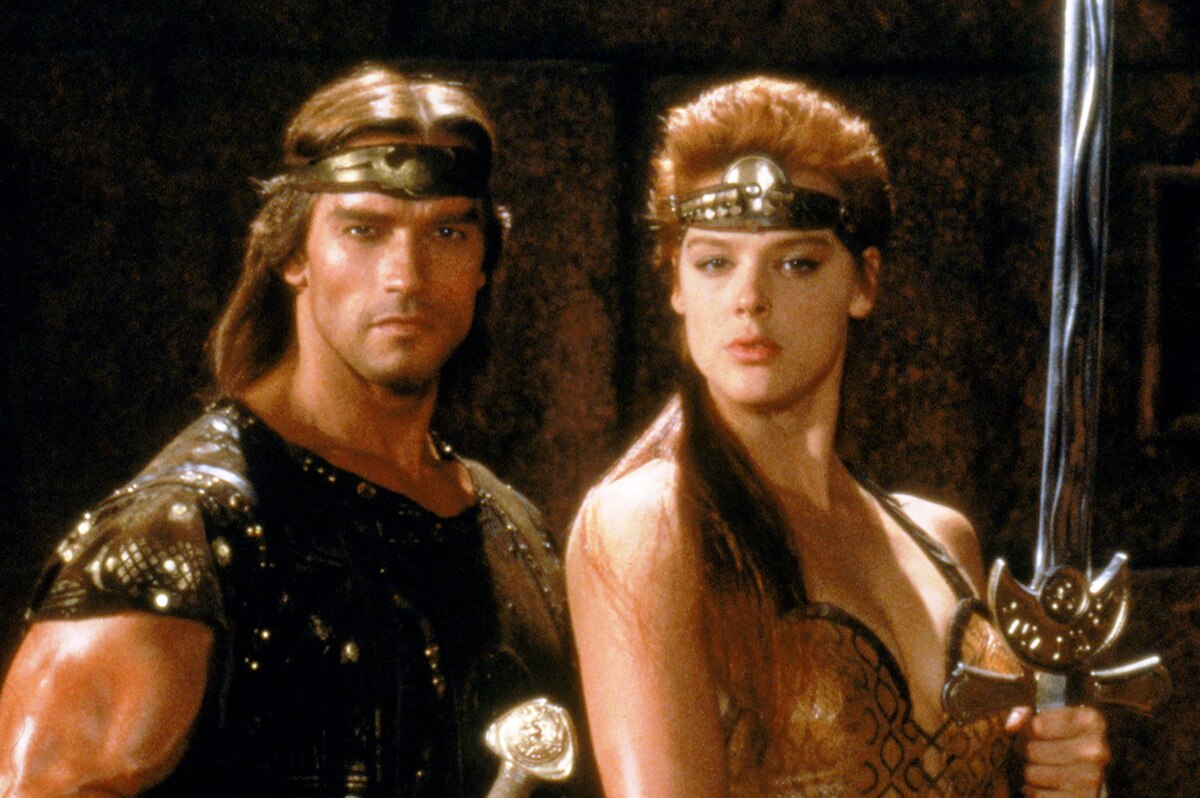
The Fleischer-Schwarzenegger pairing proved to be successful enough to inspire a second teaming for Red Sonja (1985), another sword and sorcery outing with the leading lady from the first Conan, Sandahl Bergman, enlisted to play the wicked Queen Gedren. However, the title character is actually played by Brigitte Nielsen, a Danish-born model discovered by the film's producer, Dino De Laurentiis. By the time the film opened, she was becoming a Hollywood press fixture thanks to her marriage to Sylvester Stallone and her colorful roles opposite him in Rocky IV (released later in 1985) and Cobra (1986). The marriage would prove to be short-lived and ended in 1987, though she continued to act regularly and enjoyed a fairly successful music career in Europe.
The filming of Red Sonja in Italy was widely promoted in that country as the revival of "Dinocitta", a.k.a. the Stabilimenti Cinematografici Pontini Studio just outside of Rome. The film provided a playground for legendary production designer Danilo Donati, with outdoor locations including an empty temple on the plains of Lazio. Stormy weather in the Abruzzo Mountains stalled shooting for a few days in October of 1984, but the film still came in almost on time and on budget when it wrapped in December. Despite plans to keep postproduction at Dinocitta, all work post shooting was shifted to MGM Studios in Hollywood so De Laurentiis could be present more during the process, and so that international buyers at the annual American Film Market would be closer to communicate with.
Like the Conan films, Red Sonja is based on the work of Texas-born fantasy writer Robert E. Howard. The Red Sonja character first appeared in "The Shadow of the Vulture," a 1934 short story (in which her name is spelled "Red Sonya"), and remained dormant until the popularity of the Conan comics brought her back in a new paperback epic, The Ring of Ikribu, in 1981, with five more books following. The character was inexplicably time hopped from the Ottoman Empire to the Hyborian Age of Conan the Barbarian fame in the process, a chance that was retained for the movie version.
The production of Red Sonja was intended to be a stepping stone in more barbarian-style adventures for Schwarzenegger, who was set to star in a third Conan film at the time. However, the rapidly growing cult popularity of another film he made in 1984, The Terminator, would steer his career in a different direction as a modern action and sci-fi figure. Also in the realm of unrealized possibilities, De Laurentiis was busy mounting the film Total Recall to be directed by David Cronenberg. Of course, the film ended up being made by Paul Verhoeven several years later with a very different flavor from what Cronenberg would have achieved. Interestingly, Fleischer was not the original choice for director Instead, De Laurentiis wanted iconoclastic animator Ralph Bakshi, who had shown an affinity for fantasy films with Wizards (1977), The Lord of the Rings (1978), and Fire and Ice (1983) to direct. Needless to say, the results would have been quite different.
The casting of Red Sonja proved to be a challenge for De Laurentiis, who offered the part to Bergman and even announced actress Eileen Davidson as the star in a 1984 trade item. The final cast is a colorful one including 12-year-old karate champ Ernie Reyes Jr., Italian exploitation fixture Janet Agren of The Gates of Hell (1980) fame, and burly character actor Paul L. Smith, who first made an impression in Midnight Express (1978) and went on to play Bluto in Robert Altman's Popeye (1980) and a hilarious red herring in Pieces (1983). Smith worked out at a gym three times a week prepping for the role and most famously displayed his increased strength on the Via Veneto when a Fiat weaving through traffic nearly hit him as he was crossing. Smith casually grabbed the car and turned it over, reportedly to much cheering from bystanders.
Upon its release, the MGM/UA film was given a hostile reception from critics, with Movieline dubbing it "stupefying, pitiful, tacky." However, like many '80s genre films, it has found a warmer audience with its strong aura of nostalgia. One aspect praised from the start is its rich score by none other than Ennio Morricone, who was coming off of his landmark work on Sergio Leone's Once Upon a Time in America (1984). This marked his second foray into English-language sword and sorcery territory after Hundra (1982), whose star, Laurene Landon, was also in contention for this film's leading role at one point. The Morricone score has remained a favorite over the years, and at one point, its initial limited, rare CD release paired up with his score for Bloodline was one of the most valuable collector's items on the soundtrack market.
By Nathaniel Thompson
Red Sonja
by Nathaniel Thompson | October 18, 2017
SIGN UP FOR OUR NEWSLETTERS

CONNECT WITH TCM