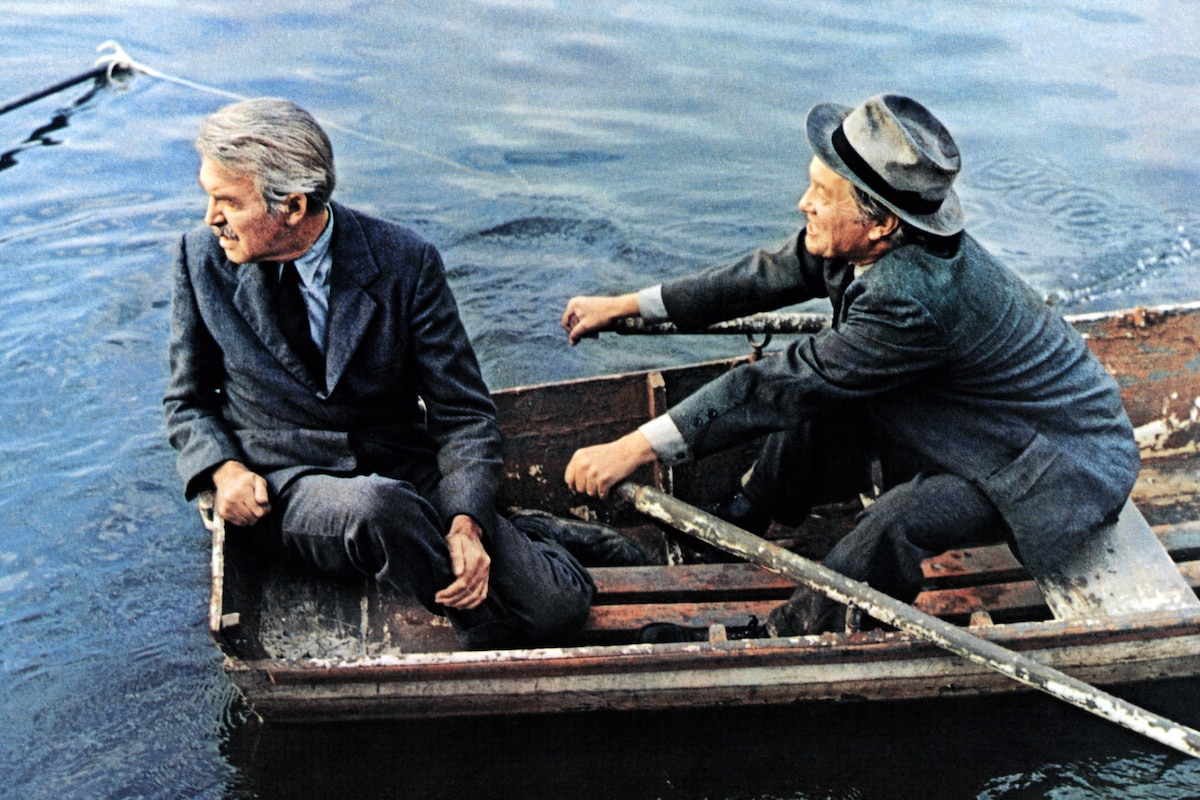
Hollywood has a long history of taming controversial subject matter. Second-generation John Ford associate Andrew V. McLaglen was a busy film producer and director of generally undistinguished action and adventure films. His 1971 Fool's Parade is adapted from a novel by Davis Grubb, the brilliant author of the celebrated 1955 The Night of the Hunter. Sharing a similar Depression-era setting, Fool's Parade touches on themes of social revolt and terrorism. The screenplay by James Lee Barrett reshapes the story into a folksy comedy-drama for star James Stewart. Filmed on author Grubb's home turf of West Virginia, McLaglen's film sees Stewart as Mattie Appleyard, a convict finishing a forty-year prison term. The old fellow is released with a check for his accumulated prison labor totaling $25,452.32. But a murderous fix has already been arranged: the check must be cashed at a particular bank, and its manager has a deal with the crooked lawman Doc Council (George Kennedy) to see that Appleyard never gets there. Also released is the endearing, addled Lee Cottrill (Strother Martin) and Johnny Jesus (Kurt Russell), a kid falsely accused of rape. The trio undertakes a colorful backwoods odyssey evading Kennedy's killers. They meet up with an unlucky traveling salesman (William Windom), and young Johnny forms a crush on a virgin prostitute (Katherine Cannon) held on a barge bordello by Cleo, a crafty madam (Anne Baxter).
In the effort to soften the story's social criticism, all the characters are given cute & quaint mannerisms and affectations. Star Stewart lays the folksy act on especially thick. From behind a scraggly mustache, Mattie Appleyard removes his glass eye, claiming that he can use it to foretell the future. Story complications veer from grim murder to cartoonish comedy, such as a cartoon-like gag in which a loyal bloodhound 'retrieves' a stick of dynamite, after it has been lit. The film retains only a hint of Davis Grubb's disturbing notions, such as the idea that a corrupt society forces the ex-convicts to re-enact the crimes that put them behind bars. But the key scene is wholly anarchistic: wrapping himself in dynamite, Stewart's Mattie scares the bank manager into cashing the check by rigging himself with a suicide bomb and threatening to blow up the bank building. It's an unexpected gambit in a year in which the Weather Underground was making real terror bombs. Yet Fool's Parade finds its way to a conventional happy ending. Grubb's bizarre characters become merely odd, or colorful, as with Strother Martin's cute old codger who likes to recite the inventory he hopes to sell in his imagined general store. Anne Baxter's saucy prostitute is furious that the Daughters of the American Revolution won't accept her as a member, with the argument that "We've been puttin' out for soldiers since 1776."
By Glenn Erickson
Fools' Parade
by Glenn Erickson | October 17, 2017
SIGN UP FOR OUR NEWSLETTERS

CONNECT WITH TCM