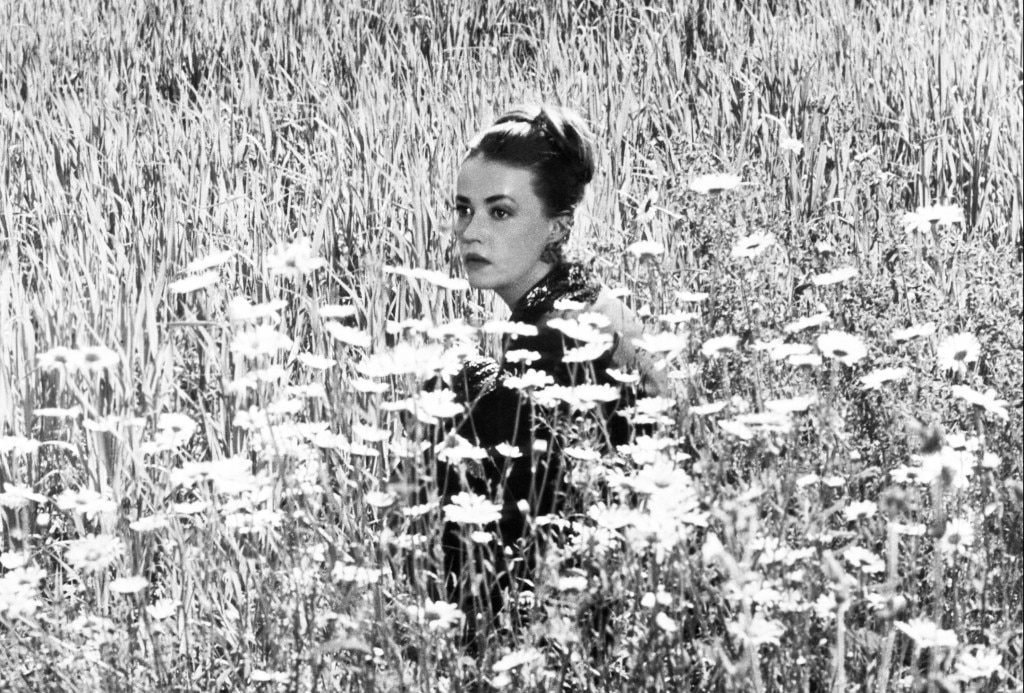
Mademoiselle (1966) was one of two French films that British director Tony Richardson made during 1965 and 1966. Starring French superstar Jeanne Moreau, Mademoiselle was at least fifteen years in the making. Jean Genet's story and later incomplete screenplay was first written in 1951 under the title of Mademoiselle ou les feux interdits , then Les rêves interdits ou L'autre versant du rêve. By 1965, it had become Mademoiselle, Les Rêve interdits and had come to Richardson's attention through his producer, Oscar Lewenstein. Marguerite Duras would write the final adaptation of Genet's story, along with a rumored four other writers, including director Richardson himself, although it is Genet who received the bulk of the screenwriting credit by reviewers.
The unnamed "Mademoiselle" is a strange and unknowable schoolteacher, who secretly creates havoc in her village by setting fires, opening floodgates, poisoning water troughs and killing animals, all without any clear reason. Everyone blames an innocent Italian woodcutter named Manou (Ettore Manni, cast when Marlon Brando turned the role down), who has been making the sexual rounds of the women in the village. Mademoiselle is not immune to Manou's charms and flirts with him in the woods, although at first he is not interested. This attraction culminates in a passionate night and has fatal consequences when the villagers take matters into their own hands. Also in the cast are Keith Skinner, Umberto Orsini, Jane Beretta, and Georges Aubert.
Mademoiselle was produced by Woodfall Film Productions and shot on location in France in the village of Le Rat. Richardson became besotted with Moreau from their first meeting, which disturbed his wife, actress Vanessa Redgrave, who told her sister-in-law, "Tony came back literally elated. It frightens me because I recognize that feeling. I've felt it myself. She must be extraordinary; Tony seemed transformed, set alight." Her suspicions were valid; the marriage began to fall apart during production when Richardson and Moreau had a brief affair, even though he and Redgrave had rented a house in France to be with their young daughters. To add to the tension, Moreau would come to their home for dinner, where the chef would whip up special meals because he also had a crush on Moreau. The Richardson's marriage would not survive and they divorced in 1967.
Mademoiselle earned universally scathing reviews on its release from critics like Roger Ebert, who began his with, "Let's have a contest, gang. The one who finds the most Freudian symbols in Tony Richardson's Mademoiselle wins the Norman Vincent Peale book of his choice. I'll give you a few to get your list started: There are 19 shots of a lake. Lakes stand for women. Sometimes it is stormy, sometimes it is covered with raindrops, sometimes it is calm. Every time you see Jeanne Moreau, she is like the lake. Stormy, covered with raindrops, calm. [...] The seduction scene lasts from about 4 p.m. until noon the next day. Miss Moreau and the lumberjack run through the fields and the forest and around the lake, and about midnight it starts to rain. Then it gets muddy. They slosh through the mud, carrying on their carefree lovers' dance. Slosh, slosh, slosh, I hear the lovers dancing." Bosley Crowther in The New York Times found the premise of Jeanne Moreau, an overtly sexy woman portrayed as sexually repressed "phony. [...] One can only suspect that Mr. Richardson and probably Mr. Genêt were out to denigrate and castigate a woman as much as they could in this film. For there is absolutely no redeeming quality in the spectacularly vicious female here."
Richardson would later say that the French had "attacked" him at Cannes for "tackling a 'French' subject. It is a film I'm proud of, though at the time I was destroyed by the violence of its reception." Despite the bad blood, Richardson was nominated for a Palme d'Or award at the Festival. The film would go on to win a BAFTA Film Award for Best British Costume (B/W) for designer Jocelyn Rickards, and cinematographer David Watkin was nominated for Best British Cinematography (B/W).
SOURCES:
Callahan, Dan Vanessa: The Life of Vanessa Redgrave ¬
Crowther, Bosley "Screen: Fiendish Female: Mademoiselle' Begins Engagement at Plaza" The New York Times 2 Aug 66
Ebert, Roger "Mademoiselle" The Chicago Sun-Times 30 Nov 67
The Internet Movie Database
Pauly, Rebecca, with Welsh, James M. and Tibbetts, John C.
The Cinema of Tony Richardson: Essays and Interviews
Stafford, Jeff "Mademoiselle, The Belle From Hell" 27 Dec 08. http://streamline.filmstruck.com/2008/12/27/mademoiselle-the-belle-from-hell/
By Lorraine LoBianco
Mademoiselle
by Lorraine LoBianco | October 16, 2017
SIGN UP FOR OUR NEWSLETTERS

CONNECT WITH TCM