A "first-person shooter" film noir that bathes its loathsomely cynical
misanthropes in sunny studio lighting, backs them up with eerie choral
singing instead of an orchestral soundtrack, and pretends (for a while)
to be a Christmas picture,Lady in the Lake is one of the oddest
things ever to issue forth from the studio vaults. That this avant-garde
work of cinematic experimentation was bought and paid for by MGM of all
places, the toniest and most traditionalist of the major studios, only
makes this bizarre concoction seem even stranger.
By 1947, Raymond Chandler was big business. His hard-boiled pulp
novels (many of them about the Don Quixote-like private eye Philip
Marlowe) were wildly popular, as were their increasingly gritty film
versions. Chandler himself took up residence in Hollywood, adapting his
own books into screenplays (The Big SleepDouble Indemnity), and penning original screenplays (The
Blue Dahlia). The character of Philip Marlowe had been essayed by
Dick Powell and Humphrey Bogart, as well as (if you're not too precise
about the name "Philip Marlowe" actually being used) Lloyd Nolan and
George Sanders. So, when Robert Montgomery proposed to MGM that he get
to star in-and direct-a version of Lady in the Lake, contemporary
audiences could be forgiven for expecting a little more of the same old
same old: another dimly-lit and archly-worded journey into Raymond
Chandler's peculiarly overcomplicated brand of noir.
But is Raymond Chandler's pulp fiction was becoming a genre unto
itself, with its own calcified rules and conventions, Robert Montgomery
was the proverbial square peg in the round hole. In 1947, Chandler was
disillusioned and frustrated with Hollywood, and all but left town;
Montgomery was just finding his calling, and looking to expand his
horizons. One man's grumpy disillusionment is another man's trippy
dream, so to speak.
Robert Montgomery had first come to Hollywood with the desire to
be a screenwriter. "Yeah, I'm a top-billed movie star, but I really want
is to write!" With his bland, somewhat doughy, good-looks and a vocal
delivery that sounded like Cary Grant minus his distinctive accent,
Montgomery racked up roles in over 50 films prior to 1945, settling
happily into a rut as one of Hollywood's less-interesting performers.
1945, though, was when Fate struck a surprising blow: on the set of
They Were Expendable, John Ford got sick. Montgomery filled in
for him, secretly. He enjoyed the taste, and wanted more.
In the main, actors-turned-directors generally make movies that
are actors' showcases, not ones that push the limits of the cinematic
form. Montgomery the iconoclast chose that later path. For years, film
theorists had puzzled over the role of the camera lens-did it have a
narrative function, and if so, what? Does the audience identify more
with the characters onscreen, or with the unseen perspective from which
those characters are witnessed? The idea of using the camera's viewpoint
as a character had kicked around Hollywood before, but to actually go and
do it, in a prestigious studio vehicle, took a degree of daring no one
had yet mustered. Full of daring bravura, Montgomery cast the camera as
Philip Marlowe; he would provide little more than the voice.
MGM's publicity boasts "YOU and Robert Montgomery solve a murder
mystery together!" It is doubtful anyone really thought about this
technique as a sort of virtual reality project, with the viewer suckered
into "being" the main character. The plot is too tangled to be deduced
by any viewer-who is not watching the events "as" Philip Marlowe so much
as staring passively through Marlowe's eyes. This is a crucial
distinction, because the consequence of the subjective camera is a
colder, more distancing film than one shot more conventionally.
Marlowe's attention, for that matter, wanders. He may stare at
another character for what seems like an eternity... or he may leer at some
passing woman instead. If he gets bonked on the head (which happens a
lot) the screen goes black; if he's alone, several minutes may pass while
he stares blankly at an empty corner of a room. We see what he sees: but
he may not be looking at anything particularly interesting at the time.
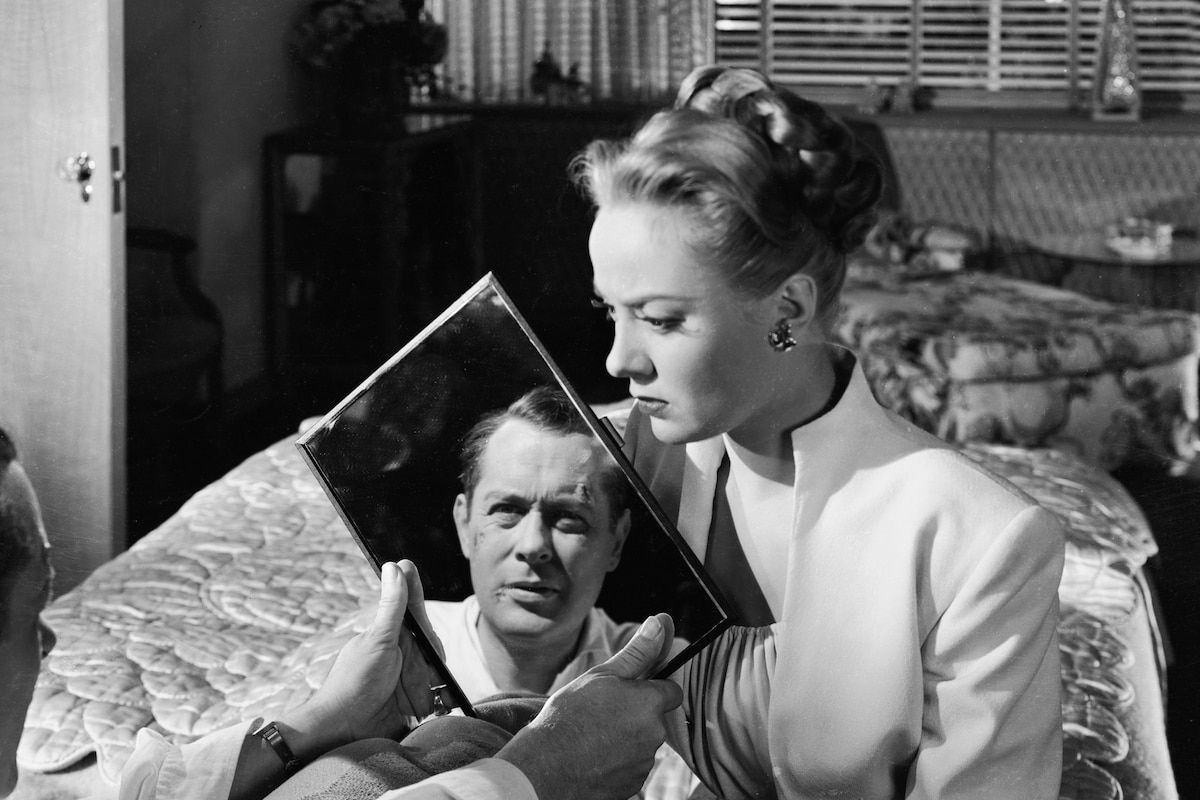
For a wraparound framing sequence, Montgomery appears onscreen as
Marlowe in his office, talking directly to the audience. It is awkward,
to say the least-we in the audience are simply not accustomed to being
addressed like that. Nor are professional actors accustomed to doing
it-Lloyd Nolan in particular found the experience discomfiting. Even in
today's post-Roger Rabbit green-screened CGI-ville, not all actors
come equipped to properly emote to ciphers and phantoms.
The experiment placed huge and unprecedented demands on the cast.
Marlowe is offscreen for almost the entire movie, save for when he
admires himself in a mirror or narrates directly at us. We cannot
see his reactions to anything. His body language is silenced, his facial
expressions invisible. With Marlowe reduced to a voice-over, all the
burden of performing onscreen shifts to the other actors, who have to
carry the picture on behalf of its all-but-absent star. Audrey Totter is
more than up to the challenge, and brings enough facial gymnastics for
two. Her eyes roll, her nostrils flare, her lips pout, she glowers with
a smoldering power so intense it's a miracle the celluloid didn't catch
fire in the camera.
Good thing, too, since cinematographer Paul Vogel and his team
had their hands full. Maintaining the premise that the camera sees what
Marlowe sees severely limits the cinematic options, and reduces the art
of editing to a game of cheats: cuts are hidden when possible, avoided
altogether when not. If it takes a badly beaten man a few minutes to
crawl on his hands and knees across a highway to a phonebooth, rest
assured it will take the exact same number of minutes of screen time to
watch this happen (and from his point of view, natch). While the result
is more gimmicky than dramatic overall, it results in a handful of
standout sequences, the best of which is a genuinely suspenseful and
nerve-jangling car chase-and anytime someone manages to make a car chase
seem fresh, it is a cause for celebration.
One wonders what producer George Haight thought of all this. He
was not of a noir sensibility, and this was a marked deviation for him.
Screenwriter Steve Fisher was a veteran of pulp thrillers, and punched up
Chandler's story with a canny eye for what would make it a better movie.
Although Montgomery's moon-eyed American-boy appearance seems at odds
with the hard-bitten Marlowe character he portrays, at least the
subjective camera keeps that minor quibble safely in the margins. From
his words, Marlowe is a "dumb, brave, cheap" dick caught up in a stew of
crooked cops and man-eating dames; drowned women and naked,
bullet-riddled pretty men; false identities and self-referential mystery
fiction; love triangles (or hexagons) and double-crosses that uncross
themselves-all ending in a trail of rice. It is by no means a typical or
representative film noir, but that is its enduring strength.
Warner Brothers' disc comes with a snappy and informative
commentary by film noir historians James Ursini and Alain Silver, as well
as an original theatrical trailer. It is packaged exclusively in the
multidisc Film Noir Classics Collection Volume 3.
For more information about Lady in the Lake, visit Warner Video. To order Lady in the
Lake (it is part of the Film Noir Classic Collection, Vol. 2), go to
TCM Shopping.
by David Kalat
Lady in the Lake - Robert Montgomery as Detective Philip Marlowe in LADY IN THE LAKE on DVD
by David Kalat | September 25, 2006
SIGN UP FOR OUR NEWSLETTERS

CONNECT WITH TCM