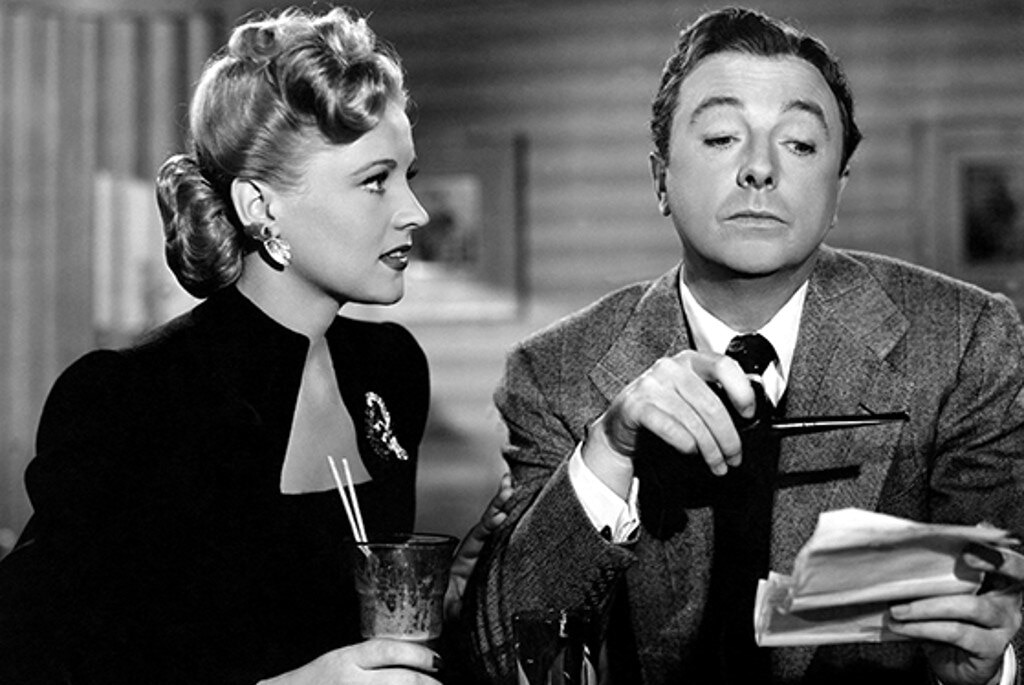
"You take a bunch of boys and a bunch of girls together, fooling around, and the first thing you know you've got... well, uh, you've got... complications," says Jack Haley in Sing Your Way Home (1945). In this RKO musical comedy, directed by Anthony Mann, Haley plays a full-of-himself journalist returning to the U.S. after the end of World War II with a shipful of young performers who were trapped in Europe four years earlier while entertaining the troops. The kids are still under the influence of the performing bug and, when not "fooling around," take every chance to burst into song.
Haley, six years past his triumph as the Tin Man in The Wizard of Oz (1939), was often cast as a second banana but, in Sing Your Way Home, enjoys one of his leading-man roles. Co-starring and showing off her skills as a vocalist is Anne Jeffreys, best remembered as Marion Kerby in the TV series Topper. She plays a beauty who shares a love-hate relationship with Haley.
"I'll Buy That Dream," written by Allie Wrubel and Herb Magidson and sung in the film by Jeffreys (reprised by Marcy McGuire and Glen Vernon), was nominated for an Oscar® as Best Song. One of 14 nominees in that category that year, it lost to Rodgers & Hammerstein's "It Might As Well Be Spring" from State Fair. Other Wrubel/Magidson numbers in Sing Your Way Home are "Heaven Is a Place Called Home," sung by Vernon and others and reprised by Jeffreys; "Seven O'Clock in the Morning," sung by McGuire; and "Who Did It?," sung by McGuire with chorus. There's also a choral arrangement of the traditional hymn "The Lord's Prayer" as arranged by Albert Hay Malotte.
Mann, who had made his feature-film directorial debut three years earlier with Dr. Broadway (1942), is not immediately associated with musicals. He would soon be recognized as a master of film noir thrillers including Desperate (1947), He Walked by Night (1948) and Follow Me Quietly (1949); and of Westerns including Bend of the River (1952), The Naked Spur (1953) and The Far Country (1954). In the 1960s he would further distinguish himself as director of such massive historical epics as El Cid (1961) and The Fall of the Roman Empire (1964).
Even so, Mann brings some assurance to the lightweight Sing Your Way Home, just as he did with two other early musicals, Moonlight in Havana (1942) and The Bamboo Blonde (1946). He would later prove his skill with musical projects by directing The Glenn Miller Story (1953), a musical bio of the swing-era bandleader; and Serenade (1956), a vehicle for opera singer Mario Lanza.
Producer: Bert Granet, Sid Rogell (Exeuctive Producer)
Director: Anthony Mann
Screenplay: William Bowers, from story by Edmund Joseph and Bart Lytton
Cinematography: Frank Redman
Art Direction: Albert S. D'Agostino
Original Music: Roy Webb, Allie Wrubel
Editing: Harry Marker
Costume Design: Renie
Cast: Jack Haley (Stevel Kimball), Anne Jeffreys (Kay Lawrence), Marcy McGuire (Bridget Forrester), Glen Vernon (Jimmy McCue), Donna Lee (Terry), Patti Brill (Dottie).
BW-72m.
by Roger Fristoe
Sing Your Way Home
by Roger Fristoe | January 03, 2007
SIGN UP FOR OUR NEWSLETTERS

CONNECT WITH TCM