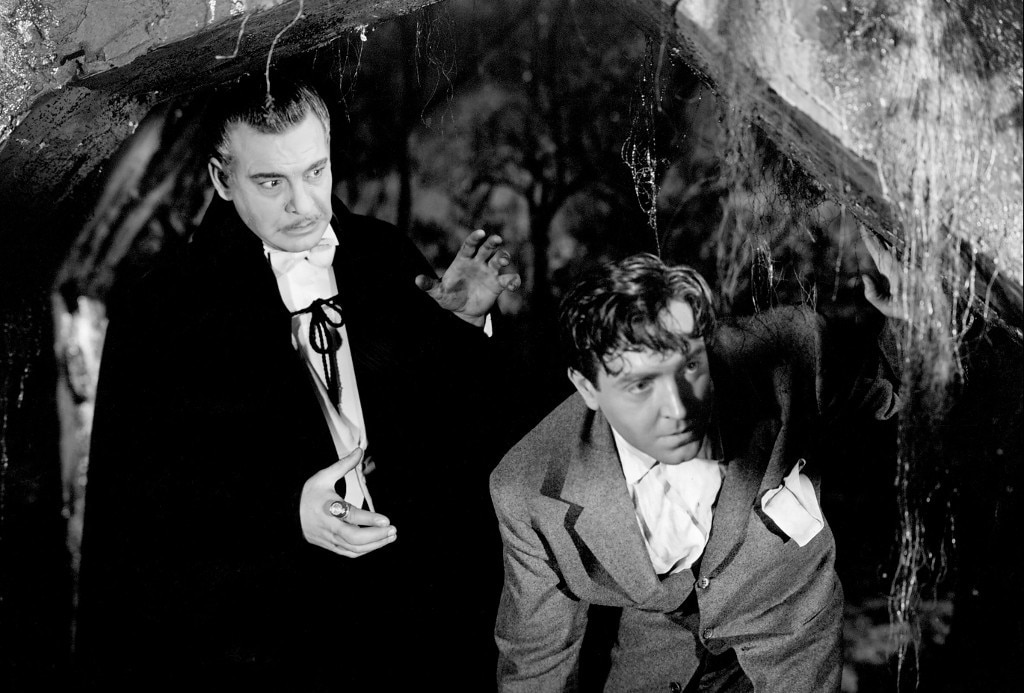
Lon Chaney, Jr. dons Count Dracula's black cape for his first and only outing as the iconic vampire in Son of Dracula (1943), Universal Studios' atmospheric third entry in its Dracula series, preceded by Dracula in 1931 and Dracula's Daughter in 1936. Chaney, Jr. (credited on the film as Lon Chaney, but not to be confused with his famous silent film star father who died in 1930) plays Count Alucard (Dracula spelled backwards), a mysterious Hungarian nobleman who arrives at the stately New Orleans plantation "Dark Oaks" at the invitation of Katherine (Louise Allbritton), the beautiful daughter of plantation owner Colonel Caldwell (George Irving). Although engaged to her childhood sweetheart Frank (Robert Paige), Katherine is fascinated by the occult and inevitably drawn to the enigmatic Count Alucard. When she inherits Dark Oaks following her father's sudden death, she and Alucard elope, leaving Frank shocked and heartbroken. Katherine, however, has a dark plan up her sleeve that no one - including the audience - sees coming. Peppered with elements of film noir from director Robert Siodmak, Son of Dracula offers plenty of eerie chills, plot twists, and groundbreaking special effects for its time, including the first ever on-screen transformation of a bat into a vampire.
One of Universal's most unique offerings from its classic horror oeuvre, Son of Dracula is also one of the most hotly debated among fans of the genre, generally over the casting of Lon Chaney, Jr. in the role of Count Dracula. Some argue that Chaney, Jr.'s physicality is lumbering, uncomfortable and ill-suited to fill the shoes of original Dracula star Bela Lugosi whose thick Hungarian accent and old world elegance helped make his name forever synonymous with the role. To others, however, Chaney, Jr. puts his own stamp on the role, giving an understated, menacing and effective performance.
Bela Lugosi was not the only famous shadow looming over Lon Chaney, Jr. in Hollywood. Born Creighton Chaney in 1906, he was the son of silent movie star Lon Chaney, known as the "Man of a Thousand Faces" due to his astonishing ability to completely transform himself through makeup in films such as The Hunchback of Notre Dame (1923) and The Phantom of the Opera (1925). Following a difficult childhood and a relatively non-showbiz life though adulthood, Chaney, Jr. began his film career only after his father's death in 1930. Originally credited onscreen with his birth name, Creighton Chaney, he gained acting experience through a wide variety of film roles, including Lennie in the critically acclaimed Of Mice and Men (1939). He changed his onscreen name to Lon Chaney, Jr. in 1935, and after landing the title role in Universal's hit 1941 horror film The Wolf Man, he became increasingly associated with playing monsters and was expected by Universal to follow in his father's footsteps.
Son of Dracula's director, Robert Siodmak, was one of many established film professionals who fled Germany during the rise of the Third Reich. Following a productive stint in France, cut short again by Hitler's invasion, Siodmak eventually settled in Hollywood where he paid his dues making B-movies before going on to direct a number of stylish thrillers and films noir including Phantom Lady (1944), The Killers (1946), The Spiral Staircase (1946) and Criss Cross (1949).
Siodmak's brother Curt established himself as a writer in Hollywood with credits including the screenplays for The Wolf Man and I Walked With a Zombie (1943) as well as the popular 1942 science fiction novel Donovan's Brain. Curt had written the original story for Son of Dracula and arranged through his connections for brother Robert to direct the film. However, as soon as Robert climbed into the director's chair, he fired Curt from his job as screenwriter on the picture and replaced him with another writer, Eric Taylor. "I understand that," said Curt in a 1988 interview, "because, between brothers, who is going to have the authority?" In the end, Eric Taylor received onscreen credit for the Son of Dracula screenplay, while Curt received story credit.
The special effects wizard on Son of Dracula was John P. Fulton, who began his career as an assistant (uncredited) on the landmark film Frankenstein (1931) and eventually rose to become the head of Universal's Special Effects department. His innovative work on early films like The Invisible Man (1933) and Bride of Frankenstein (1935) helped lay the groundwork for the astonishing modern effects he created for Son of Dracula. Fulton went on to win three Academy Awards for his special effects work on later films, including The Ten Commandments (1956) in which he created the celebrated parting of the Red Sea sequence, which left audiences gasping in amazement.
One of Universal's most frequently used leading ladies, Evelyn Ankers, who co-starred with Lon Chaney, Jr. in several thrillers, has a small supporting role in Son of Dracula as Katherine's sister Claire. The lesser known Universal contract player Louise Allbritton makes a memorable impression in the female lead as the morbidly obsessed Katherine who becomes Dracula's willing bride.
Son of Dracula remains an underrated eerie gem of the classic horror genre with the dark undercurrent of a noir. Regardless of where you stand on the debate about Chaney, Jr. as Dracula, his performance is fascinating to watch. Chaney, Jr., who has the distinction of being the only actor to have portrayed all four of Universal's major horror characters on film (Count Dracula, The Wolf Man, Frankenstein's Monster and The Mummy), avoids the trappings of trying to imitate Bela Lugosi's iconic performance and makes the role his own. Over the years fans and critics of the genre have rediscovered the film and have come to appreciate Son of Dracula as a unique and satisfying contribution to Universal's horror canon.
By Andrea Passafiume
Son of Dracula
by Andrea Passafiume | September 20, 2017
SIGN UP FOR OUR NEWSLETTERS

CONNECT WITH TCM