Belgian author Georges Simenon was one of the most successful French-language authors of the 20th century. He earned his reputation with the hugely popular Inspector Jules Maigret mysteries but they are just one side of the author's legacy. He wrote over 200 novels and even more short stories over his long career, the majority of them psychological thrillers, what the French called "romans durs" (hard novels), usually centered on otherwise ordinary people who are suddenly thrust into extraordinary, unexpected, or otherwise life-changing situations. His works, the Maigret mysteries and the romans durs both, were translated into dozens of languages and became the basis of more than 60 films and numerous TV programs over the years.
The 1952 British thriller The Man Who Watched Trains Go By is based on Simenon's 1938 novel of the same name, the story of a quiet, respectable accountant and family man in a Dutch port city whose well-ordered life is upended when he discovers that his boss has looted the company and left him broke and adrift. The film was retitled The Paris Express for the United States, where Simenon's works were less well known, but the original title is more expressive. Kees Popinga, the loyal accountant of a grand old shipping firm, is enchanted by the promise of adventure that trains represent and the sounds of whistles and engines rumbling by are heard in the background throughout the film.
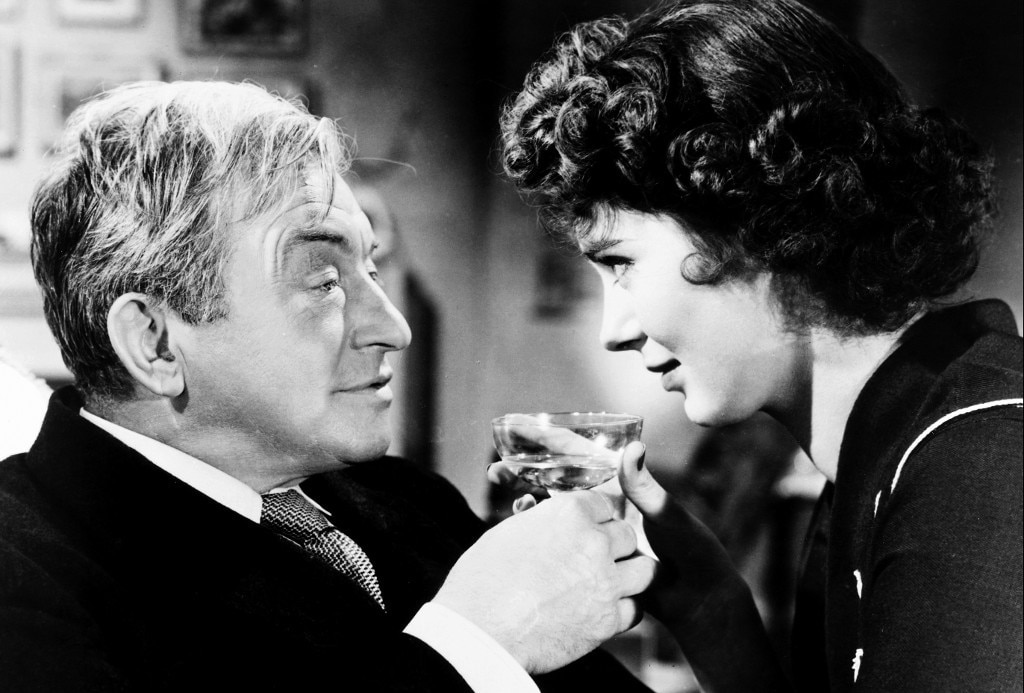
Claude Rains, one of the greatest screen actors of his generation, takes the lead in the screen adaptation by filmmaker Harold French. Rains was a fine leading man but more often cast in supporting roles, playing heroes and villains and everything in between and earning four Oscar nominations along the way. He could be suave, charming, sinister, timid, witty, sly, calculating, and commanding on screen and his voice was one of the most mesmerizing to echo from a theater speaker. In the novel Kees is a 39-year-old man and Rains was well over 60 at the time. His portrayal plays on that live-in quality, a contented man of routine and simple pleasures whose only real passion is chess, and a trusting man who loses faith when he witnesses his boss betray everything Kees dedicated himself to.
The role of femme fatale Michele, the Paris mistress of his errant boss, is played by Swedish actress Märta Torén, who was promoted as "the next Ingrid Bergman" when she made her Hollywood debut in 1948. After starring opposite Humphrey Bogart in Sirocco (1951) and Dana Andrews in Assignment: Paris (1952), she came to England for The Man Who Watched Trains and remained in Europe until her untimely death in 1957 at the age of 31.
Marius Goring is Lucas, the detective on the trail of Kees, in a part that was expanded from the novel. Goring was a favorite of Michael Powell, who cast him in his two most memorable roles: the flamboyant angel in 18th-century French finery in A Matter of Life and Death (1946) and the intense composer who falls in love with Moira Shearer's ballet star in The Red Shoes (1948). Goring adds an edge of eccentricity to Lucas, who first takes on Kees in a chess match and continues to use chess metaphors in the ongoing battle of wits.
Herbert Lom plays Julius de Koster, Jr., Kees's boss, with an arrogance and a touch of the sinister he so often brought to the screen, and young Anouk Aimée, future star of Lola (1961) and A Man and a Woman (1966), has a small role as Jeanne, a sexy streetwalker who guides Kees to a dive hotel.
Sources:
British Film Noir Guide, Michael F. Keaney. McFarland & Company, 2010.
Claude Rains: An Actor's Voice, David J. Skal with Jessica Rains. University Press of Kentucky, 2008.
Claude Rains: A Comprehensive Illustrated Reference to His Work in Film, Stage, Radio, Television and Recordings, John T. Soister with JoAnna Wioskowski. McFarland & Company, 1999.
Introduction to The Man Who Watched Trains Go By, Luc Sante. New York Review Books, 2005.
IMDb
By Sean Axmaker
The Man Who Watched Trains Go By (aka Paris Express)
by Sean Axmaker | August 29, 2017
SIGN UP FOR OUR NEWSLETTERS

CONNECT WITH TCM