"I had imagined this journey as a quest. I finished my studies in May. I wanted to burn all the bridges, all the formulas, and if I got burned, that was all right, too. I wanted to be warm. I wanted the sun and I went after it."
--Klaus Grunberg delivering the opening narration from More
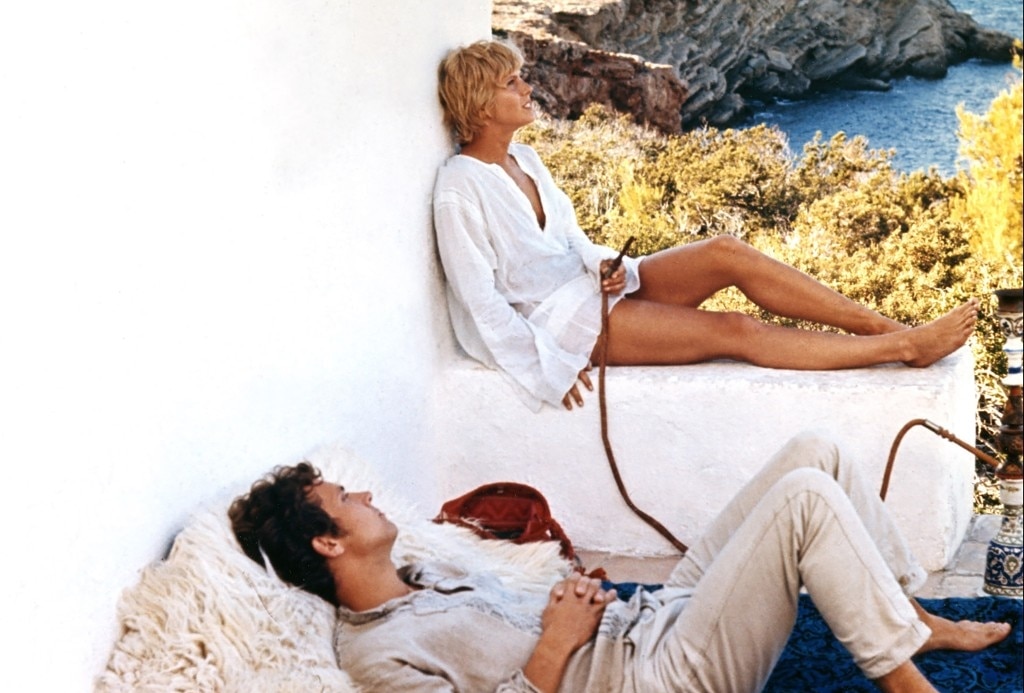
Like Icarus, the German student, Stefan, at the center of director Barbet Schroeder's 1969 debut feature flies too close to the sun, only to be destroyed. But in More, the "sun" can mean multiple things: the sun-swept island of Ibiza, where much of the action takes place, the mercurial American expatriate Estelle (Mimsy Farmer), whom Stefan follows there, and the fleeting release provided by drugs, an addition into which Estelle leads him.
The film follows Stefan (Klaus Grünberg) who decides to drop out after finishing his studies at university. After hitchhiking to Paris and dabbling in burglary, he hooks up with an American girl (Mimsy Farmer) and follows her to Ibiza. Through her relationship to a former Nazi (Heinz Engelmann), he gets involved in the drug culture, which leads to his addiction to heroin.
Barbet Schroeder had made his name first as a critic for the film magazine Cahiers du Cinéma and then by producing films for director Eric Rohmer. For his first film, Schroeder turned to current cultural shifts, focusing on the rise of ennui after the student rebellions in Paris in 1968 and the rise of the counter-culture with its emphasis on free love and turning on. The film is far from a social tract, however. Schroeder focuses on drug use not as a social problem to be studied and solved but rather as a part of the culture. He doesn't use camera tricks to capture the feel of a high, good or bad, as had been done in films like The Trip (1967) and Easy Rider (1969). Instead, he shoots the drug use and the characters' reactions to being high straight on, in a near-documentary fashion. This is reinforced by his use of authentic locations in Paris and Ibiza, including his mother's villa by the Mediterranean. Ultimately, the film is more a dissection of a relationship and the personal issues that destroy it. As Schroeder would tell interviewer Noel Simsolo, "If my film is against anything, it is against attachments, illusions, selfishness, alienation. As for myself, I have no compassion for my hero. Someone who destroys himself is very unattractive to me." (Schroeder quoted in Elaine Lennon, "The Mordant Geography of Desire in Barbet Schroeder's More (1969), Off Screen, November 2015)
The film's look was provided by Spanish cinematographer Nestor Almendros, who had worked with Schroeder on Rohmer's The Collector (1967) and with Farmer on The Wild Racers (1968), his first foray into U.S. filmmaking. Almendros would become one of the world's most acclaimed cinematographers, winning an Oscar; for Days of Heaven (1978) and working with such legendary directors as François Truffaut (nine films, starting with 1970's The Wild Child), Terrence Malick (Days of Heaven), Mike Nichols (1986's Heartburn) and Martin Scorsese (1989's New York Stories). He and Schroeder would reteam for The Valley (Obscured by Clouds) (1972), /General Idi Amin Dada: A Self Portrait (1974), Maîtresse (1975) and Koko: A Talking Gorilla (1978).
For his leads, Schroeder cast German actor Grünberg in his film debut and Farmer. Grunberg would go on to a long career in Europe, most notably in Jirí Weiss' Martha and I (1990). Farmer, who took her stage name from Lewis Carroll's "Jabberwocky," had started in film as a teenager with an uncredited role in Gidget Goes Hawaiian (1961). Her first credited screen role was as James MacArthur's love interest in Spencer's Mountain (1963). In the late 1960s, she appeared in a string of youth exploitation films, including Riot on the Sunset Strip (1967) and The Wild Racers. She traveled to Europe in search of more demanding roles, which she got right off the bat with More, for which she had to embody the character's flirtatiousness, sudden rages and drug-induced states. That was followed by Road to Salina (1970) and Dario Argento's giallo Four Flies on Grey Velvet (1971). She continued working in European films for the next two decades, but left acting in 1991 to focus on art. Since then, she has become an acclaimed sculptor and painter and served on the art department for such films as Charlie and the Chocolate Factory (2005), Guardians of the Galaxy (2014) and Beauty and the Beast (2017).
Schroeder enlisted members of the rock band Pink Floyd to create the soundtrack, their first for a motion picture, but insisted he did not want background music. Instead, all of the music comes from on-screen sources. The soundtrack, released on August 9, 1969 in the U.S., would be their first album without founding member Syd Barrett, whom they had kicked out of the group a year earlier. The score combined psychedelic rock with acoustic folk ballads and some experimental instrumentals. On its release, it reached number nine on the UK charts. The band would reunite with Schroeder to score The Valley (Obscured by Clouds) and would provide the memorable score for Michelangelo Antonioni's Zabriskie Point (1970)
The film was very successful with European critics and at the overseas box office, even though French film censors forced Schroeder to bleep out the ingredients Grünberg and Farmer discuss while creating their own version of LSD. Critics hailed Schroeder as a major new filmmaker and compared Farmer favorably to Jean Seberg in Breathless (1960). In the U.S., it met with more mixed reactions. Vincent Canby of the New York Times called More a "very beautiful, very romantic film about self-destruction," praising the acting, the directing and Almendros' camera work. He was echoed by other New York reviewers, but the film did not fare as well in other U.S. cities. Although Roger Ebert praised Farmer's "freaky, brittle, and almost neurotically repressed" performance, he found most of the film boring, stating that watching people turn on was far from dramatic.
Schroeder moved to America for acclaimed films like Barfly (1987) and Reversal of Fortune (1990), for which he received an Academy Award; nomination for Best Director. He then turned to psychological thrillers with Single White Female (1992). More continues to be regarded highly in Europe, where it screened as a Cannes Classic at the 2015 Cannes Film Festival.
Director: Barbet Schroeder
Producer: David Lewis, Schroeder
Screenplay: Paul Gegauff, Schroeder
From a story by Schroeder
Cinematography: Nestor Almendros
Score: Pink Floyd
Cast: Mimsy Farmer (Estelle Miller), Klaus Grünberg (Stefan Bruckner), Heinz Engelmann (r. Ernesto Wolf), Michel Chanderli (Charlie), Henry Wolf (Henry), Louise Wink (Cathy)
By Frank Miller
More (1969)
by Frank Miller | August 24, 2017
SIGN UP FOR OUR NEWSLETTERS

CONNECT WITH TCM