"God help Bobby and Helen. They're in love in Needle Park."
--Tagline for The Panic in Needle Park
Originally viewed as a searing, almost too grueling look at drug abuse, this 1971 drama is now best known as the first film to present Al Pacino in a leading role. It was the film that convinced director Francis Ford Coppola and Paramount executives to cast him in his breakthrough role, as Michael Corleone in The Godfather (1972). There are other reasons The Panic in Needle Park is worthy of reappraisal, however. It remains a brutally honest work from one of the 1970s' most visionary directors, Jerry Schatzberg, while also featuring a finely honed performance from its unjustly forgotten leading lady, Kitty Winn.
Photographer Schatzberg, most famous for the portrait that became the cover for Bob Dylan's Blonde on Blonde album, was part of the new generation of filmmakers that swept into Hollywood after the surprising success of Bonnie and Clyde (1967) and 2001: A Space Odyssey (1968). Suddenly film executives were open to presenting the personal visions of young directors they hoped would help them tap into the elusive "youth audience." Schatzberg got his first chance to direct with Puzzle of a Downfall Child (1970), which starred then girlfriend Faye Dunaway as a fashion model trying to make sense out of her life. On the strength of that movie, producer Dominick Dunne approached him to direct The Panic in Needle Park. At first, Schatzberg turned it down. Then Al Pacino, who was interested in playing the male lead, personally approached him. He was so impressed with Pacino; he not only signed on for the film, but also fought to keep Pacino in the lead when investors tried to convince him to cast a bigger box office name. At one point, they even considered Jim Morrison of The Doors. The film, with Pacino as star, eventually was picked up by 20th Century-Fox.
The Panic in Needle Park was based on the novel by James Mills, who wrote it after publishing a two-part pictorial essay on drug abuse in Life magazine in 1965. Needle Park is the nickname for New York's Sherman Square near 70th and Broadway, a famous hangout for drug addicts since the 1950s. The novel's film rights initially sold to Avco Embassy before passing to Dominick Dunne. He assigned the screenplay to his brother, John Gregory Dunne, and sister-in-law, Joan Didion, both acclaimed novelists who had never written a film script before. Since they were living on the West Coast, they did research by staying at a hotel near Sherman Square for three weeks.
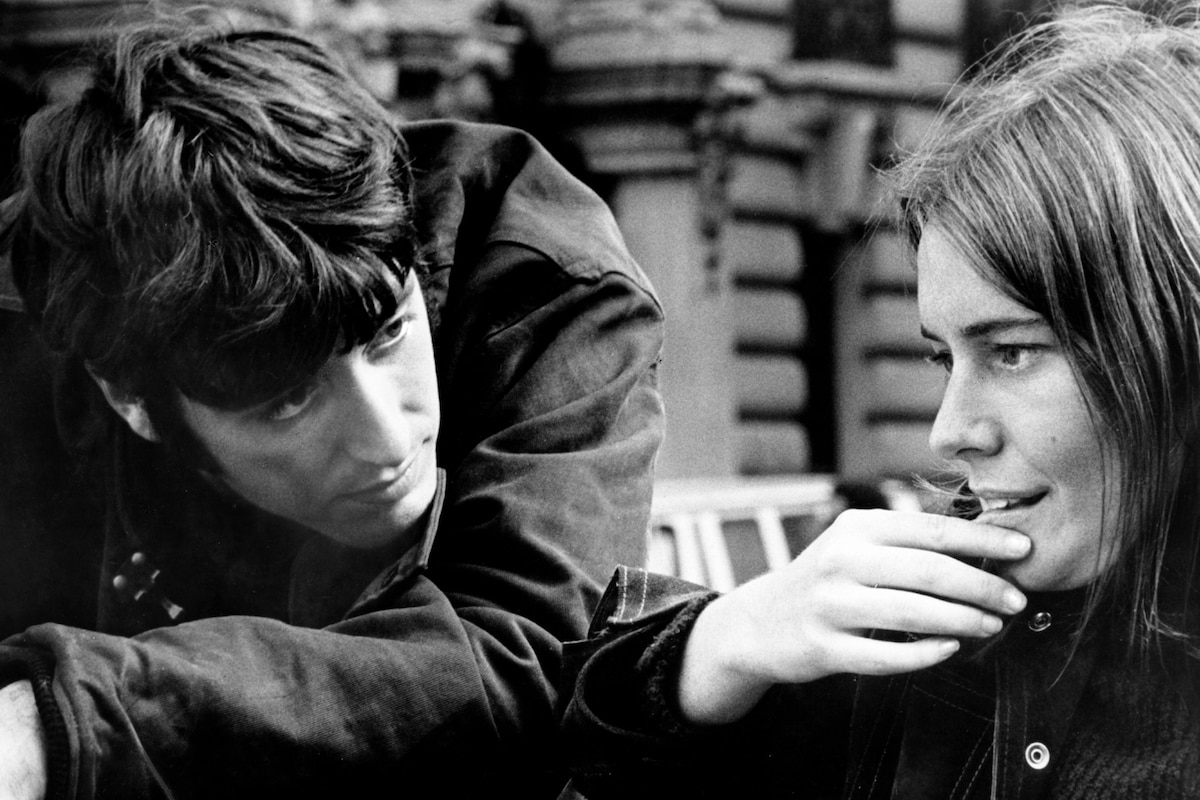
The Panic in Needle Parkfocuses on the relationship between Bobby (Pacino), a drug dealer, and Helen (Winn), a student from the Midwest recovering from a bad abortion. As their relationship deepens, she helps him run drugs and eventually starts shooting up herself. As it becomes increasingly difficult to score drugs, Helen turns to prostitution and theft before becoming a police informant. This is the first mainstream film to show addicts shooting up. The first actor to do so in the film, Warren Finnerty, had done so ten years earlier in Shirley Clarke's underground classic The Connection (1961).
The film was shot in New York City, with location shoots in Needle Park and Riverside Park, on the Staten Island Ferry, in the East Village, in a New York hospital and in a jailhouse. Schatzberg used techniques borrowed from the French New Wave to shoot scenes on jittery hand-held cameras, a practice that made the action seem more realistic. Although he had hired classical composer Ned Rorem to score the film, he ultimately decided to go with no background music, using New York City street sounds as the only background. Makeup designer Herman Buchman used flexible collodian to create realistic track marks for the actors. He modeled their design on his study of hospital patients and corpses. The film's graphic depiction of drug use led to its being banned in England for four years.
In the U.S., The Panic in Needle Park opened to mixed reviews, which Roger Ebert attributed to Fox's selling the film as a sensationalistic exposé of the drug culture instead of focusing on its true strength, the sensitive depiction of a relationship torn apart. J. Hoberman of the Village Voice also complained that too many critics reviewed the screenwriters' and director's pedigrees, questioning how two erudite novelists and a fashion photographer could make a film about low-income addicts. For many, however, the film had a very powerful effect. Winn was named Best Actress at the Cannes Film Festival, where the picture was also nominated for the Palme d'Or. Two churches held special screenings in conjunction with drug awareness programs, and a Boston theater chain disregarded the film's R rating to allow children ten and older to see the film as a warning against drugs.
Francis Ford Coppola screened the picture for executives at Paramount to get them to cast Al Pacino in The Godfather (1972), the role that set him on the road to stardom. Pacino and Schatzberg would re-team for the director's next film, Scarecrow (1973), which won the Palme d'Or at Cannes. Winn had no such luck. Despite a high-profile role as Regan MacNeil's nanny in The Exorcist (1973), her film career didn't last for very long. Her last feature was the horror film Mirrors (1978), followed by a few television appearances through 1984. Nor did Schatzberg go as far as other members of Hollywood's new generation like Coppola or Martin Scorsese, despite fine work on pictures like The Seduction of Joe Tynan (1979) and Street Smart (1987).
Today The Panic in Needle Park is best remembered for providing Pacino with his first starring role, though it deserves re-evaluation as a powerful expression of Hollywood's move toward innovative directorial visions and for the fine work of all involved.
Director: Jerry Schatzberg
Producer: Dominck Dunne
Screenplay: Joan Didion, John Gregory Dunne
From the book by James Mills
Cinematography: Adam Holender
Cast: Al Pacino (Bobby), Kitty Winn (Helen), Alan Vint (Hotch), Richard Bright (Hank), Kiel Martin (Chico), Warren Finnerty (Sammy), Marcia Jean Kurtz (Marcie), Raul Julia (Marco), Joe Santos (DiBono), Paul Sorvino (Samuels), Rutanya Alda (Admitting Nurse)
By Frank Miller
Panic in Needle Park
by Frank Miller | August 24, 2017
SIGN UP FOR OUR NEWSLETTERS

CONNECT WITH TCM