For anyone not familiar with Dont Look Back, the first thing to know is that the "dont" in the punctuation-free title has no apostrophe - an ironic fact now that Bob Dylan, the movie's subject and star, has won the Nobel Prize for literature. The second thing to know is that D.A. Pennebaker's classic 1967 documentary starts with one of the most iconic moments of 1960s pop culture: Dylan's hard-driving 1965 hit "Subterranean Homesick Blues" fills the soundtrack while the singer holds, displays, and tosses away a series of cue cards bearing various words from the song along with occasional puns and jokes.
Pennebaker shot multiple versions of the cue-card sequence in different locations, and since the sound is always the same, the version appearing in the finished film was probably chosen because Dylan fumbled the cards in the other takes. In any case, it's a fascinating choice for the movie's opening, since "Subterranean Homesick Blues" was one of Dylan's very first recordings with an electrified rock'n'roll backing - it opens the rock-music side of his album Bringing It All Back Home, just then being released - whereas Pennebaker's movie is an up-close chronicle of his final tour as an all-acoustic folk singer.
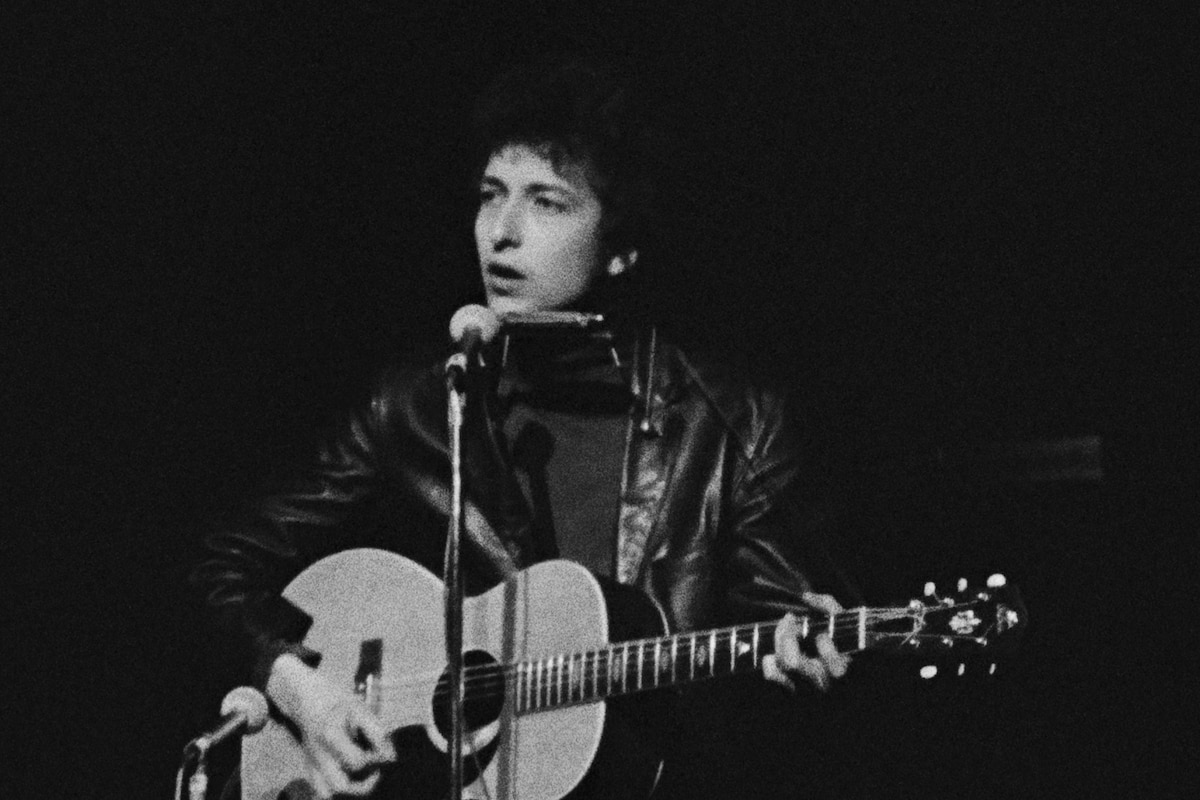
That tour took Dylan across England in the spring of 1965, beginning in Sheffield and finishing at London's staid old Royal Albert Hall, an enormous venue where he kept the audience transfixed with nothing but his voice, his guitar, a couple of microphones, and his amazingly poetic lyrics. Two months after returning home, he brought his electric guitar to the celebrated Newport Folk Festival, where he was backed by Mike Bloomfield and Barry Goldberg from Paul Butterfield's popular blues-rock band. The set at Newport thrilled listeners who regarded rock and folk as equally legitimate genres, but it outraged folk-music loyalists who saw the switch to electric as a commercial sellout. In another irony, all of Dylan's performances in Dont Look Back are acoustic, but the film premiered two years after Pennebaker completed it, because distributors were clueless about how to handle such an unprecedented picture. By that time Dylan was known as an electrified rocker all over the globe, thanks to the first side of Bringing It All Back Home, his world tour in 1966, and the propulsive albums Highway 61 Revisited and Blonde on Blonde, released in 1965 and 1966, respectively.
The title of Dont Look Back recalls a line from "She Belongs to Me," the second cut on the rock-music side of Bringing It All Back Home: "She's got everything she needs/She's an artist, she don't look back." Pennebaker disclaimed any reference to the song when he discussed the film, however, saying that Dylan didn't want one of his lyrics in the title. According to Pennebaker, the phrase actually came from a well-known remark by Satchel Paige, the African-American baseball star, whose humorous words of warning - "Don't look back. Something might be gaining on you." - came to the director's mind when he observed Dylan's relentlessly forward-looking attitude to life and work. The title also sums up Pennebaker's approach to cinéma-vérité filmmaking, a music-like blend of preparation and improvisation that requires nonstop attention to the present moment and whatever might be immediately around the bend. Pennebaker helped invent this hugely important style in his earlier work with Robert Drew and Richard Leacock, and Dont Look Back is one of its foundational achievements.
The idea of a documentary portraying Dylan came from Albert Grossman, the singer's manager, at a time when Pennebaker knew nothing about Dylan except that "The Times They Are a-Changin'" played on the radio a lot. Pennebaker had recently made a short documentary about jazz singer Dave Lambert, and a film about a folksinger sounded like a logical next step. So he took out his customized 16mm gear - a handmade sync-sound camera capable of longer-than-normal takes - and joined the tour, shooting concert performances, backstage activities, and backroom dealings. The result was more than twenty hours of footage that Pennebaker edited down to a final cut of 96 minutes. Dylan generally cooperated with the director and his tiny crew, rarely showing preferences about what should or shouldn't be filmed.
Others onscreen at various times include Grossman, a central figure in the business side of Dylan's career; Bob Neuwirth, a musician and day-to-day organizer of the tour; Dylan's romantic partner Joan Baez, herself a topline folk-music star who mistakenly thought she'd be performing alongside him; keyboard player Alan Price, then on his way out as a member of Eric Burden and the Animals; pop singer Marianne Faithfull, a Rolling Stones fellow traveler; John Mayall, leader of John Mayall and the Bluesbreakers; and Donovan, a rising singer-songwriter who has a friendly musical duel with Dylan resulting in a clear victory for the latter, whose informal rendition of "It's All Over Now, Baby Blue" blows Donovan's nondescript "To Sing for You" to smithereens.
While these celebrities and semi-celebrities are fun to watch, some of the most memorable moments in Dont Look Back come from people who aren't famous at all: the wife of a high sheriff who schmoozes with Dylan while seeming uncertain just who he is; an alcohol-fogged visitor who infuriates Dylan by throwing a glass out a hotel-room window; an angry hotel employee who argues with Grossman; and a British journalist for Time who finds himself under verbal attack by Dylan and pretty much fails to defend his publication, his profession, or himself. These and other individuals amount to a colorful parade of personalities, although they're occasionally hard to keep track of, since Pennebaker provides few identifying captions and often shoots from offbeat angles in low light.
But of course Dylan is the main attraction, both on and off the stage. It's captivating to see him tapping at a typewriter while Baez sings quietly off to the side, and nothing in the film is more fascinating than flashback footage taken by the great independent filmmaker Ed Emshwiller showing a very boyish Dylan singing protest songs to African-American farmers in a cornfield during a voter-registration drive years earlier. Pennebaker went on to make the 1968 documentary Monterey Pop, a vastly more ambitious project with a first-rate camera crew including Leacock, Albert Maysles, Nick Proferes, and Nick Doob, and his later pictures include Ziggy Stardust and the Spiders from Mars (1973), depicting David Bowie's last Ziggy Stardust concert; Jerry Lee Lewis: The Story of Rock & Roll (1991, directed with Chris Hegedus), a nonfiction biopic; and Woodstock Diary (1994, directed with Hegedus), a television documentary marking the twenty-fifth anniversary of the eponymous rock festival. He has made films outside the music world as well, but he is a key figure in the realm of rock'n'roll cinema, and Dont Look Back is arguably his finest work.
Director: D.A. Pennebaker
Producers: Albert Grossman, John Court, Leacock-Pennebaker, Inc.
Cinematographer: D.A. Pennebaker
Film Editing: D.A. Pennebaker
With: Bob Dylan, Joan Baez, Donovan, Alan Price, Albert Grossman, Bob Neuwirth
BW-96m.
by David Sterritt
Don't Look Back
by David Sterritt | August 24, 2017
SIGN UP FOR OUR NEWSLETTERS

CONNECT WITH TCM