This is the film that catapulted German director Werner Herzog into international fame and the one that first showcased for the world his most characteristic themes: an individual's obsessive drive to fulfill a great achievement that mushrooms into power-mad hubris, and man overreaching his limits in the natural world, which he has romanticized, underestimated, and fatally misunderstood.
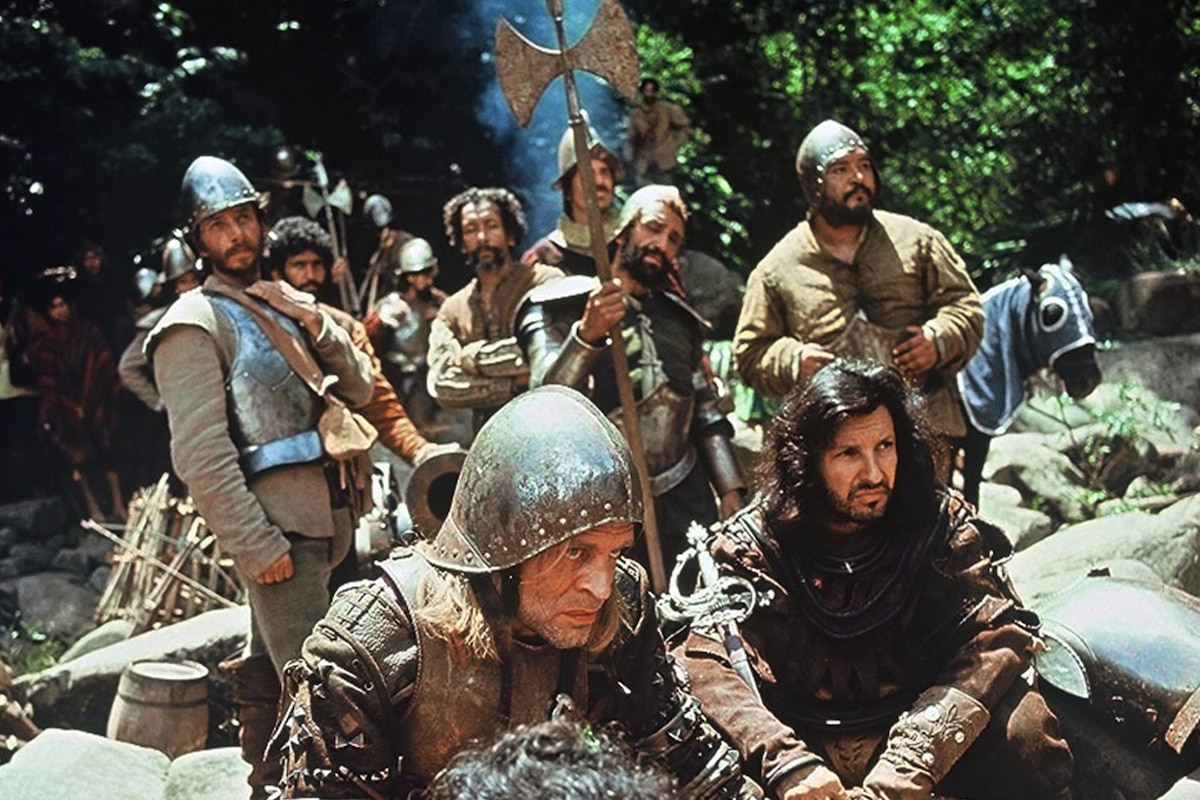
The title character isn't the only obsessive haunted by an impossible vision of greatness, although he is the one who takes it to its crushing extremes. Although Herzog invented many plot details and characters, the story is based on doomed expeditions in the 16th century by Spanish conquistadors on a mad quest to find the legendary lost city of gold, El Dorado. In Herzog's telling, when explorer Gonzalo Pizarro (Alejandro Repullés) finds his expedition hopelessly bogged down in the hostile Peruvian rain forest, he sends a small advance party to explore further up river, led by the aristocrat Don Pedro de Ursua (Ruy Guerra). The party is made up of second-in-command Don Lope de Aguirre (Klaus Kinski) and his daughter (Cecilia Rivera), nobleman Fernando de Guzman (Peter Berling) and his wife, a priest, soldiers, and enslaved Incans. Through murder and betrayal, Aguirre assumes command of the expedition with disastrous results.
The story does incorporate many historical details, conflating two such expeditions into one: Pizarro's 1540-1541 journey into the Amazon and a later one in 1560 by Ursua. During the second journey, Aguirre, a professional soldier, made a plan to use the 300-man expeditionary force to overthrow the Spanish rule of Peru. His grab for power, of course, ended badly.
The film was shot on location in Peru in chronological order, because Herzog believed the production's progress on the river paralleled the explorers' journey in the story. The difficulties and personality clashes that arose certainly marked the filming as a folly nearly as insane as the Spanish hunt for gold, although it would be surpassed by the seriously troubled production of a later film about an even madder quest, Fitzcarraldo (1982). Because of the remote filming locations and limited funds, there were times when Herzog had to trade his wristwatch and even his boots just to have food for the day, according to his commentary on the DVD release of Aguirre.
Much of the background information for this article comes from that commentary and later interviews the director gave. On the DVD, he talks about, among many other details, the difficulty of acquiring the monkeys featured at the end of the film. Because he paid only half of what the monkey handlers asked for, they kept the production's money and sold them off to someone else. As they were being prepared for shipment to Florida, Herzog claims he masqueraded as a veterinarian and prevented the shipment by insisting the animals did not have their needed vaccinations. He was able to get them back, and after filming of their scenes was complete, they were released into the wild, but not before the film's star, Klaus Kinski, claimed to have been bitten by several of them.
Always a difficult, colorful, often deranged actor, Kinski is the subject of many of Herzog's commentaries and interviews. The two met years before this production when the then-struggling Kinski rented a room in a house where a teenaged Herzog and his family also lived, subjecting them to wild and frequently terrifying behavior during the three months he stayed there. Nevertheless, when it came time to cast the role of Aguirre, Herzog immediately thought of Kinski and sent him the screenplay.
"Between three and four in the morning, the phone rang," Herzog later recalled. "It took me at least a couple of minutes before I realized that it was Kinski who was the source of this inarticulate screaming. And after an hour of this, it dawned on me that he found it the most fascinating screenplay and wanted to be Aguirre."
This was the first of five films the two made together over the course of 15 years, during which they developed a stormy, sometimes violent professional relationship that the director documented in his film My Best Fiend (1999), eight years after Kinski's death at the age of 65.
In the DVD commentary, Herzog talks about how he had to resort to all sorts of manipulations to get the performance he wanted out of his volatile star. For example, Kinski wanted to express his character's madness at the end of the film by very loud shouting, which Herzog thought too obvious. In order to get a quieter, more contained approach to the scene, Herzog let Kinski yell and rage through an hour and a half of takes until the actor was so exhausted he could only do it Herzog's way. That is the version that made it into the final cut of the film.
Herzog also said Kinski threatened to quit when Herzog refused to fire a sound assistant who had angered Kinski, forcing Herzog to threaten to shoot the actor and then turn the gun on himself. In his autobiography, Kinski disputed this, claiming he was the only one on set who had a gun.
Like several of his other films, Aguirre was shot with a 35mm camera Herzog had stolen from the Munich Film School. He has openly and unapologetically admitted the theft.
"It was a very simple 35mm camera, one I used on many other films, so I do not consider it a theft," he said. "For me, it was truly a necessity. I wanted to make films and needed a camera. I had some sort of natural right to this tool. If you need air to breathe, and you are locked in a room, you have to take a chisel and hammer and break down a wall. It is your absolute right."
The original musical score of the picture is by Florian Fricke, whose band Popol Vuh (named for the Mayan creation myth) has contributed the soundtracks to many Herzog films. According to the director, Fricke devised an instrument he referred to as a "choir organ." The device ran three dozen tapes of different sound and music running parallel to each other in loops. Using a built-in keyboard, the tapes were played much like an organ to achieve a sound akin to a human choir but one Herzog said is "very artificial and really quite eerie."
The film garnered much critical praise and international attention. It was nominated for a César (the French "Oscar"), won Best Foreign Film from the French Syndicate of Cinema Critics, and Best Cinematography at the German Film Awards in 1973, where it also got Outstanding Feature and Best Performance by an Actor (for Kinski) nominations. The picture premiered in Germany in December 1972 but was not released in the U.S. until April 1977, subsequently being honored for Best Cinematography by the National Society of Film Critics.
New York Times critic Vincent Canby called it "a splendid and haunting work." Critic Roger Ebert said it was "one of the great haunting visions of the cinema." It has been influential to many other directors; James Gray (The Immigrant, 2013; The Lost City of Z, 2016) called Aguirre a masterpiece, and Francis Ford Coppola cited it as an influence on Apocalypse Now (1979)>
Director: Werner Herzog
Producers: Werner Herzog, Hans Prescher
Screenplay: Werner Herzog
Cinematography: Thomas Mauch
Editing: Beate Mainka-Jellinghaus
Music: Popol Vuh
Cast: Klaus Kinski (Aguirre), Del Negro (Brother Gaspar de Carvajal), Ruy Guerra (Ursua), Peter Berling (de Guzman), Helena Rojo (Ines), Cecilia Rivera (Flores)
By Rob Nixon
Aguirre, the Wrath of God
by Rob Nixon | August 22, 2017
SIGN UP FOR OUR NEWSLETTERS

CONNECT WITH TCM