American audiences were decades behind the ball on a lot of directors until the home video era really kicked in, and few examples of what we were missing are more potent than Jacques Becker. With only 13 narrative features to his credit before his death in 1960, he's now a familiar art house name thanks to acknowledged classics like Le Trou (1960) and Touchez Pas au Grisbi (1954). However, only one of his films received significant U.S. theatrical play in his lifetime, or ever for decades after: Casque d'Or (1952), a ravishing melodrama that serves as one of the best showcases for French treasure Simone Signoret.
Becker had been working his way up through the French film industry by the time he started directing shorts in the mid-1930s, including experience as an assistant to Jean Renoir. His modern, sometimes jagged style was a contrast to many of his postwar peers, finding favor after his passing with the French New Wave filmmakers who were rebelling against other directors like Henri-Georges Clouzot. "One can see why Becker was a hero for the New Wave directors," noted the Pacific Film Archive in its notes for a retrospective spotlighting this film. "It anticipates Shoot the Piano Player (1960) by a decade. With a fluidity that almost defies narrative plotting, Becker unfolds a tale of love doomed by its setting, the Paris demimonde at the turn of the century."
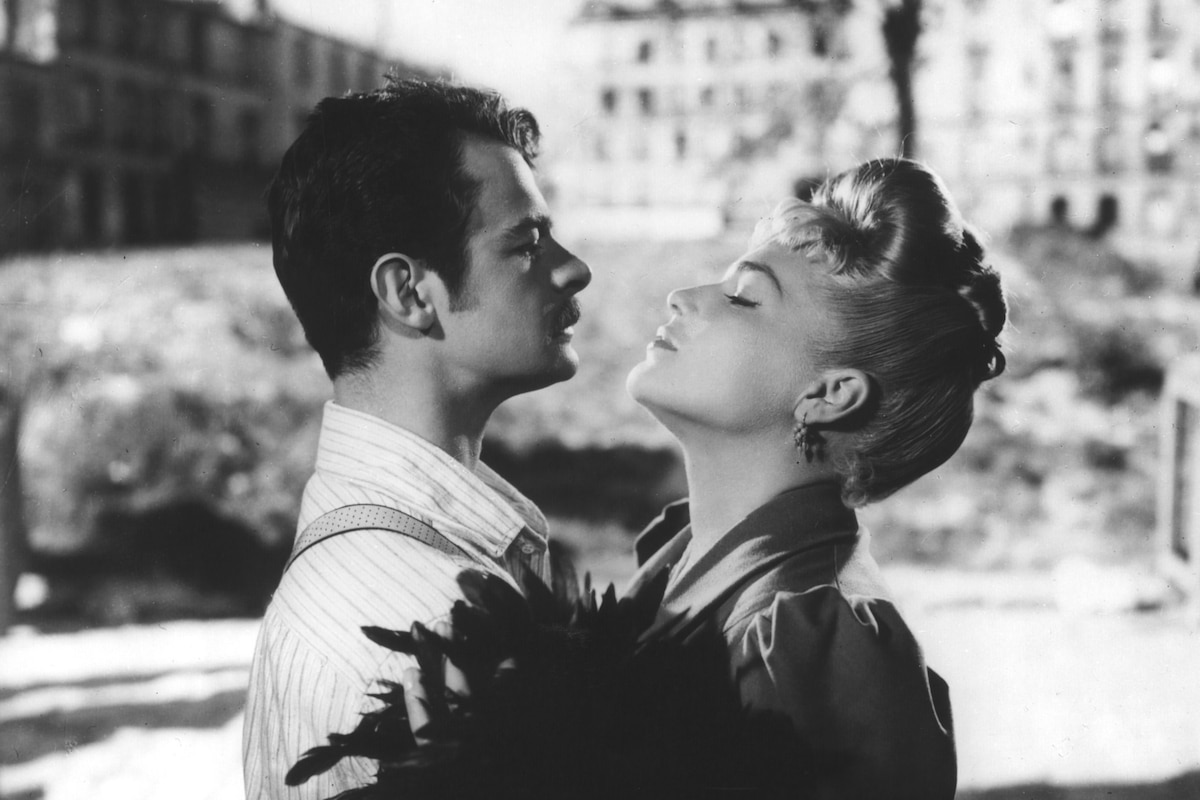
The title of Casque d'Or literally means "Helmet of Gold," a nickname given to Signoret's character, Marie. She's paired up here with Serge Reggiani, her memorable costar in their segment of Max Ophüls' classic anthology La Ronde (1950), for a tragic story of love in turn-of-the-century Paris based on a real-life crime in 1901 - by a woman also nicknamed "Casque d'or," Amélie Hélie. Signoret's performance is among her best, earning a British Film Academy award for her portrayal of a woman whose life is tied to the underworld while her heart yearns to break free.
The film was given a notable subtitled release in America from DisCina International, who also handled such prestige titles as Orpheus (1950) and Topaze (1951). In both England and the U.S., distributors tried to come up with a more Anglo-friendly title with various engagements under such titles as The Girl with the Golden Hair, Golden Helmet, Golden Marie, and Casque d'Or, the Story of a Blonde. However, it's the simple original moniker that's remained with it over the years, and it's hard now to imagine calling it anything else.
Ironically this film wasn't terribly well received when it first opened in France, but since then its reappraisal at home and its classic status in many other countries has been a major force in establishing Becker's name among the pantheon of great French filmmakers. In one tantalizing case of a cinematic "could have been," it even inspired writer Caroline Thompson to sign up to write a remake of the film in 2001 for Fox Searchlight, to be made back to back with Perfume: the Story of a Murderer for Ridley Scott and the biopic Johnny Eck, intended to star Leonardo DiCaprio. None of those saw the light of day (Perfume was later made by Tom Tykwer in 2006 far away from Fox), but one can only wonder how Becker's own view of Paris fifty years removed might have translated a full century away in another country altogether.
By Nathaniel Thompson
Casque d'Or
by Nathaniel Thompson | July 26, 2017
SIGN UP FOR OUR NEWSLETTERS

CONNECT WITH TCM