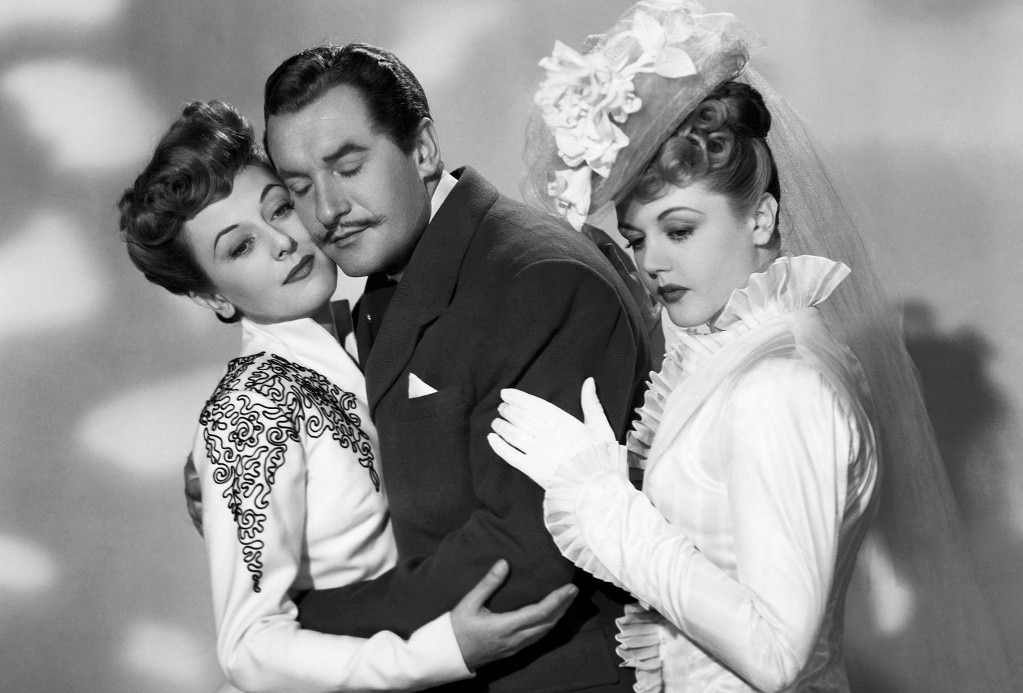
George Sanders sings! George Sanders dances! That wasn't the tagline for the 1947 drama/romance The Private Affairs of Bel Ami, but it could have been. After all, how many opportunities does the cinema provide for watching Sanders whoop it up with Angela Lansbury on the dance floor before crooning for her little girl? The real tagline is the first title card after the credits: "This is the history of a scoundrel." Given that preface, the drama, based upon the novel Bel Ami by Guy de Maupassant, puts George Sanders in a familiar position, to be sure. Still, it's interesting to note that despite the familiarity of Sanders playing an unscrupulous rake, it's one of the fullest and deepest performances of his entire career.
The story begins in 1880, in Paris, as two old war buddies, Georges Duroy (Sanders) and Charles Forestier (John Carradine), meet by chance in a street café. Duroy is unemployed and on his last three meals worth of money. Forestier, by contrast, is doing better than he ever expected. With plenty of money and prestige as an editor in Paris, he offers Duroy a job. Duroy accepts but concedes he's never written before so Forestier asks him to dinner to meet his publisher. While at the dinner party, Duroy meets Clotilde de Marelle (Angela Lansbury) and Forestier's wife, Madeleine (Ann Dvorak). Charles' publisher asks Sanders for an article and when he has trouble writing it, Forestier sends him to Madeleine for help. After all, he says, she taught him everything he knows. Duroy falls for Madeleine, and she for him, and Clotilde for him as well. After a night out dancing and singing with Clotilde, she tells Duroy she will call him "Bel Ami" based on the song they heard about a scoundrel that reminds her of him. The nickname is all too fitting and eventually, the relationships are tested.
The Private Affairs of Bel Ami was directed by Albert Lewin and although he only directed a handful of movies, he created a signature unique in forties cinema, indeed of any decade. He often commissioned an original work by a contemporary, cutting edge artist to use in his movies for dramatic effect. In The Picture of Dorian Gray (1945), it was the title painting itself, done by Ivan Albright. In Pandora and the Flying Dutchman (1951), it was an original work by Man Ray. Here, in The Private Affairs of Bel Ami, it is The Temptation of St. Anthony by Max Ernst. It was selected when Lewin had several painters compete for the prize of having the painting appear in the film. One of the painters was Salvador Dali, whose version, although it did not appear in the film, went on to become far more famous than Ernst's version.
Lewin had an interesting career long before he turned to direction. He was a professor of English at the University of Missouri before becoming a drama critic in the late teens, early twenties. That's when he came to the attention of Samuel Goldwyn in Hollywood. He became a reader for Goldwyn and quickly moved up the chain until he was the supervisor of the script department. Not long after, he became Irving Thalberg's personal assistant and before long was producing movies for the studio. After moving to Paramount in the thirties, he continued as a producer before being bitten by the directing bug in the forties. His interest in art may have led him to the change in careers but it clearly wasn't lasting. After only a smattering of films, he bored of directing and retired.
While he was directing, though, he found a kindred spirit in George Sanders and the two worked together more than once. Sanders got along well with Lewin and it was Lewin who gave Sanders some of his earliest lead roles that weren't the Falcon or the Saint. In fact, Sanders starred in Lewin's first three films and only failed to appear in the fourth due to scheduling conflicts. Sanders, of course, went on to win the Oscar three years later for his fantastic work as Addison DeWitt in All About Eve (1950) but his work here is among the fullest characterizations he ever did.
Also in the cast were Angela Lansbury and Ann Dvorak. Lansbury, who was just three years into her career, and only 22 years old, had already earned two Oscar nominations and was playing characters that seemed well beyond her years. Lansbury had worked with both Lewin and Sanders before in The Picture of Dorian Gray but was increasingly relegated to small roles that didn't make use of her substantial talents. She quickly gravitated toward the theater and became a major Broadway star. Dvorak, like Lansbury, started her career early, in her teens, and by the time she did this film, was a well-seasoned professional. She retired from acting early, however, in 1951, choosing to spend time with her husband.
Finally, there was John Carradine, one of the greatest underused actors in Hollywood history. Carradine played so many parts, it's impossible to verify how many. That's because he claimed to have played in dozens of movies before he ever got a single screen credit. While Hollywood used him in a variety of parts, it was sinister parts they eventually settled on but his talent produced so much more. Here, as always, he is excellent.
Together, the actors create the drive of the movie. Their interplay and chemistry make the story worth watching. Of course, it was probably impossible for George Sanders to play a scoundrel and not be worth watching, but this time around, he not only plays the part, but ends the movie with a surprisingly touching and heartbreaking conclusion.
Director: Albert Lewin
Producer: Ray Heinz, David L. Loew
Written by: Albert Lewin, based on the novel by Guy de Maupassant
Editor: Albrecht Joseph
Art Director: Frank Sylos
Music: Darius Milhaud
Costume Design: Norma Koch
Cinematographer: Russel Metty
Cast: George Sanders (Georges Duroy), Angela Lansbury (Clotilde de Marelle), Ann Dvorak (Claire Madeleine Forestier), John Carradine (Charles Forestier), Susan Douglas Rubes (Suzanne Walter), Hugo Haas (Monsieur Walter), Warren William (Laroche-Mathieu), Frances Dee (Marie de Varenne), Albert Bassermann (Jacques Rival), Marie Wilson (Rachel Michot)
By Greg Ferrara
The Private Affairs of Bel Ami
by Greg Ferrara | July 24, 2017
SIGN UP FOR OUR NEWSLETTERS

CONNECT WITH TCM