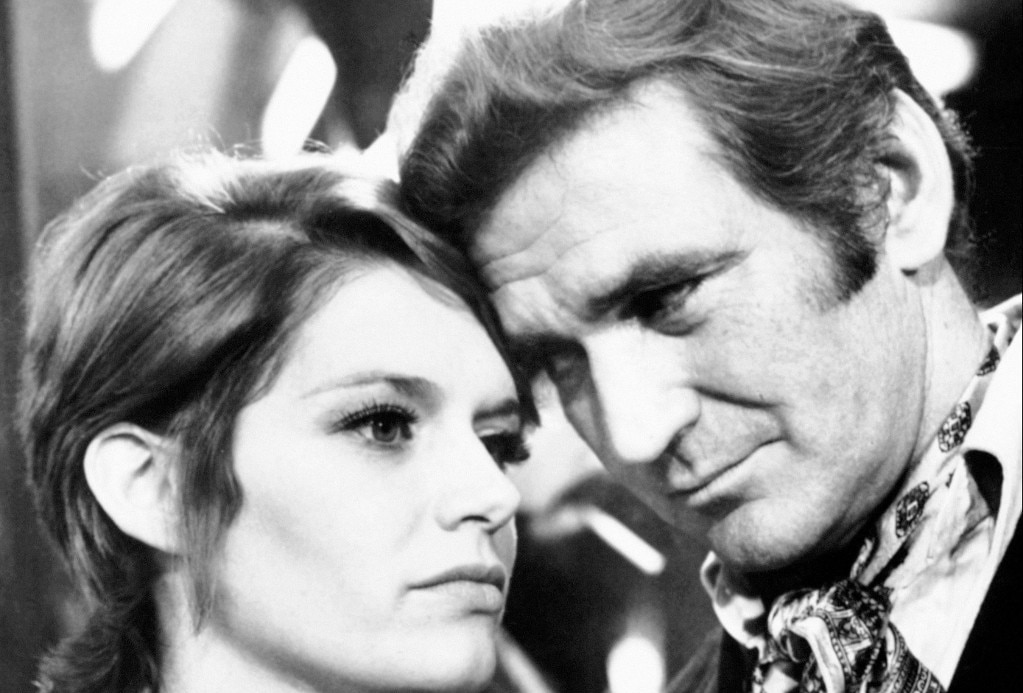
Promoted as a sex farce, this British release reaches for something more substantive, not always successfully and creating something of a jarring tonal shift. Australian actor Rod Taylor (The Birds, 1963; Winston Churchill in Tarantino's Inglorious Basterds, 2009, his final film role) plays a successful talent agent with a difficult rock star client and a marriage that falls apart. He moves in with a friend but finds himself drawn in to an affair with his friend's wife. The film was a bit late in a cycle of European-set sex romps (varying in tone and intent from What's New, Pussycat, 1965, to Alfie, 1966) that celebrated the swinging lifestyle of a caddish womanizer who often learns a hard life lesson.
In 1969, before production began, Taylor gave a sneak peek to an Australian magazine: "According to the script, I'm a character who keeps having these fantasies over women. There's one incident which strikes me as being particularly funny. This mixed-up character - me - catches a bus and discovers that the girl collecting the fares is completely nude. The only items which cover her modesty are the money-bags and some leather straps. Then he notices all the passengers are sitting naked. I shall be nude myself in this scene, and let's say I shall need plenty of rehearsals with the girls before I'm satisfied with the scenes. At least, I hope so."
The final film didn't turn out that way. In fact, so many changes were made to the original script, based on a 1967 novel by Gordon Williams, that the director, Silvio Narizzano, quit before principle photography even began, and screenwriters Chris Bryant and Allan Scott requested to have their names removed from the credits.
Canadian Narizzano, whose best-known film, Georgy Girl (1966), certainly qualified him to direct a "swinging London" social comment, was replaced by John Krish, who earlier made the sex comedy The Wild Affair (1965). The pseudonym "Andrew Meredith" was substituted for Bryant and Scott's writing credit.
Carol White plays the object of Taylor's affection, the wife of his best friend. White made a name for herself opposite Terence Stamp in Ken Loach's critically acclaimed and Golden Globe-nominated directing debut Poor Cow (1967). She was considered an actress of some promise, but her life and career were derailed by substance abuse problems. After The Man Who Had Power Over Women she made only a handful of movies over the next dozen years before her death from either a drug overdose or liver failure at the age of 48 in 1991.
Cast in a smaller role is the actress Magali Noël, best known for her role as Gradisca in Federico Fellini's Amarcord (1973).
The film was shot on location in London and Paris by cinematographer Gerry Turpin, a BAFTA award-winner for The Whisperers (1967) and Oh, What a Lovely War (1969). Turpin was given a special technical Academy Award in 1984 "for the design, engineering and development of an on-camera device providing contrast control, sourceless fill light and special effects for motion picture photography."
The music was composed by Johnny Mandel, Oscar winner for his song "The Shadow of Your Smile" from The Sandpiper (1965).
The film got mixed reviews on its release. Variety called it "a sex comedy done in lively enough fashion" that "strays into a more serious territory trying to show up the hollowness behind the tinselly pop world." On the other hand, Roger Greenspun in the New York Times said it was "a silly movie that wastes the talents of a generally good cast headed by the estimable Rod Taylor."
Director: John Krish
Producers: Leonard Lightstone, Judd Bernard
Screenplay: Chris Bryant, Allan Scott, based on the novel by Gordon Williams
Cinematography: Gerry Turpin
Editing: Thom Noble
Art Direction: Colin Grimes
Music: Johnny Mandel
Cast: Rod Taylor (Peter Reaney), Carol White (Jody Pringle), James Booth (Val Pringle), Penelope Horner (Angela Reaney), Clive Francis (Barry Black)
By Rob Nixon
The Man Who Had Power Over Women
by Rob Nixon | July 21, 2017
SIGN UP FOR OUR NEWSLETTERS

CONNECT WITH TCM