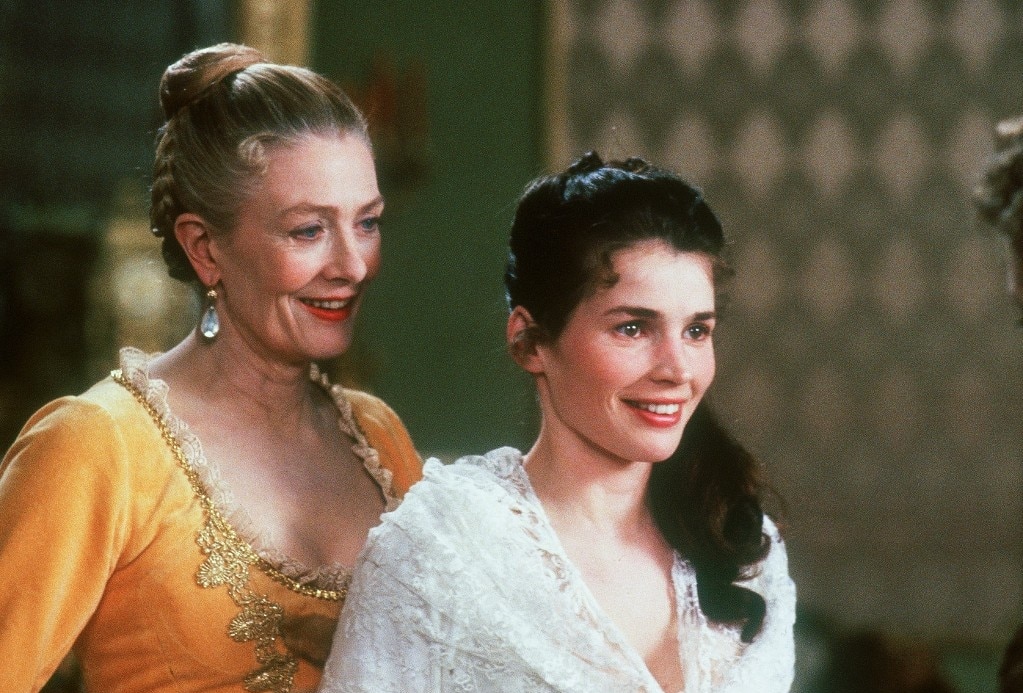
The early years of Catherine II of Russia (Catherine the Great) are dramatized in Young Catherine (1991), which was filmed as a British/Canadian/American television miniseries with Turner Pictures as a co-producer and originally shown in the U.S. as a two-part miniseries on TNT. English actress Julia Ormond, a few years before her period of Hollywood stardom, plays Catherine. The outstanding cast also includes Vanessa Redgrave, Christopher Plummer, Maximilian Schell, Franco Nero and Marthe Keller.
The story begins in 1744 when Catherine, a 16-year-old Prussian princess then known as Sophie, is taken from her homeland and brought to Russia with her mother, Princess Johanna (Marthe Keller), on the orders of Empress Elizabeth (Vanessa Redgrave). It seems that Sophie has been chosen as a possible bride for Elizabeth's nephew and the heir to the Russian throne, Grand Duke Peter (Reece Dinsdale).
Elizabeth approves of Sophie and arranges for the former Protestant to become a Russian Orthodox, and for her name to be changed to Catherine. But the imperious Empress banishes Princess Johanna on charges of conspiring with the Prussian king, Frederick the Great (Maximilian Schell).
Catherine is less than impressed by her betrothed, finding Peter to be a bumbling, child-like semi-idiot. But her own thirst for power has kicked in, and she wants to take her place in court intrigue, "not as a pawn," she tells a lady-in-waiting, but as a queen. Her chief ally is Sir Charles Williams (Christopher Plummer); her chief enemy, Count Vorontsov (Franco Nero), who had wanted a Polish princess on the throne and at one point plots to get rid of Catherine by poisoning her.
With Peter proving a flop as a husband (due to an intimate physical problem that is discussed in graphic detail), Catherine takes a lover, Count Grigory Orlov (Mark Frankel) and has a son by him. Elizabeth takes control of this new heir to the throne but turns against Catherine. As the years pass, however, Catherine becomes a great heroine and inspiration to her countrymen. On her deathbed, Empress Elizabeth realizes that the only hope for Russia's future lies in this determined young woman who is willing to take the throne, if necessary, by force. The film ends with Catherine's coronation; she will, of course, go on to become one of the most powerful and progressive monarchs in Russian history.
The opulently produced $8 million film was shot entirely in the USSR, thanks to the glasnost policy begun in 1985 that welcomed film production by foreign countries. Shooting was primarily on locations in Leningrad (nee St. Petersburg), including the Winter Palace, the royal czar's residence; the Peter-and-Paul Fortress, the city's original citadel; and the Smolny district with its pastel-blue cathedral. The Winter Palace, with its elaborate arrangements of rooms, hallways, staircases and ceiling frescoes, is particularly vivid in the striking cinematography by Ernest Day (an Oscar nominee for 1984's A Passage to India).
Young Catherine won critical praise, with People magazine describing it as "what a miniseries should be: a lavish pageant, full of grandiloquent actors, fabulous costumes and magnificent architecture, all put in service to intrigue, power, romance and hints of the ever-popular kinky royal sex."
The mini-series won Primetime Emmy nominations in the Miniseries or Special category for Vanessa Redgrave (Outstanding Supporting Actress) and Larisa Konnikova (Outstanding Costume Design). Redgrave won in her category at the CableAce Awards. The film won as Best Dramatic Mini-Series at the Gemini Awards, with other nominations going to Julia Ormond as Best Actress in a Leading Role, Photography (Ernest Day), Costume Design (Konnikova) and Production Design/Art Direction (Harold Thrasher and Natalia Vasilveya).
Young Catherine proved a breakout role for Julia Ormond, who had been working as a television actress since 1989 and would soon enjoy her moment in the Hollywood sun with starring roles in the feature films Legends of the Fall (1994), First Knight (1994), and Sabrina (1995). She has since balanced leading and supporting roles in films and such U.S. TV series as Nurse Jackie, Law and Order: Criminal Intent, and Madmen.
According to Vanessa Redgrave biographer Dan Callahan, the actress was "felled by illness" during production of Young Catherine and looked after by Franco Nero, her former costar in Camelot (1967) and her future husband. (They were married in 2006.) In addition to his role here as Frederick the Great, Maximilian Schell had played the title role of Peter the Great in a well-received 1986 mini-series, with Redgrave cast as Peter's sister, Tsarevna Sophia.
Catherine the Great has been portrayed in more than a dozen other movies and TV films including another TV movie of the 1990s, Catherine the Great (1995), starring Catherine Zeta-Jones. Here are some of the others: Catherine the Great (1920), Forbidden Paradise (1924), The Rise of Catherine the Great (1934), The Scarlet Empress (1934), A Royal Scandal (1945), Shadow of the Evil (1950), Catherine of Russia (1963), and Great Catherine (1968). Unfortunately, Mae West's 1944 Broadway production Catherine Was Great - in which the star kidded Catherine's reputation for a prodigious sexual appetite with an "imperial guard" of lusty musclemen - was never committed to film!
By Roger Fristoe
Young Catherine
by Roger Fristoe | July 20, 2017
SIGN UP FOR OUR NEWSLETTERS

CONNECT WITH TCM