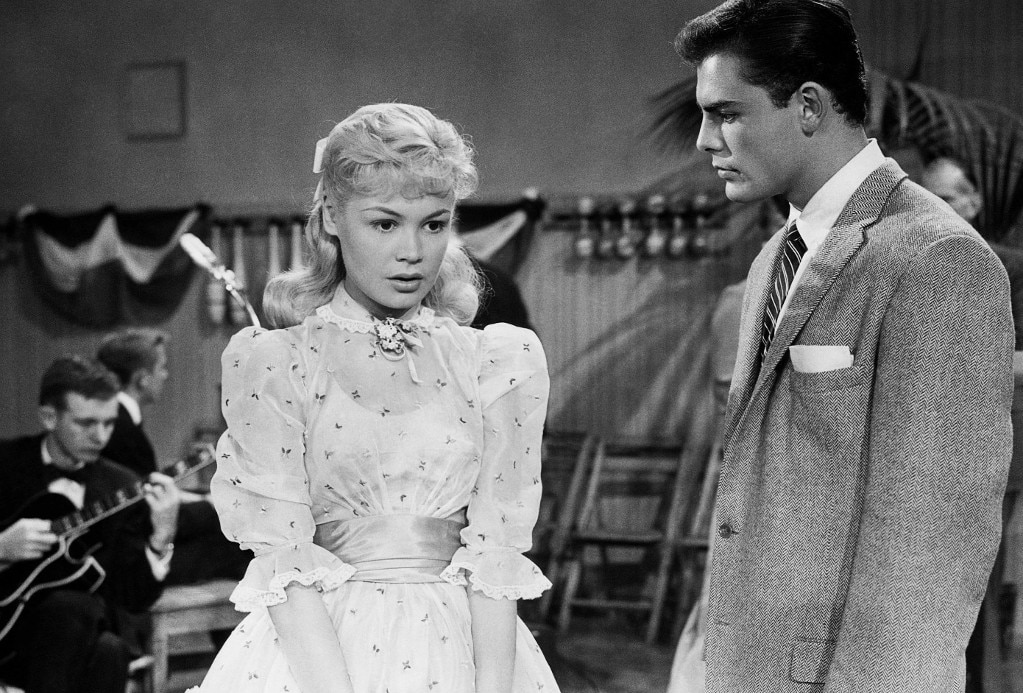
"The story of a small town with a dirty mind!" read the poster for The Restless Years (aka Teach Me To Cry) (1958), one of many films in the 1950s that dealt with both the problems of teenagers and morally weak adults, and the pettiness of small towns. Based on the play by Patricia Joudry, it tells the story of sixteen-year-old Melinda Grant (Sandra Dee, in her first starring role) who is shunned by her classmates when it is rumored that she is illegitimate, despite her emotionally disturbed and overly-protective mother, Elizabeth's (Teresa Wright) claims that her husband died when Melinda was a baby. Melinda meets new student Will Henderson (John Saxon, in his first of three films opposite Sandra Dee), and the two outcasts bond at a school dance. Will's parents warn him to stay away from "bad girl" Melinda because she could ruin their chances of social success and potential business contacts, but Will has fallen in love. Also in the cast were James Whitmore, Margaret Lindsay, Virginia Grey, Hayden Rorke, Luana Patten, and Jody McCrea, the son of Joel McCrea and Frances Dee.
The Restless Years is a soap opera in the vein of Peyton Place where everyone has a secret and nearly everyone is scheming and backstabbing, whether for financial dominance, upward mobility, or as little as the lead in a high school play. There are plenty of sexual undertones, with Melinda avoiding seduction, being given ominous warning by her mother, then falsely accused of being Will's lover, and finally, learning the truth about her father.
Under the working titles The Wonderful Years and Bandstand, The Restless Years was produced by Ross Hunter, who was responsible for Sandra Dee's film career. He had signed the former child model to a personal contract for The Restless Years but loaned her out to MGM for two films because Universal didn't think she was ready for them. Instead of telling Dee and undermining her confidence, he let her believe that she was signed to the studio, which was more glamorous and important than being under contract to a producer. Once she had made her mark at MGM, she was officially signed and became one of the last contract players at Universal. Now ready to go with The Restless Years, Hunter chose Helmut Kautner to direct from a screenplay by Edward Anhalt. It was a quick shoot at the studio, with production lasting only from late August to late September 1957.
Released over a year later, in December 1958, The Restless Years did solid business at the box office and earned good reviews by critics and industry publications like Motion Picture Daily who praised "seasoned performers" like Wright, Whitmore and Lindsay as well as "bright newcomers as John Saxon, Sandra Dee, Luana Patten, and Jody McCrea." Teresa Wright was given a special award in New York by The General Federation of Women's Clubs of America for her performance in the film, and Sandra Dee would go on to make several more films through the 1950s and 1960s.
By Lorraine LoBianco
SOURCES:
http://www.afi.com/members/catalog/DetailView.aspx?s=&Movie=52704
"Award for Miss Wright" Motion Picture Daily Dec 58
Berns, Samuel "The Restless Years: Universal - CinemaScope" Motion Picture 22 Oct 58
Kashner, Sam and MacNair, Jennifer The Bad & the Beautiful: Hollywood in the Fifties
Staggs, Sam Born to Be Hurt: The Untold Story of Imitation of Life
The Restless Years
by Lorraine LoBianco | July 18, 2017
SIGN UP FOR OUR NEWSLETTERS

CONNECT WITH TCM