The Wife Takes a Flyer
The Wife Takes a Flyer starts with the kind of disclaimer you don't see very often: "The resemblance of our characters to any Nazi military figures is intentional and not coincidental and is done with premeditation and extreme malice aforethought." That's because this broad, unsubtle comedy premiered in 1942, when the United States was fighting the Second World War and Hollywood was no longer worried about losing overseas distribution by insulting foreign powers. The film aims insults aplenty at the German military, the Nazi party, and the Fuhrer, and there's some disrespect for the Japanese emperor as well. This isn't a polite movie, but it has the same disdain for master-race oppressors that powered Michael Curtiz's immortal Casablanca, the Ernst Lubitsch classic To Be or Not to Be, and the great Walt Disney cartoon Der Fuehrer's Face, which were also released in 1942, a very good year for anti-Nazi cinema.
The story takes place in Nazi-occupied Holland, where the Gestapo is searching for Christopher Reynolds, an American who served in Britain's Royal Air Force until he was shot down. The head of the hunting party is Major Zellfritz, the most bumbling and self-important Nazi officer this side of Colonel Klink in the 1965-71 sitcom Hogan's Heroes. Christopher finds shelter in the mildly dysfunctional Woverman household, where family members give him a place to stay and pass him off as one of their own, letting him borrow the identity of hard-drinking Hendrik Woverman, who's in rehab at a sanatorium.
The real Hendrik is married to Anita Woverman, the heroine of the story, and as soon as Christopher sees her he wishes she were more than just his make-believe wife. Further complicating things, Major Zellfritz starts wooing Anita, showering her with flowers that accomplish nothing beyond making her sneeze. Lying low in the Woverman house, Christopher looks for chances to continue his anti-Nazi work, eventually recruiting Anita to do some spying as well. On top of all this, Anita needs to divorce Hendrik but the bogus "Hendrik" would rather stay "married," and there's a strong chance that the actual Hendrik will get discharged from the sanatorium and suddenly show up, blowing Christopher's cover and getting the Woverman clan in hugely serious trouble with the Nazi overlords.
The screenplay by Gina Kaus and Jay Dratler structures the story as a series of extended set pieces, limiting the number of settings for what appears to have been a modestly budgeted production. Many scenes unfold in the Woverman living room; there's a long sequence in a divorce court; later scenes transpire in a home for old ladies where Anita takes up residence after the divorce; and the climax happens in a Nazi court where Christopher is on trial for his life. The picture was directed by the undistinguished but prolific Richard Wallace, who gives the tale enough visual energy to keep it from seeming terribly static or repetitive.
The Wife Takes a Flyer was released in Britain as A Yank in Dutch, and the silliness of its punning titles indicates the silliness of the movie. There are puns in the screenplay too - when someone asks what country supplied a cooked chicken that Major Zellfritz brings for dinner, for instance, he replies that "every country gives us the bird." The movie also has cleverer touches here and there, as when Christopher sends a covert signal to an anti-Nazi sympathizer by peeling away part of the label on a beer bottle, turning "DRAFT" into "RAF" right under the enemy's nose. There's a funny Three Stooges-style scene where a gaggle of Nazis fling so many "Heil Hitler" salutes in so small a space that they start slapping one another's heads, and I love the notes jotted down by the judge in the divorce court: after heading a piece of paper "she" and "he," the distinguished jurist scribbles an "x" or "o" when someone makes a good point or a bad one, turning the proceedings into a high-stakes game of tic-tac-toe.
Its mostly ridiculous content notwithstanding, The Wife Takes a Flyer takes a solid stand against the Axis powers, represented mainly by Major Zellfritz and the other Nazis but also by Emperor Hirohito of Japan, seen in a crudely drawn caricature at one point, and by Fascist ruler Benito Mussolini of Italy, who gets a rude reference or two. Nazi cruelty and callousness are threaded through the dialogue - "I enjoyed your coffee," Major Zellfritz remarks, "almost as much as I enjoyed the executions this morning" - and the stupidity of the major symbolizes the stupidity of master-race ideology. This said, not everyone appreciated the movie's use of heavy-hitting humor as a weapon. One naysayer was the influential New York Times critic Bosley Crowther, who wrote in his 1942 review, "Some one has said that we Americans will have come to a perilous pass when we can no longer laugh at our enemies - which, in one sense, may be true. But certainly the sort of laughter which [this film] limply woos is a token neither of wit nor a healthy respect for the foe." He went on to call the picture a "painfully labored comedy" with "unspeakably wretched" acting, an "embarrassingly stupid and off-key" script, and a concept that is "an insult to American intelligence."
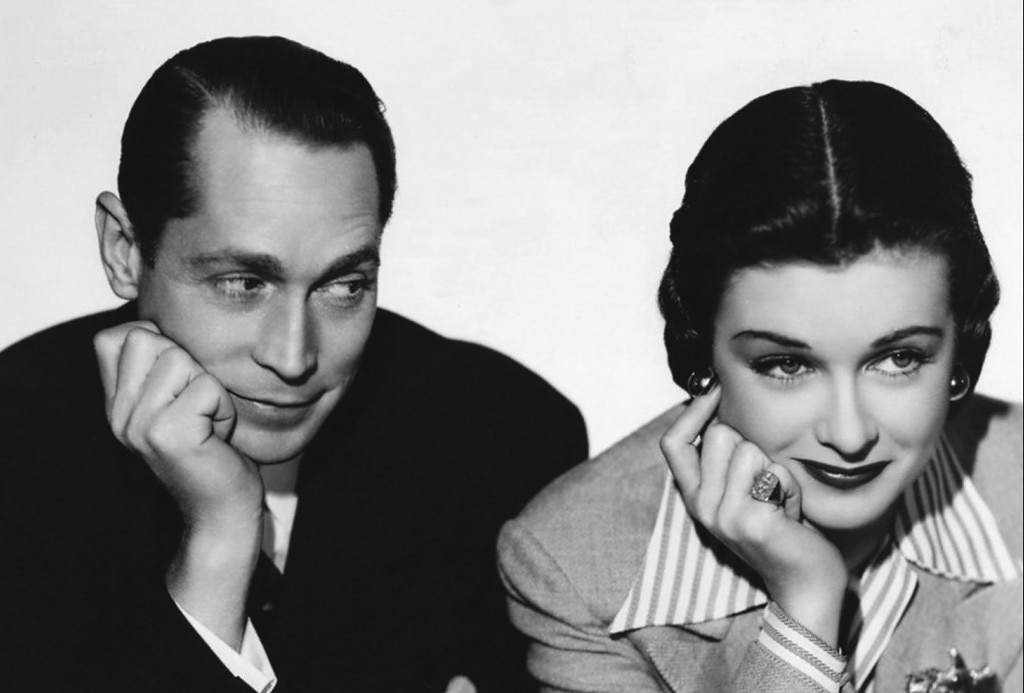
The Wife Takes a Flyer isn't nearly as bad as that, and although Allyn Joslyn gives an irritating one-note performance as Major Zellfritz, the topline stars - Joan Bennett as Anita and Franchot Tone as Christopher - are smooth as silk even when the story sags and the dialogue lags. Add in some snippy lawyer jokes and a terrific cameo by the marvelous Hans Conried as Hendrik, who barges into the narrative at last, and you have a moderately enjoyable exercise in Hollywood propaganda from the war-torn year of 1942.
Director: Richard Wallace
Producer: B.P. Schulberg
Screenplay: Gina Kaus, Jay Dratler; additional dialogue by Harry Segall
Cinematographer: Franz F. Planer
Film Editing: Gene Havlick
Art Direction: Lionel Banks
Music: Werner R. Heymann
With: Joan Bennett (Anita Woverman), Franchot Tone (Christopher Reynolds), Allyn Joslyn (Major Zellfritz), Cecil Cunningham (Countess Oldenburg), Roger Clark (Keith), Lloyd Corrigan (Thomas Woverman), Lyle Latell (Muller), Georgia Caine (Mrs. Woverman), Barbara Brown (Maria Woverman), Erskine Sanford (Jan), Chester Clute (Adolphe Bietjelboer), Hans Conried (Hendrik Woverman), Romaine Callender (Zanten), Aubrey Mather (Chief Justice), William Edmunds (Gustav), Curtis Railing (Mrs. Brandt), Nora Cecil (Miss Updike), Kurt Katch (Capt. Schmutnick), Margaret Seddon (Twin), Kate MacKenna (Twin)
BW-96m.
by David Sterritt
The Wife Takes a Flyer
by David Sterritt | July 17, 2017
SIGN UP FOR OUR NEWSLETTERS

CONNECT WITH TCM