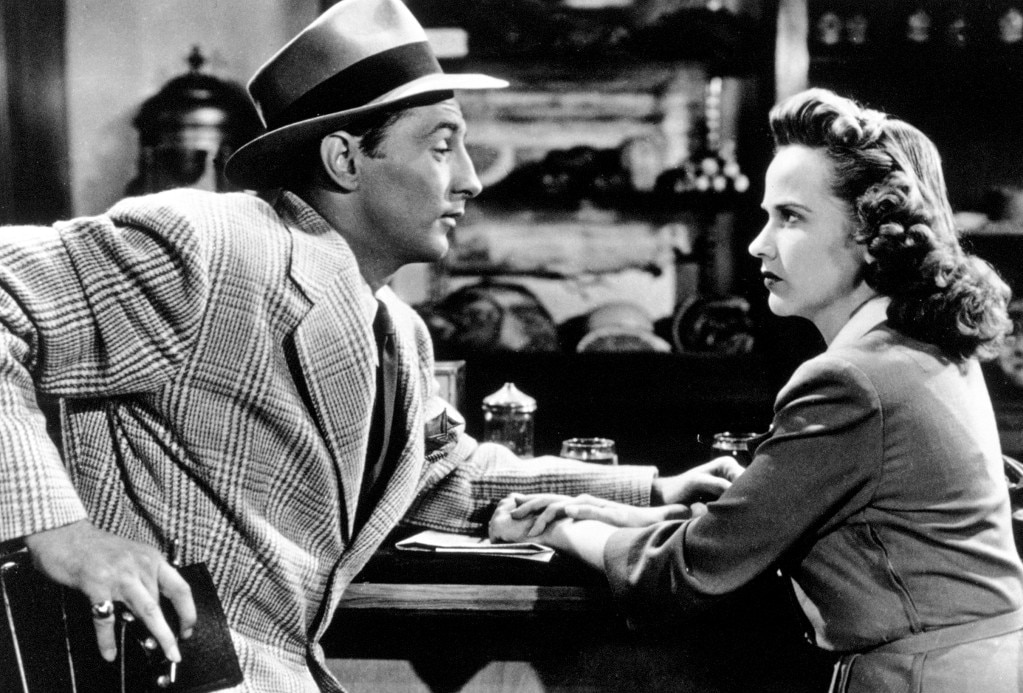
Many of those involved in When Strangers Marry (1944) (later re-released as Betrayed) had much bigger credits to come in their still-budding careers, but by sheer talent and creativity they elevated this little B picture for Monogram Pictures into something special. In fact, B movie historian Don Miller even wrote that When Strangers Marry is "unquestionably the finest B film made."
The project started with producers Frank, Maurice, and Herman King, of King Brothers Productions, who were making movies for peanuts in the early 1940s for Monogram. Former bootleggers and vending machine purveyors, they were colorful, cigar-chomping personalities who would later produce the classic film noir Gun Crazy (1950). At this point, they had churned out seven movies in recent years for PRC and Monogram, and for their next one they reached out to Columbia's Harry Cohn to borrow director William Castle, who had just impressed all of Hollywood with his creativity on The Whistler (1944), and who is now best remembered for The Tingler (1959).
Castle arrived for a meeting, and the Kings put him in a room to read a script. It was "miserable," Castle later wrote. "The dialogue was so bad an eight-year-old child could have done better." But it was just a test. The Kings knew it was terrible and they were hoping Castle would agree, so that they could then offer their real picture, at that point an unpublished story called Love From a Stranger. When he passed the test, Castle was introduced to screenwriter Philip Yordan, who would later make his mark as one of the top Western and epic writers in Hollywood. But at this point in early 1944, Yordan had just three B movies to his credit. He and Castle re-worked the story, adding elements they thought could work effectively for a low-budget quickie, and wound up with a simple but promising yarn of a woman arriving in New York from a small town to meet her new husband, whom she gradually suspects may be a killer. Yordan took the outline to writer Dennis J. Cooper and paid him to shape it into a screenplay, but Cooper's work, Yordan later said, was unsatisfactory: "I had to rewrite it, but I put his name on it."
The Kings loved the script and told Castle he had seven days to shoot it on a budget of $50,000. If he succeeded, they would pay him a bonus of $1000. They cast veteran supporting player Dean Jagger in the lead, along with virtual newcomer Kim Hunter (borrowed from David O. Selznick), and 27-year-old Robert Mitchum, who had been playing myriad bit parts for the past year or so including a small role in the Kings' Johnny Doesn't Live Here Anymore (1944). When Strangers Marry would turn out to be a key film in his nascent career, the first in which he significantly let loose the dark and "scary" side of his persona.
Because of the limited shooting time, Castle rounded up the cast for a week of rehearsals. Kim Hunter later said he asked the cast if they would be willing to do this for free, "'and you can't tell the King Brothers.' And we all said, 'Oh God yes, we'd love to rehearse.'" They met secretly in Castle's small apartment and worked out all the sequences in advance. "Thank God we had rehearsals," Hunter said, "because when we did go over to Monogram to start shooting there was no time to think. You moved from scene to scene. But Bill Castle was marvelous, and because of those days in [his] apartment we knew what we were doing."
Hunter added that the King brothers tried to intimidate Robert Mitchum into signing a multiyear contract, which he refused. According to Hunter, during the week of filming, Mitchum would "be sitting down, waiting for his next scene or something, and suddenly he would be surrounded...by chaps he swore had guns, and they were trying to talk him into signing. I know Bob was very glad when the film was over with because he was still alive! And believe me, we were all eager to get out of there, but Bob in particular was relieved." As it turned out, Mitchum soon signed a contract with RKO instead.
Castle drew inspiration from Alfred Hitchcock as well as producer Val Lewton's current low-budget chillers, and he succeeded in creating an effective New York City atmosphere entirely on studio sets. "I wanted the film to express the melancholia of being troubled and lonely in a strange city," Castle recounted. "Using dull, flat gray light throughout I managed to make the film stark and unrelenting, projecting the story as an actuality rather than something being enacted for a camera or audience. The terror was accentuated by the use of irritating sounds and quick cuts of grotesque and surprising images. But the miracle was that I managed to finish it in seven days, for $50,000. I got my $1,000 bonus."
When Strangers Marry wrapped in early August 1944, and was released a mere two weeks later. It drew the admiration of Orson Welles, who offered to make a movie with Castle, and rave reviews from just about everyone else. James Agee wrote in Time magazine: "I have seldom, for years now, seen one hour so energetically and sensibly used in a film." Trade paper Variety deemed the film a "taut psychological thriller about a murderer and a manhunt full of suspense and excitement. A superior sort of whodunit... Film has smart, fresh handling throughout, in scripting, direction and especially photography."
In some theaters, the picture opened on a double bill with One Mysterious Night (1944), a Boston Blackie film directed by Budd Boetticher and another example of film noir in the B movie world of 1944 Hollywood.
By Jeremy Arnold
SOURCES:
William Castle, Step Right Up! I'm Gonna Scare the Pants off America
Todd McCarthy and Charles Flynn, eds, Kings of the Bs
Patrick McGilligan, Backstory 2: Interviews With Screenwriters of the 1940s and 1950s
Don Miller, B Movies
Lee Server, Robert Mitchum: Baby, I Don't Care
When Strangers Marry
by Jeremy Arnold | July 13, 2017
SIGN UP FOR OUR NEWSLETTERS

CONNECT WITH TCM