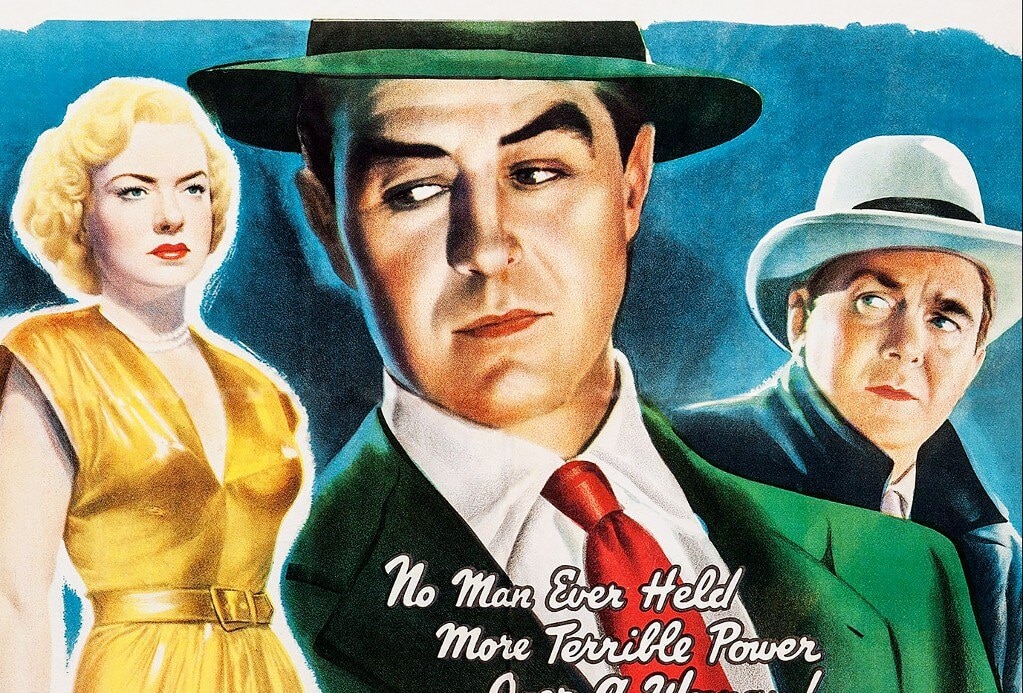
The devil gets top billing in Alias Nick Beal (1949). Ray Milland's Nick Beal isn't Satan, mind you, but his knack for appearing in locked rooms without anyone seeing him enter and disappearing just as mysteriously suggests a little black magic is involved and his endgame doesn't involve money or power but the corruption of a good man's soul. His target is District Attorney Joseph Foster (Thomas Mitchell), a paragon of virtue who runs a club for wayward boys and fights a losing battle against an organized crime boss. "I'd sell my soul to nail him," he confesses to a friend and, as if on cue, he's handed a cryptic note with an invitation to meet in a nearly derelict waterfront bar that is practically swallowed up in the fog. By the end of their meeting he crosses the legal line for the first time and justifies his moral compromise by citing the greater good. It's just the beginning of his compromises on his road to the Governor's mansion.
You could call Alias Nick Beal a morality play by way of film noir. Based on a story by Mindret Lord titled "Dr. Joe Faust," it's directed by John Farrow, who guided Milland through the noir classic The Big Clock (1949), and scripted by hard-boiled crime novelist Jonathan Latimer, a regular Farrow collaborator who wrote The Big Clock and The Night Has a Thousand Eyes (1948), another film noir that tipped into the supernatural. Cinematographer Lionel Linden contrasts Foster's busy, well-lit world with the shadowy atmosphere of Beal's presence as he tempts Foster, and he turns the waterfront set into a world literally lost in the fog for Beal's entrance and exit. And it proves the old acting adage "It's always more fun to play the villain." Milland won an Academy Award playing an alcoholic struggling with his demons in The Lost Weekend (1945) but was more often a romantic lead than a tormented protagonist and, at least at this point of his career, rarely a bad guy. He seems to relish the opportunity to inhabit such a commanding figure, playing the role with a dark charm, a suggestion of menace behind the cultured voice and intense eyes, and a sinister sense of humor to his temptations and manipulations.
Farrow was not necessarily well-liked by many of his actors--Milland described him as "the most disliked man at Paramount"--but he and Milland got along well. "Farrow was very good for me and very good with me," he told interviewer Barrie Pattison. Alias Nick Beal was the third of four pictures they made together. According to Milland, Farrow even incorporated some of his suggestions such as building the waterfront set so all the planes were out of true, "kind of cockeyed."
Paramount borrowed Audrey Totter from MGM for the role of the fallen woman transformed into a seductress by Beal. She had played femme fatales in Lady in the Lake (1947) and The Unsuspected (1947) but her character here is less icy and more ambivalent. Totter recalled the film fondly years, calling it a happy set, and she considers it one of "the best pictures I made."
Douglas Spencer, who has a small role as mob accountant Henry Finch, is known to film buffs as the reporter in The Thing From Another World (1951) and for supporting roles in Shane (1953) and The Diary of Anne Frank (1959), but along with scores of bit parts and uncredited appearances he was Milland's stand-in for decades. Milland rewarded his service with small parts in a number of his films.
"I consider the best picture I have ever made to be Alias Nick Beale," Farrow proclaimed in an interview years later. "This was a film made with both inspiration and honesty.... I said what I wanted to say, and the way I wanted to say it, without any studio interference." At least until the film was finished. Farrow and screenwriter Latimer called their film The Dark Circle. After seeing the finished film, recalls Farrow, "Paramount's New York office lost heart. They changed the ending and the title and then advertised it to fit its new name." The film was promoted as a straight crime thriller and, despite good reviews (the New York Times review, attributed simply to T.M.P., described it as "an arresting, expertly tuned morality drama calculated to hold attention the while it drives home a pointed lesson about the dangerous consequences of pride, greed and lust for power"), it didn't make much of a ripple in the U.S. Its reputation grew over the years, fueled in part by its rarity; Paramount never released the film to home video and it was rarely shown on TV. It makes Alias Nick Beal one of the most sought-after classics of its era.
Sources:
Femme Noir: Bad Girls of Film, Karen Burroughs Hannsberry. McFarland, 1998.
Wide-Eyed in Babylon, Ray Milland. William Morrorw & Company, 1974.
The Devil on Screen: Feature Films Worldwide, 1913 through 2000, Charles P. Mitchell. McFarland, 2010.
Dark City Dames: The Wicked Women of Film Noir, Eddie Muller. Regan Books, 2001.
Films Famous, Fanciful, Frolicsome & Fantastic, John Reid. Lulu.com, 2006.
AFI Catalog of Feature Films
"Morality Drama at the Paramount," movie review by T.M.P. The New York Times, March 10, 1949.
IMDb
By Sean Axmaker
Alias Nick Beal
by Sean Axmaker | July 12, 2017
SIGN UP FOR OUR NEWSLETTERS

CONNECT WITH TCM