"It comes as no surprise that J. Arthur Rank's latest film, Black Narcissus, from Rumer Godden's novel of the same name, is well up to the best British standards. What is surprising is the storm of protest registered against this sensitive study of missionaries in the Himalayas by more than 300 Roman Catholic nuns and priests in conference last month at Notre Dame University. Their chief complaint concerns a community of 'worldly, neurotic, and frustrated nuns,' and thus depicts an 'utterly abnormal case.' Although the conference made some good points about religious movies in general, the charges in this instance seem slightly exaggerated. Rank did not accede to the Catholic request that he label the film a 'unique case,' but he inserted a foreword explaining that these are Protestant nuns of the Anglican faith. In any case, the nuns, with one exception, are represented as splendid, steadfast women who, having taken on an impossible assignment, execute a strategic withdrawal. ...Among the many excellent qualities Black Narcissus has superb color shots and a uniformly fine cast which, besides Miss Kerr and Farrar, includes Flora Robson and Sabu - this time minus his elephant. Whatever its minor faults, this is a strangely disturbing film, full of subtle antagonisms, and adult and sympathetic in treatment." - Newsweek, August 18, 1947.
"Black Narcissus is the curious story of some Anglican nuns who, in the interests of healing and teaching the Himalayan natives, are sent to establish a new convent in an abandoned mountain harem....change brings no good for any of the Sisters. They are disturbed by the remoteness of the place and its unearthly quiet, by the winds, by the breath-taking beauty of the mountains. They are unsettled by the florid carnality of the murals which glow from the walls of the old pleasure house. And people trouble them as much as the place and its erotic past. A lush young native girl (Jean Simmons) and a splendidly dressed young nobleman (Sabu) come to the convent to learn the ways of God and of Western civilization, but stay to play peek-a-boo. The local nabob's insolent British handyman (David Farrar) lolls about the nunnery in shorts, displaying enough chest hair to stuff a kneeling cushion. ...The attempt to convey the idea that nuns are human beings is doubtless laudable and sincerely undertaken. But considering the fact that writer-directors Michael Powell and Emeric Pressburger made the excellent Colonel Blimp [1943], it is surprising how little they get across here, about human beings. The talk about the strange, compelling atmosphere of the place - a Lost Horizon routine in reverse - is just talk; lovely as some of the Technicolor photographs are, they bring little of the strangeness to the audience's eyes. Although some of the characters change, they change by sudden leaps & bounds, and without sufficient motivation. Messers. Powell and Pressburger have made the most of some melodramatic scenes and have hooked together many close-ups of uncommon sensitiveness and force. But in spite of a considerable lavishing of talent and good intention, Black Narcissus remains a striking sample of bad art, combining the least attractive features of slick and long-haired fiction. - Time, August 25, 1947.
"A curiously fascinating psychological study of the physical and spiritual tribulations that overwhelm five Protestant missionary nuns in the remote vastness of the Himalayas is unfolded with considerable dramatic emphasis in Black Narcissus. This English-made picture, presented yesterday by J. Arthur Rank and Universal-International at the Fulton Theatre in West Forty-Sixth Street, is a work of rare pictorial beauty. The awesome grandeur of the setting, a fantastic old place perched on a mountainside 8,000 feet above the floor of India but still dwarfed by the snow-capped peaks of Kanchenjunga, is stunningly reflected in Technicolor. Indeed, the whole chromatic scheme of the picture is marvelous to behold, and the russet hues of sunset streaking through the dilapidated Palace of Mopu, where once wine flowed and harem ladies cavorted, is a brilliant achievement in color composition. Michael Powell and Emeric Pressburger have come so close to executing a perfect fusion of all the elements of cinematic art - story, direction, performances, and photography - that one wishes they had hit upon a theme at once less controversial and more appealing than that of Black Narcissus. Not being familiar with Rumer Godden's novel, we don't know how closely the film adheres to its source. But that is of small consequence after all. What matters is that which they have imaged on celluloid, and that is an engrossing, provocative contemplation of the age-old conflict between the soul and the flesh. ...While Messrs. Powell and Pressburger may have a picture that will disturb and antagonize some, they also have in Black Narcissus an artistic accomplishment of no small proportions." Thomas M. Pryor, The New York Times, August 14, 1947.
"Interesting to compare with another version of a Rumer Godden story, Renoir's The River [1951], in that whereas Renoir shot on location in India and created an almost documentary feel to his film, Powell refused to go to the Himalayas and shot at Pinewood, coming up with a heady melodrama that treats India as a state of mind rather than a real country. ...Powell's use of color, design and music was never so perfectly in tune with the emotional complexities of Pressburger's script, their talents combining to create one of Britain's great cinematic masterpieces, a marvelous evocation of hysteria and repression, and incidentally one of the few genuinely erotic films ever to emerge from these sexually staid isles." - Geoff Andrew, Time Out Film Guide.
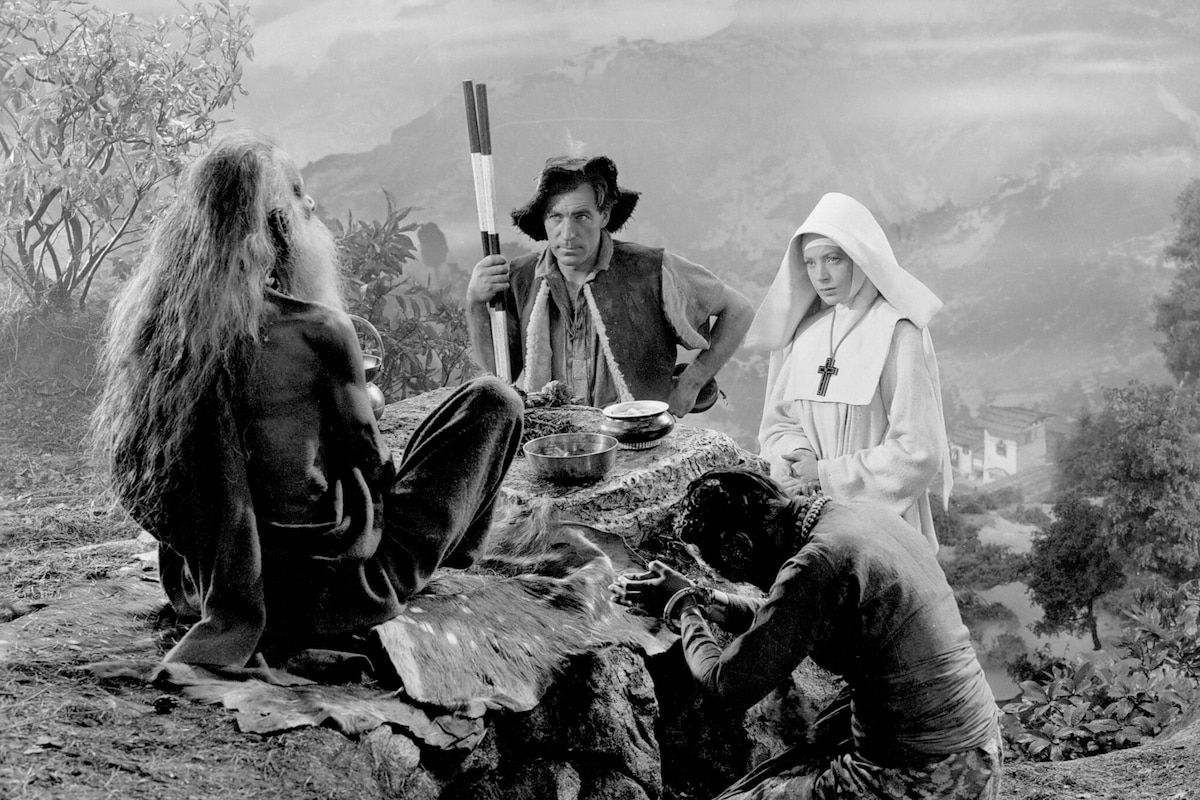
"Black Narcissus is one of [Powell and Pressburger's] enduring films, but it is also very much of its time: an era when sex on screen meant smoldering glances, when Technicolor was gloriously fresh. Deborah Kerr plays the self-disciplined Sister Clodagh, fighting back memories of a lost romance. David Farrar is the exquisitely handsome Englishman who manages the rajah's estate and drives the sisters mad. Kathleen Byron gives an over-the-top performance as the hysterical Sister Ruth. Her eyes seem to glow red with demonic possession, but don't worry: it's just that old devil Lust trying to escape. The campy edge the film has acquired over the years does nothing to diminish its stature, for Black Narcissus was always a hothouse flower. Though it looks gorgeously exotic, it was filmed at Pinewood Studios in London, often with painted backdrops. (When the wind whistles through the high windows of the palace, notice that the clouds don't move). Some scenes were filmed at an estate in Surrey, where a one-time English military man planted a tropical garden to remind him of India. The artificial touches only enhance the storybook quality that was always one of the Archers' great strengths." - Caryn James, The New York Times, March 17, 1995.
"Visually sumptuous, dramatically charged movie, from Rumer Godden novel, about nuns trying to establish a mission in a remote Himalayan outpost amid formidable physical and emotional challenges. One of the most breathtaking color films ever made (winning Oscar®s for cinematographer Jack Cardiff and art director Alfred Junge). Scenes in which Mother Superior Kerr recalls her former life, a key plot element, were originally censored from American prints." - Leonard Maltin's Classic Movie Guide.
"Black Narcissus is that rare thing, an erotic English film about the fantasies of nuns, startling whenever Kathleen Bryon is involved." - David Thomson, The New Biographical Dictionary of Film (Alfred A. Knopf.
"Cynics may dub this lavish production Brief Encounter in the Himalayas and not without reason. Stripped of most of its finery, the picture...resolves itself into the story of two sex-starved women and a man...Most effective acting comes from Kathleen Bryon who has the picture's plum as the neurotic half-crazed Sister Ruth." - Variety Movie Guide (Prentice-Hall).
"An unlikely theme produces one of the cinema's most beautiful films, a visual and emotional stunner despite some narrative uncertainty." - Halliwell's Film & Video Guide (HarperPerennial).
"It is a rare treat to see nuns that don't want to sing or dance but serve God, just as it is a rare feat for the Archers...to produce a subtly erotic film about nuns. The Himalayan scenery is especially remarkable because it sets the mood of the film perfectly and was all created on a sound stage at Pinewood." - The Rough Guide to Cult Movies (Penguin).
"An erotic masterpiece about nuns!...Picture is splendidly acted, uncompromisingly written - surprising choices are made constantly - and ranks as one of the most stunningly beautiful color films of all time..." - Danny Peary, Guide For the Film Fanatic (Fireside).
" It remains a rapturous, near-indescribable work of cinematic art, spun from a simple story about nuns who travel to the Himalayas to start a school and a hospital, only to have mountain winds and native mysticism weaken their confidence and their faith. The title refers to an exotic perfume that clouds the air around their mission, redirecting the thoughts of the mother superior (Deborah Kerr) to the sensuous world she meant to leave behind." - Noel Murray, The Onion A.V. Club.
"The co-directors created from Rumer Godden's novel an extraordinary melodrama of repressed love and Forsterian Englishness - or rather Irishness - coming unglued in the vertiginous landscape of South Asia..Particularly affected is Sister Ruth - a magnificent performance from Kathleen Byron - who conceives an erotomaniacal obsession for Dean, and her final appearance in the film, gaunt and wraithlike, is still one of the scariest moments in British cinema history. The studio sets and backdrops are superbly and still convincingly rendered, and the film looks more beautiful than ever." - Peter Bradshaw, The Guardian.
Awards and Honors:
Black Narcissus won an Oscar® in 1947 in two categories:
Best Color Art Direction: Alfred Junge
Best Color Cinematography: Jack Cardiff
In addition, Jack Cardiff also won a 1947 Golden Globe award for Color Cinematography.
Deborah Kerr was given the 1947 Best Actress award by the New York Film Critics Circle, and Kathleen Byron received a nomination in the same category.
Compiled by John M. Miller & Jeff Stafford
The Critics Corner: BLACK NARCISSUS
by John M. Miller & Jeff Stafford | March 05, 2012
SIGN UP FOR OUR NEWSLETTERS

CONNECT WITH TCM