At the end of World War II, motion picture facilities in Britain were coming back into civilian use following service toward the war effort, and Michael Powell and Emeric Pressburger, as the independent production entity known as The Archers, had a decision to make. During the war, J. Arthur Rank had acquired both of the premiere facilities in England - Denham Studios and Pinewood Studios - and The Archers were able to choose one as their base of operations. Previously they had worked at Denham but now opted for the newer Pinewood. It would prove to be an important decision because Powell surprised everyone on staff during planning for Black Narcissus by announcing that not a frame of the film would be shot on location in India - it would be entirely produced at Pinewood. Scenes set in the forbidding palace high on the Himalayan peaks would rely on the talents of production designer Alfred Junge and his team. For scenes set in the lush valley below, Powell had an idea for location shooting, but in a spot much closer to home; Horsham, to be exact. "There's a famous house and gardens there called Leonardslee. It has one of the most famous sub-tropical gardens in England," Powell wrote in his autobiography. "...British merchant princes and pro-consuls when they retired and come back to Britain to live, would bring whole trees and bushes wrapped in matting to remind them of India. Himalayan plants and trees do well in the British climate." Powell wanted to keep the design and look of Black Narcissus consistent and completely under his control, feeling that mood and atmosphere was the key to the picture. He said, "If we went to India and shot a lot of exteriors, according to the usual plan, and then came back to Pinewood and then tried to match them here, you would have two kinds of colour and two kinds of style."
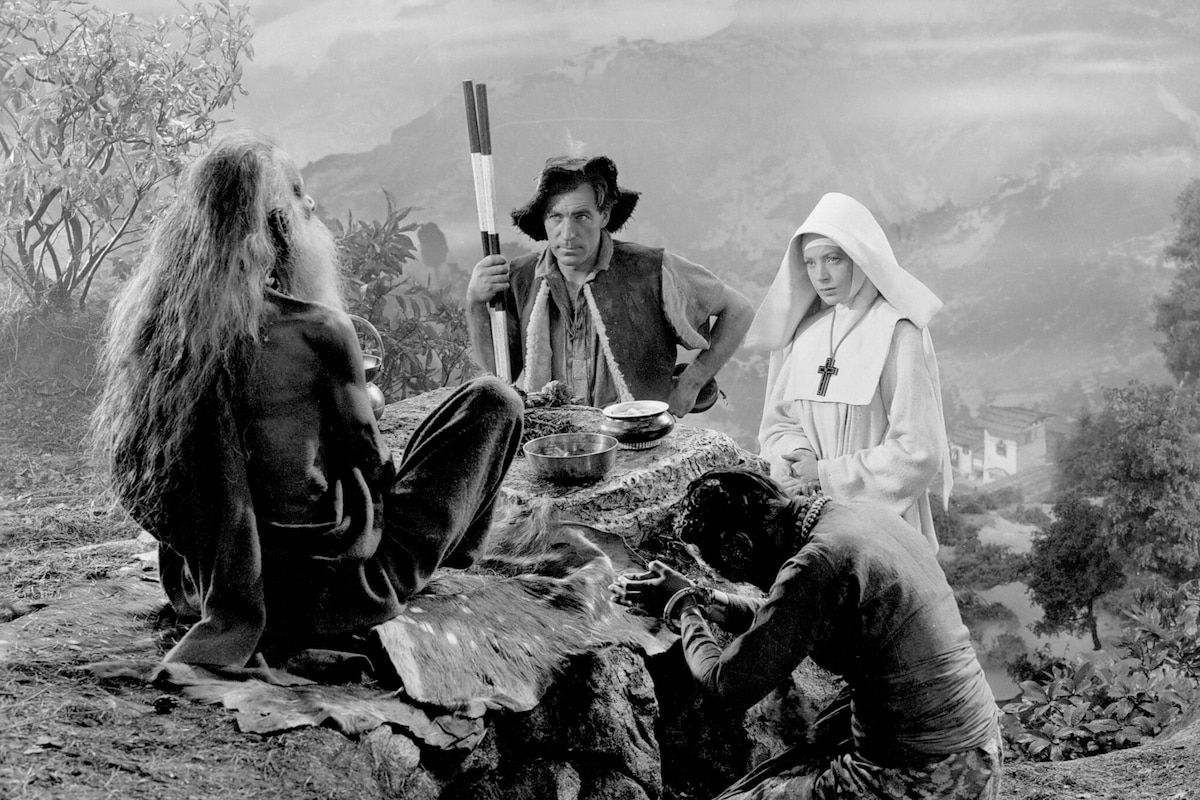
Principal photography for Black Narcissus took place at Pinewood Studios between May 16 and August 22, 1946. Junge tackled the formidable task of creating the Himalayas on stages and back lots. He made extensive use of huge canvas backdrops, painted with vibrant Himalayan landscapes. The backdrops, which naturally hid the actual English countryside, were tilted back at a 35 degree angle to eliminate shadows and soak up as much of the sun as possible, allowing for more hours of shooting time. Broader vistas, including the shots which establish the precarious cliff-side setting of the palace, were accomplished in post-production with glass shots and matte paintings.
Cinematographer Jack Cardiff drew inspiration for his shots from the great painters; he experimented with the tones of Van Gogh, for example, or the reds and greens from Rembrandt. In her British Film Guide book on Black Narcissus Sarah Smith quotes Cardiff, who explained the influence of Vermeer and Caravaggio: "They both lit with very simple light. Many painters did, but with Vermeer and Caravaggio you were very conscious of it; they really used the shadows. Caravaggio would just have one sweeping light over everything so that you were aware of the single light." The resulting lighting was unusual for Technicolor films of the time, and initially caused concern for Technicolor consultant Natalie Kalmus. She grew to appreciate the look Cardiff was creating once she saw the initial rushes, however.
For the scenes depicting the villagers, Powell and his team had a ready supply of extras. As Powell wrote, "...when the war was just over, there was an immense floating population of Asians around London Docks, and we had no difficulty in building up a list of extras for the crowd scenes: Malays, Indians, Gurkhas, Nepalese, Hindus, Pakistanis, hundreds of them. We formed groups of different castes and races, and each group had a leader."
Powell and Pressburger had parted ways from the composer of many of their early films, Allan Gray, and Powell sought out a new composer for Black Narcissus, one who would share his "operatic" vision of the film. Carol Reed suggested Brian Easdale, whom Reed had met in India while working on a wartime documentary. Powell was anxious to use "...someone who was my superior in musical thought, a collaborator who would lead me out of my depth and whom I could tempt even further out of his." Powell also had something else in mind: the chance to create a sequence of "composed film" - that is, a section of the film that is pre-scored and which could be shot directly in time to music. As Powell later wrote, "we settled upon the sequence which followed the rejection of Sister Ruth by Mr. Dean. It starts with Sister Clodagh haunted by her conscience and literally haunted by Sister Ruth, bent upon her murder." Easdale scored this section of the script, and a piano track was recorded. A playback of this track was used as a guide in shooting the sequence. Powell elaborated, "It was planned step by step, bar by bar, by Brian and myself. I wanted to get the maximum suspense out of the cat-and-mouse play between the two women and we succeeded. The crew were amazed when Brian and I appeared with stopwatches and exact timings when we started to shoot the sequence." Later, during final recording, Easdale replaced the piano track with a thirty-eight piece orchestra and a choir of a dozen voices. (Powell and Pressburger's next film, The Red Shoes (1948), would push the possibilities of the composed film even further).
The last scene in the film, of the rains beginning as Mr. Dean watches the Sisters leaving Mopu, was carefully devised. It was Cardiff's idea to have a few initial drops of rain hitting the foreground flowers. Cardiff was to later regret this brainstorm, however. There was originally meant to be a concluding scene, in which Sister Clodagh returns to Calcutta and speaks with the Mother Superior. Cardiff thought that this sequence featured some of the best work of his career, but the power of the rain scenes demanded that they end the film. (This editing decision was probably made by Pressburger, who usually supervised the cutting of films by The Archers).
Black Narcissus was released in Great Britain on May 26, 1947 by the Rank Organisation. Through The Archers' deal with Rank, the film was assured solid distribution in the United States, because Rank had entered into an agreement with Universal Studios in 1946 which resulted in the distribution arm Universal-International. As it turned out, the film only had spotty distribution in America, due to censorship problems. Powell later observed, "...they couldn't leave a picture with nuns in it alone." Powell and Pressburger were actually aware of the potential for censorship trouble in America before the film was shot. In April of 1945, a rough draft of the script was submitted to Joseph Breen at the Production Code Administration. Breen outlined his initial concerns to Rank: "While the story is not quite clear and concise, to us it has about it a flavor of sex sin in connection with certain of the nuns, which, in our judgment, is not good." The Breen office, however, passed the finished film in June 1947, but on the condition that a foreword was added making it clear that the nuns were Anglo, rather than Roman Catholic. Indeed, it was with the Catholic Legion of Decency that Rank encountered the most problems. The Legion of Decency launched a campaign against the film's release as early as April 1946, when the Archbishop of Calcutta began writing about the production. Predictably, when the film was reviewed by the Catholic weekly The Tidings, published in Los Angeles, the judgment was harsh: "It is a long time since the American public has been handed such a perverted specimen of bad taste, vicious inaccuracies and ludicrous improbabilities." When the Legion of Decency screened the film, it was given a "C" classification, or "Condemned." Street reported that "out of thirteen Fathers, eight gave it a 'C' rating, the rest recommending A2, unobjectionable for adults."
The Legion of Decency still held great sway on filmgoing habits in America, and a Condemned film would eliminate a huge number of ticket sales. The film had already opened in New York and Los Angeles, but the ban interfered with scheduled openings in other cities, such as Detroit and Memphis. Rank was in a bad position. Parliament had just imposed a 75 percent duty on American films imported to England, and Hollywood was temporarily boycotting the British market. The few British films that could play well in America were encouraged as a goodwill gesture, so Rank was anxious that Black Narcissus play in as many American cities as possible. The only option they saw was to make cuts to the film to satisfy the Legion of Decency. So in September, 1947, the film was edited by 900 feet or so - ten cuts in all. All of Sister Clodagh's memories of Ireland were cut, accounting for most of the offending footage. The close-up of Sister Ruth applying lipstick also fell victim to censorship, and a few lines of suggestive dialogue were also eliminated, for example Mr. Dean's line to Sister Briony, "You will be doing me a great favor when you educate the local girls." Finally, the wording of the foreword was changed so that there would be no mistaking that the order of nuns might be Catholic; now it said that "a group of Protestant nuns in mysterious India find adventure, sacrifice, and tragedy." Now satisfied, the ban was removed and the film was released with an A2 classification from the Legion.
by John M. Miller
Behind the Camera
by John M. Miller | March 05, 2012
SIGN UP FOR OUR NEWSLETTERS

CONNECT WITH TCM