During World War II, British actress Mary Morris introduced director Michael Powell to a new novel, Black Narcissus, by Rumer Godden. Morris and Powell had both worked on the elaborate Alexander Korda fantasy film The Thief of Bagdad (1940), and Morris thought that the Godden book would make a great film and supply a plum acting role for herself. Powell immediately took to the book. As he later wrote in his autobiography A Life in Movies, "I could see that the story, so coolly told in excellent prose, would be wildly exotic and erotic on the screen." Powell's filmmaking partner, Emeric Pressburger, needed little prodding on the subject; Pressburger's wife Wendy had previously brought the book to his attention and he had already started making inquiries about the film rights to the novel. Negotiations for the rights were carried on as the pair completed post-production on their latest film, A Matter of Life and Death (1946, a.k.a. Stairway to Heaven).
About the scripting chore Powell later wrote, "...we had always written our own original stories, as well as the film script... and I was nervous about tackling an adaptation from a book. The elements that make a book a success are not the same as those that make for a good film, and I had learnt to know the difference." Powell admired the job that Pressburger had done on the script, however, and as time went on, he was "...almost persuaded that we had written the original story ourselves."
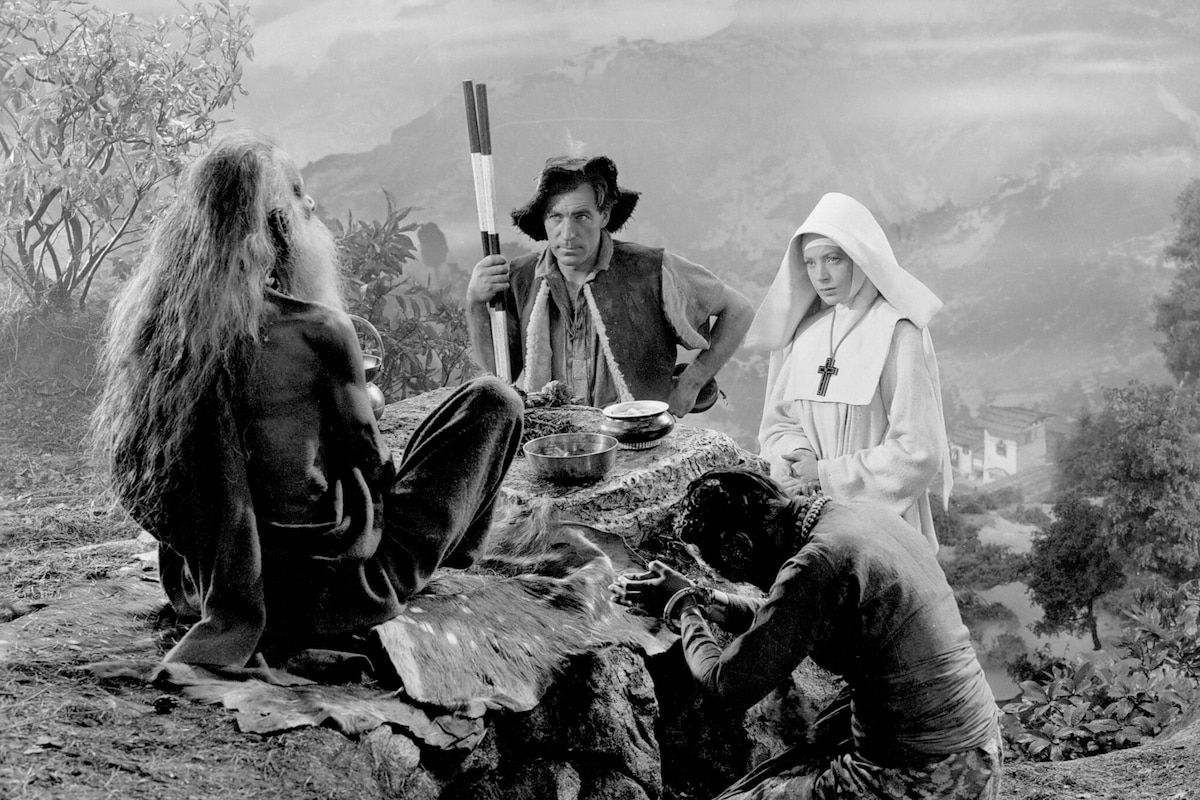
Powell went about the task of casting the film. Although Mary Morris had wanted to play the key role of Sister Ruth, Powell gave it to Kathleen Byron: "She was young, confident and unusual looking, with extraordinary big eyes and a long pointed nose. I thought she could do it." Powell had also, he wrote, been having an extra-marital affair with the actress. For the lead role of Sister Clodagh, Powell was initially keen on trying to persuade Greta Garbo to emerge from retirement, but Pressburger was insistent on trying to get Deborah Kerr. Powell said, "I laughed at the idea. I turned it down flat. She was too young, far too young, ten years too young." Powell quotes Pressburger as saying, "'If she were as old as Garbo, you'd want her to look ten years younger than she is. Deborah is twenty-six and can easily look thirty-six. And she won't mind doing it, either.'" Kerr was in a curious position by 1947. She was just coming into her own, but with little help from the studio that held her contract, Metro-Goldwyn-Mayer. MGM signed her in 1943, but in the intervening years she had continued to work in Britain.
For the role of the erotic young Indian girl Kanchi, Powell wanted teenager Jean Simmons, who had recently made a mark as Young Estella in David Lean's adaptation of Dickens' Great Expectations (1946). Powell's friend Lawrence Olivier also wanted Simmons, to play Ophelia in his film version of Hamlet (1948). Though scheduling allowed the actress to play both parts, Powell and Olivier playfully wrote back and forth over the competitive casting; at one point Olivier wrote, "Dear Micky, how you could imagine that a typical English teenager, straight from the vicarage, can play a piece of Indian tail, beats me. I enclose a book of erotic Indian pictures to help your casting director. Love, Larry."
David Farrar was cast as the estate manager Mr. Dean; "He reminded me in looks of Gary Cooper," Powell later wrote. First, Powell and Pressburger shot a test in color of the actor. According to Powell, Farrar "burnt up the screen," so the two not only cast him for the film, they also signed him to a three-picture contract with The Archers. As the young prince, Powell cast Indian actor Sabu, star of such Korda Brothers films as Elephant Boy (1937), Jungle Book (1942), and The Thief of Bagdad, which Powell had co-directed. Powell later wrote that the part of the Young General was "tailor-made" for the actor, and that "when he replied enthusiastically, we enlarged the part. Sabu was shrewd and soon saw this was no ordinary film, and he was proud to be in it."
by John M. Miller
The Big Idea
by John M. Miller | March 05, 2012
SIGN UP FOR OUR NEWSLETTERS

CONNECT WITH TCM