In 1919, a young Frank Capra had his first brush with picture-making when he got work as an extra on the western The Outcasts of Poker Flat (1919). The movie was shooting on the Sacramento River near where Capra found temporary work on a ranch. The film's director was Jack (later John) Ford, and the star was Harry Carey. Capra told Carey that he was interested in a career in movies, and got some encouragement from the actor, who was already a film veteran, having started in D. W. Griffith's stock company of players. Twenty years later, Capra was able to repay Carey for his kindness, by casting him in the key supporting role of Vice President in Mr. Smith Goes to Washington.
The film rights to The Gentleman from Montana, Lewis R. Foster's story which was the basis for Mr. Smith Goes to Washington, had originally been purchased by director Rouben Mamoulian (Dr. Jekyll and Mr. Hyde, 1931). Harry Cohn offered Mamoulian $75,000 for the rights, but the director turned it down. Mamoulian had another ploy in mind; he was anxious to direct Golden Boy (1939) for Columbia, so after Cohn agreed, Mamoulian sold Cohn the rights for the same amount he paid: $1,500.
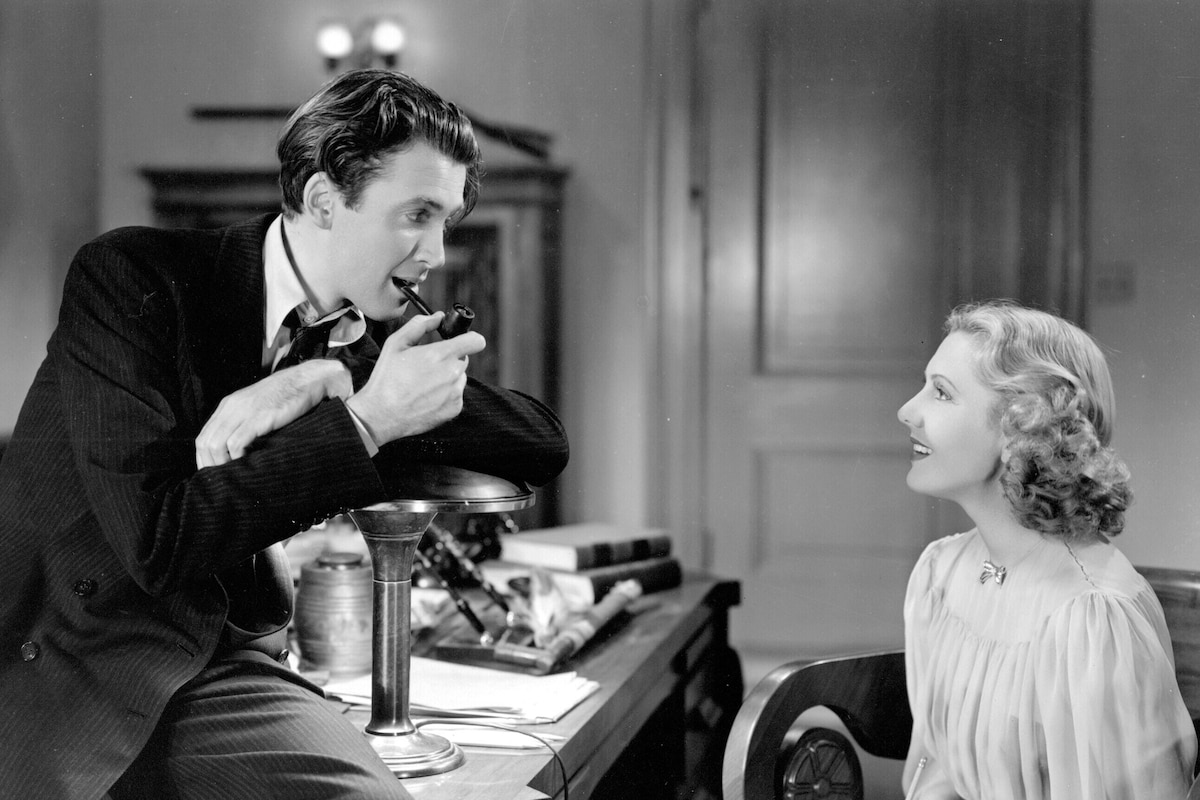
For a key scene in Mr. Smith Goes to Washington in which a drunk Saunders (Jean Arthur) must admit to herself that she is in love with naive Jefferson Smith, Frank Capra turned for help to another director with a strong story sense, Howard Hawks. Hawks made suggestions for the scene, which was ultimately played as a single two-shot with no cuts - playing off Thomas Mitchell, the scene was a tour-de-force for Arthur.
Character actress Beulah Bondi played Ma Smith, Jeff's mother in Mr. Smith Goes to Washington, marking the third of five times that the actress played mother to a character played by James Stewart. Previously, she appeared with Stewart in Of Human Hearts and Vivacious Lady (both 1938), and subsequently she would play Ma Bailey in It's a Wonderful Life (1946), and then twenty-five years later play the mother of Stewart's character again in an episode of the latter's TV series, The Jimmy Stewart Show (1971).
Jean Arthur was sensitive about being photographed on her "good side," so in pre-production, care was taken in set design and construction so that her entrances showed only the "good" side of her face.
One of the fondly remembered scenes in Mr. Smith Goes to Washington is the tourist trip that Jeff Smith takes upon arriving in the nation's Capital. The montage of monuments and patriotic images was compiled by Slavko Vorkapich. Originally from Serbia, Vorkapich began his career as a cinematographer in the silent era, then specialized in photographic effects and special transitions in films such as Dancing Lady (1933) and Viva Villa! (1934). He began creating montage effects with spectacular work in San Francisco (1936), and thereafter was credited for montage sequences for such films as The Good Earth (1937), Maytime (1937), Test Pilot (1938), and The Crowd Roars (1938). He worked with Capra again on Meet John Doe (1941).
FAMOUS QUOTES from MR. SMITH GOES TO WASHINGTON (1939)
Governor Happy Hopper (Guy Kibbee): [Jefferson Smith is] a big-eyed Patriot, knows Lincoln and Washington by heart, stands at attention in the Governor's presence, even collects stray boys and cats. A perfect man, never in politics in his life, wouldn't know what it was all about in two years, let alone two months.
Jefferson Smith (James Stewart): ...Dad used to tell me that Joe Paine was the finest man he ever knew. I don't think I'm gonna be much help to you down there in Washington, Senator. I'll do my best. With all my might, I can promise you one thing - I'll do nothing to disgrace the office of the United States Senate.
Jefferson Smith: Dad always used to say the only causes worth fighting for were the lost causes.
Clarissa Saunders (Jean Arthur): Daniel Boone's lost...Lost in the wilds of Washington...The Boy Ranger, aw, he'll show up. He must have a compass with him.
Jefferson Smith: I don't think I've ever been so thrilled in my whole life, and that Lincoln Memorial! Gee Whiz! And Mr. Lincoln, there he is. He's just lookin' right straight at you as you come up those steps. Just - just sitting there like he was waiting for somebody to come along.
Saunders: Look Senator, I wasn't given a brain just to tell a Boy Ranger what time it is.
Senator Joseph Paine (Claude Rains): Don't be a fool, Saunders. If certain things happen, I'm taking everybody up with me and you'll get one of the biggest jobs in Washington.
Diz Moore (Thomas Mitchell): See you got Daniel Boone in all right.
Saunders: Daniel in the lion's den.
Jefferson Smith: Why don't you tell the truth for a change?
Sweeney Farrell (Jack Carson): How do you want it Senator? Dished out or in a bottle?
Jefferson Smith: People in this country pick up their papers and what do they read?
Diz: Well, this morning, they read that an incompetent clown had arrived in Washington, parading like a member of the Senate.
Jefferson Smith: (Pointing out the window) That's what's got to be in it!
Saunders: What?
Jefferson Smith: The Capitol Dome.
Saunders: On paper?
Jefferson Smith: I want to make that come to life for every boy in this land. Yes, and all lighted up like that too! You see, you see, boys forget what their country means by just reading 'the land of the free' in history books. And they get to be men - they forget even more. Liberty's too precious a thing to be buried in books, Miss Saunders. Men should hold it up in front of them every single day of their lives and say: 'I'm free to think and to speak. My ancestors couldn't. I can. And my children will.' Boys want to grow up remembering that.
Jefferson Smith: My dad had the right idea. And it all worked out. He used to say to me: 'Son, don't miss the wonders that surround you because every tree, every rock, every anthill, every star is filled with the wonders of nature.' And he used to say to me: 'Have you ever noticed how grateful you are to see daylight again after coming through a long dark tunnel?' 'Well,' he'd say, 'Always try to see life around you as if you'd just come out of a tunnel.'
Saunders: I wonder Diz, if this Don Quixote hasn't got the jump on all of us. I wonder if it isn't a curse to go through life wised up like you and me.
Saunders: Why don't you go home?...This is no place for you - you're half-way decent. You don't belong here. Now go home.
James Taylor (Edward Arnold): Either he falls in line with us and behaves himself or I'll break him so wide open they'll never be able to find the pieces.
Paine: You've got to face facts, Jeff. I've served our state well, haven't I? We have the lowest unemployment and the highest federal grants. But, well, I've had to compromise. I've had to play ball. You can't count on people voting. Half the time they don't vote anyway. That's how states and empires have been built since time began. Don't you understand?
Jefferson Smith: There are a lot of fancy words around this town. Some of them are carved in stone. Some of 'em, I guess the Taylors and Paines have put 'em up there so suckers like me can read 'em. Then when you find out what men actually do - Well, I'm gettin' out of this town so fast and away from all the words and the monuments and the whole rotten show.
Saunders: They aren't all Taylors and Paines in Washington. Their kind just throw big shadows, that's all. You didn't just have faith in Paine or any other living man. You had faith in something bigger than that. You had plain, decent, every day, common rightness. And this country could use some of that. Yeah - so could the whole cock-eyed world.
Jefferson Smith: I got up here and I started to open my mouth and the long and powerful arm of Mr. James Taylor reached into this sacred chamber and grabbed me by the scruff of the neck.
Jefferson Smith: And I'll tell you one thing, that wild horses aren't gonna drag me off this floor until those people have heard everything I've got to say, even if it takes all winter.
H. V. Kaltenborn (Himself): Half of official Washington is here to see democracy's finest show, the filibuster, the right to talk your head off, the American privilege of free speech in its most dramatic form. ...In the diplomatic gallery are the envoys of two dictator powers. They have come here to see what they can't see at home. Democracy in action.
Jefferson Smith: And I hate to stand here and try your patience like this, but either I'm dead right or I'm crazy!
Jefferson Smith: I guess this is just another lost cause, Mr. Paine. All you people don't know about the lost causes. Mr. Paine does. He said once they were the only causes worth fighting for. And he fought for them once, for the only reason that any man ever fights for them. Because of just one plain simple rule: 'Love thy neighbor.' And in this world today, full of hatred, a man who knows that one rule has a great trust. You know that rule, Mr. Paine. And I loved you for it, just as my father did. And you know that you fight for the lost causes harder than for any others. Yes, you even die for them.
Compiled by John Miller
Trivia - Triva and Fun Facts About MR. SMITH GOES TO WASHINGTON
by John Miller | May 09, 2011
SIGN UP FOR OUR NEWSLETTERS

CONNECT WITH TCM