Frank Capra faced a daunting logistical problem in filming the Senate scenes for Mr. Smith Goes to Washington. The Senate chamber had been faithfully recreated on the Columbia stages by art director Lionel Banks and a huge team of craftsmen, and the set was just that: a chamber. It was a tall, four-sided set filled with hundreds of people. Action required for the story would also be taking place simultaneously on three levels: the Senate floor, the rostrum where the Vice President sat, and the galleries holding the press, the pages, and the public. As Capra put it in his autobiography, "How to light, photograph, and record hundreds of scenes on three levels of a deep well, open only at the top, were the logistic nightmares that faced electricians, cameramen, and soundmen." Capra would also rely heavily on reaction shots of the many observers in the scenes set in the Senate chamber. He wanted to retain a natural flow to these shots and so, for these reasons, the usual one-camera set up could not be employed; "...we might still be there," Capra said. The technical team "...devised a multiple-camera, multiple-sound method of shooting which enabled us, in one big equipment move, to film as many as a half-dozen separate scenes before we made another big move."
Capra also described in his autobiography a novel way of keeping continuity in performances during the filming of close-ups. For example, in filming a master shot of a scene between Jean Arthur and fellow actors, the actors can obviously bounce lines off each other in a natural way, but what to do when shooting Arthur's close-up of the same scene? Capra says, "...I 'invented' a way to surround Jean Arthur in her close-up with the exact reality that had surrounded her in the master shot... The sound of the master shot was recorded not only on film, but on a record as well. When the master shot was approved, the sound department rushed the record back to the set and put it on a playback machine. Attached to my chair were a volume-control dial and a push button with which I could cut in or cut out the playback's loudspeaker at will. ...No actors, stand-ins, or script girls mouthing insipid feed lines. Just Jean Arthur and the playback."
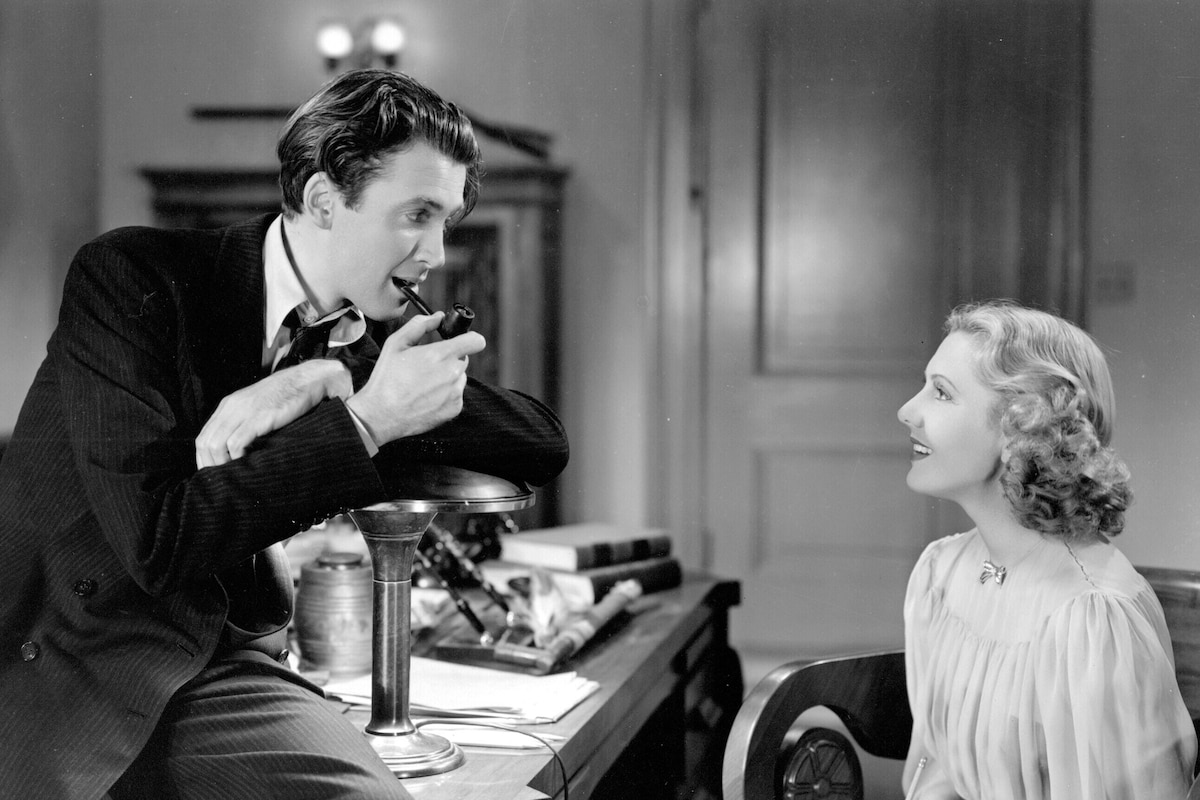
Meanwhile, James Stewart was delighted with his role, and began to attend the rushes - something he had seldom done with his films at MGM. Capra screened the footage at the projection room in his house. As quoted in Jimmy Stewart: A Life in Film by Roy Pickard, the actor said, "The first time I stopped off at Capra's house I was there an hour and forty minutes. There was take after take, from every angle. He really covered himself. Every scene from every angle. Well, I didn't stay to the end. The next night it was clearly going to be even longer! After an hour I turned to Frank. He was fast asleep." Needless to say, Stewart soon went back to avoiding dailies.
For the climactic filibuster scenes, Jefferson Smith had to sound hoarse after twenty-three hours of straight talking. Actor Stewart had trouble simulating the effect, so he consulted a throat doctor, asking how a gravelly voice could be induced rather than cured. As quoted again by Pickard, the actor said, "He dropped dichloride of mercury into my throat, not near my vocal chords, but just in around there. It wasn't dangerous. And he said: 'how's that?' I said: 'rasp, rasp'. He said: 'You got it.'" Stewart had the doctor apply the solution on the set; he was worried that Capra would disapprove and accuse Stewart of being a mechanical actor, but the director was delighted. Capra said, "the result was astonishing. No amount of acting could possibly simulate Jimmy's intense pathetic efforts to speak through real swollen chords."
Capra's film finished shooting on July 7, 1939 - eight days over schedule and $288,660 over budget. A round of audience sneak previews followed, and the director had an unusual approach for them. Capra had found the audience previews for Lost Horizon (1937) to be traumatic, so, as he wrote in his autobiography, he "...never attended a single preview of my subsequent films." For his next picture, You Can't Take It with You, he relied on others to report back to him the audience reactions. For Mr. Smith Goes to Washington, he hit upon a different approach: "Let Cohn take a hundred wise guys to the preview. I sent one man with a tape recorder. ...Where the film was interest-grabbing, the audience was silent, hushed. Where it was dull or long, I heard coughs, shufflings, rattlings of peanut bags. The laughs - from giggles to guffaws - were measured exactly in length and volume. ...like tailors tearing apart and rebuilding a coat to their chalk marks, we re-edited our film to the tape." Capra does not mention it in his book, but the ending of the film was severely cut following the previews. Originally, there was a protracted denouncement. Following Smith's collapse on the Senate floor, there were several scenes showing his triumphant return to his home state. He and Saunders are given a parade, the political machine of James Taylor is dismantled, Smith visits Senator Paine at home and forgives him, and there is a reunion with Ma Smith and her blessing given to Saunders as a daughter-in-law. All of this was cut after Capra assessed the reactions of test audiences. (Two brief shots of the parade sequence are visible in the movie's trailer).
Before his film was released to the general public, a major screening was held in Washington, D. C., at the invitation of the Washington Press Club, at Constitution Hall on October 16, 1939. More than 4,000 people attended, including Senators, congressmen, Supreme Court justices, and much of the Georgetown elite. Harry Cohn was there, and Capra and his wife attended, sitting with the family of Senator Burton K. Wheeler, Republican from Montana. (Although Montana was never mentioned as the state Jefferson Smith was from in the film.) Some biographers have charged that Capra "overdramatized" his account of the preview in his book, and that there wasn't a flood of walkouts as he wrote. The audience was only superficially polite at best, however, and there were certainly strong reactions from certain congressmen and members of the press in the days and weeks that followed.
Well documented was the reaction of Joseph P. Kennedy, the ambassador to Great Britain, who sent Harry Cohn a cablegram urging him to withdraw the film from European distribution. Kennedy wrote, "I have a high regard for Mr. Capra ...but his fine work makes the indictment of our government all the more damning to foreign audiences... I feel that to show this film in foreign countries will do inestimable harm to American prestige all over the world. ...Pictures from the United States are the greatest influence on foreign public opinion of the American mode of life. The times are precarious, the future is dark at best. We must be more careful." Cohn and Capra had sent Kennedy many clippings from American reviews and editorials, all praising the film and expressing the opinion that Democracy can withstand, and in fact encourages, such questions as the film raises.
Not only did Mr. Smith Goes to Washington score a resounding success with critics, it also did well with audiences. The film made millions at the box office, but due to its high negative cost (almost $2 Million) and distribution expenses, the net profit to Columbia was only $168,500. Mr. Smith Goes to Washington was the last obligation Capra had to the studio and Harry Cohn, and following its completion he was a free agent.
by John Miller
Behind the Camera
by John Miller | May 09, 2011
SIGN UP FOR OUR NEWSLETTERS

CONNECT WITH TCM