In early 1939, Frank Capra was without question the most prominent film director in America. He had just won the Best Director Oscar® for his most recent movie, You Can't Take It with You (1938). That film, which also won for Best Picture, was just the latest in a string of hits Capra had made for Columbia Pictures and the studio's mogul, Harry Cohn. With his longtime collaborator and screenwriter Robert Riskin, Capra had helmed such classics for Cohn's studio as Lost Horizon (1937), Mr. Deeds Goes to Town (1936), and It Happened One Night (1934), for which Capra had won his first Best Director Oscar®. Capra was at something of a loss for a follow-up to You Can't Take It with You, particularly because Riskin had taken an offer from Metro-Goldwyn-Mayer and left Columbia. One of Capra's initial ideas, a costume biography of Chopin, was shot down immediately by Cohn, especially when Capra expressed an interest in shooting it - at great cost - in Technicolor. When he saw a two-page synopsis of an unpublished novel called The Gentleman from Montana (by Lewis R. Foster), Capra jumped on it - it featured an Everyman who becomes embroiled in the darkest aspects of Washington politics. Some consideration was given to making it a sequel to the earlier Gary Cooper film and calling it Mr. Deeds Goes to Washington, but Capra realized he needed a younger, more self-assured character than Longfellow Deeds would have been. With Riskin unavailable, writer Sidney Buchman was hired to work on the screenplay.
Capra, Buchman, and Capra's long-time assistant director Art Black traveled to Washington, D.C. As Capra later wrote in his autobiography, The Name Above the Title, "The first thing we did in our Capital City was to go rubbernecking in a sightseeing bus. We wanted to see Washington just as our dewy-eyed freshman Senator from Montana would see it..." Knowing that filming the many scenes in the Capitol Building would be out of the question, Capra and his crew would face the formidable task of building a replica of the Senate chamber back at Columbia. "With us were cameraman Joe Walker to shoot backgrounds, and a still-photo crew to photograph the thousand and one details of the Senate - walls, doorknobs, chandeliers, etc. - with a yardstick in each shot as a dimension parameter for the studio set builders."
Columbia and Capra also engaged an advisor for the film, Jim Preston, who for forty years had served as the superintendent of the Senate press gallery. Capra told Preston, "I want you to arrange for our crew to come in here and photograph all the details - inkwells, pencils, stationery, everything down to the hole the Union soldier kicked in Jeff Davis' desk the day Jeff walked out to join the Confederacy. Later on you will come to Hollywood and help me select ninety-six actors to fill those desks - that look like real Senators..." Preston replied that the composite U.S. Senator was fifty-two years old, five feet-eleven inches tall, and weighed 124 pounds.
While in Washington, Capra was a guest of the press corps and attended a White House press conference with President Roosevelt. Hearing FDR address the weighty issues of Chamberlain appeasing Hitler and Japan attacking China gave Capra reason to doubt his film: "...here was I, in the process of making a satire about government officials; a comedy about a callow, hayseed Senator who comes to Washington carrying a crate of homing pigeons - to send messages back to Ma - and disrupts important Senate deliberations with a filibuster. The cancerous tumor of war was growing in the body politic, but our reform-happy hero wanted to call the world's attention to the pimple of graft on its nose." A visit to the Lincoln Memorial turned Capra's thinking around; he witnessed a scene there that he was determined to depict in his movie: "We must make the film if only to hear a boy read Lincoln to his grandpa."
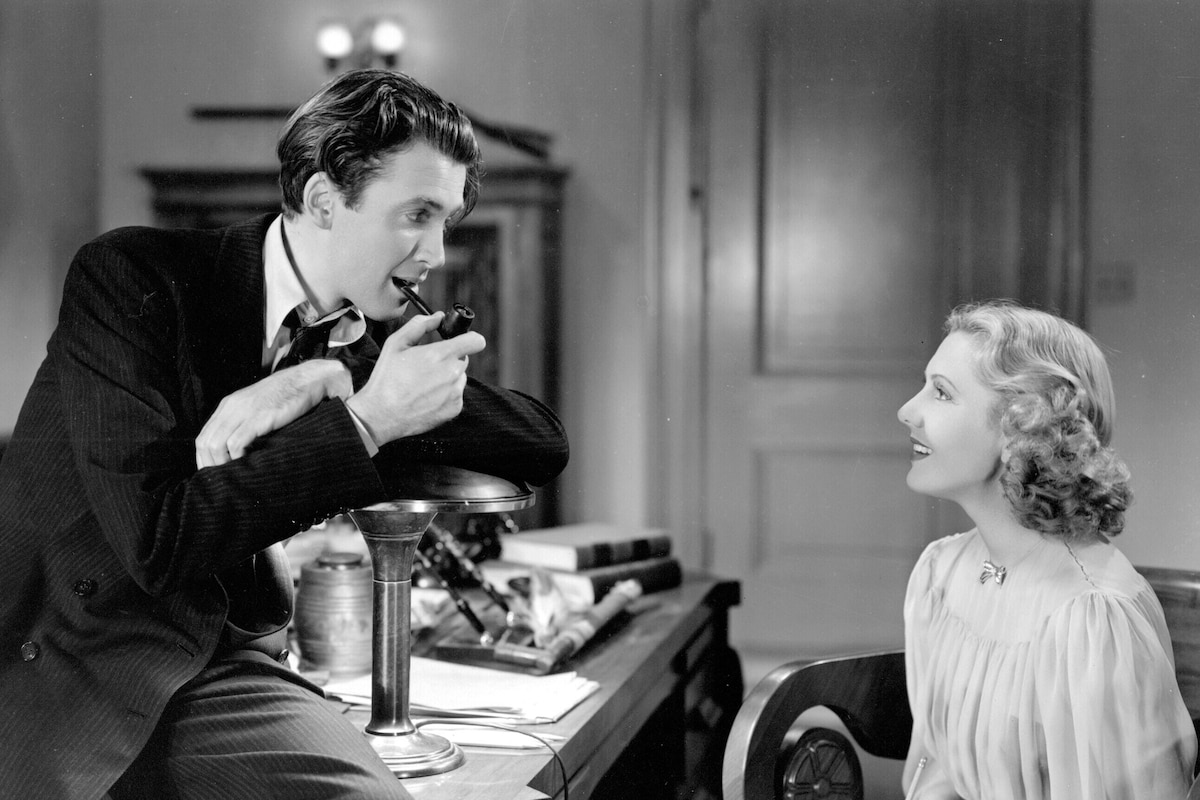
Capra and company returned to Hollywood in November, 1938 to finish writing and preproduction, including an all-important task for Capra: casting. The film had an amazing 186 speaking parts. As Capra later wrote, "I seldom, if ever, made any screen tests. I thought they were idiotic and certainly unfair to the players. I selected my cast solely by instinct." For his two leads, Capra didn't look any further than the stars of his most recent film, and cast James Stewart and Jean Arthur. Edward Arnold, who had also appeared in You Can't Take It with You, was cast as primary villain James Taylor. Thomas Mitchell, who would eventually appear in a total of four Capra features, was cast as the cynical reporter Diz Moore, and H. B. Warner, a veteran of five Capra films, appeared as the Majority Leader. The director went outside of his usual casting choices for two important roles: as the flawed senior Senator Paine, he cast British actor Claude Rains. For the key role of the Vice-President, who presides over the Senate, Capra wanted "a strong American face." He found it in Harry Carey, who had been acting in cowboy films since 1908.
by John Miller
The Big Idea
by John Miller | May 09, 2011
SIGN UP FOR OUR NEWSLETTERS

CONNECT WITH TCM