SYNOPSIS
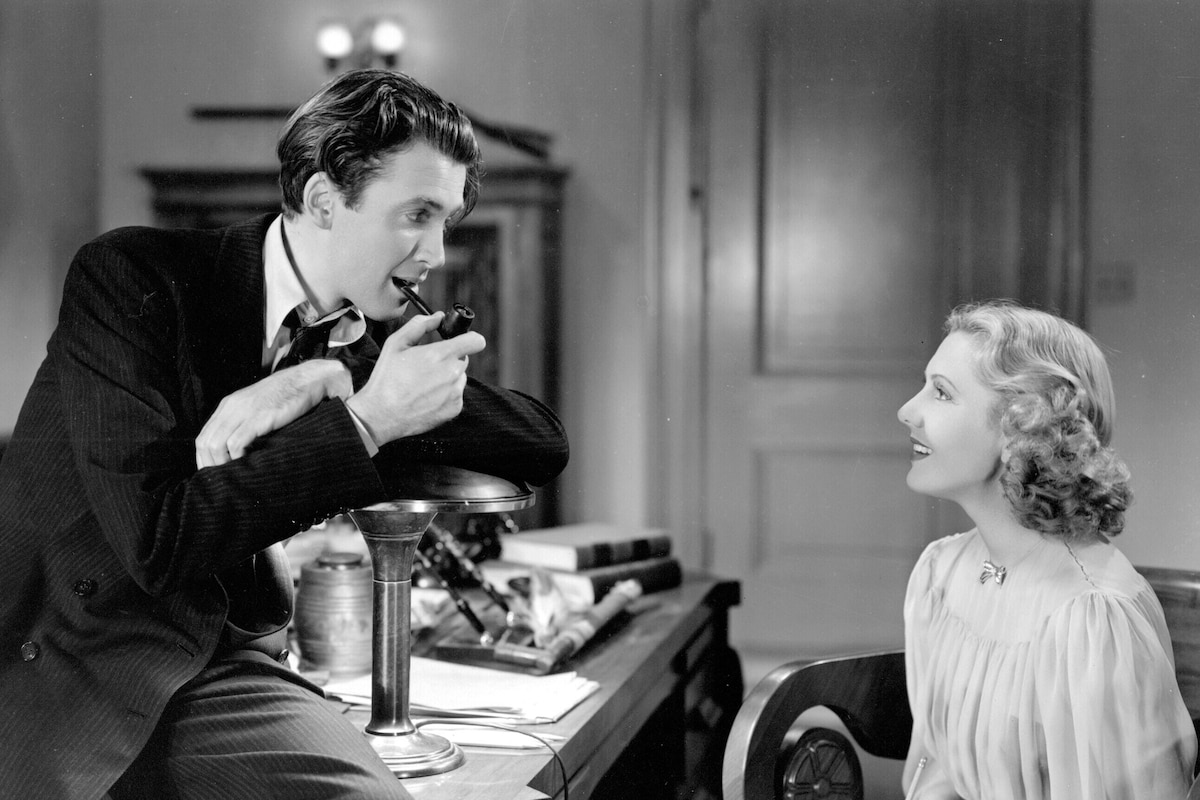
The untimely death of a junior Senator (from an unnamed American state) sends political boss Jim Taylor (Edward Arnold) into a momentary panic. Taylor needs the votes in the Senate to back a pork barrel project that will line his pockets. He controls the state's Governor, Hubert Hopper (Guy Kibbee) and the state's beloved senior Senator, Joseph Paine (Claude Rains), who suggest a popular citizen and local Boy Ranger leader, Jefferson Smith (James Stewart) to fill the empty position. Smith is humbled and proud to be under the wing of Paine, who had known Smith's late father, a crusading journalist. The patriotic Smith drinks in the sights in the nation's Capitol and reports to the Senate. He is hit hard upon his arrival by the Washington Press Corps, including reporter Diz Moore (Thomas Mitchell), who paint him as a naive fool in the newspapers. With the encouragement of Paine and with help from his cynical assistant Clarissa Saunders (Jean Arthur), Smith begins to draft a bill to establish a Boy's Camp in his state. Unfortunately, Smith's bill conflicts with Taylor's plans for pork politics; Taylor turns all of his might against Smith, including Senator Paine. Smith sees the enormity of the forces against him, but he is determined to get the truth out to the people of his state. Saunders is falling in love with Smith, and she, Diz, and others sympathetic to the effort, including the President of the Senate (Harry Carey), help Smith in his last-ditch effort to clear his name.
Produced/Directed by: Frank Capra
Screenplay: Sidney Buchman, from the story by Lewis R. Foster
Cinematography: Joseph Walker
Art Direction: Lionel Banks
Editors: Gene Havlick and Al Clark
Music: Dimitri Tiomkin
Principal Cast: James Stewart (Jefferson Smith), Jean Arthur (Clarissa Saunders), Claude Rains (Sen. Joseph Paine), Edward Arnold (Jim Taylor), Harry Carey (President of the Senate), H.B. Warner (Sen. Fuller), Guy Kibbee (Gov. Hubert Hopper), Thomas Mitchell (Diz Moore), Eugene Pallette (Chick McGann), Beulah Bondi (Ma Smith).
BW-130m.
Why MR. SMITH GOES TO WASHINGTON is Essential
Though it's now universally revered as an ode to democratic ideals, Frank Capra's Mr. Smith Goes to Washington (1939) was originally denounced by many Washington power-brokers. That may come as a bit of a shock if you haven't seen this classic picture for several years. Jimmy Stewart's lead performance made him a star, and is justly remembered as the key component of a beautifully constructed narrative. But Capra, for all his flag-waving and sometimes naive moralizing, saved a great deal of bite for the hallowed halls of American government.
If not subversive, the movie is at least driven by a strong distaste for the misuse of power by our elected officials. This was an exceptionally gutsy message at a time when Americans were concerned with the rise of Nazism overseas, and Capra surely knew he would ruffle a few feathers. But he put his foot down and said exactly what he wanted to say, much like the film's patriotic lead character. This is the kind of movie that makes you want to light up a sparkler.
Capra nearly cast Gary Cooper, but finally settled on Stewart. "I knew he would make a hell of a Mr. Smith," he said. "He looked like the country kid, the idealist. It was very close to him." Stewart knew this was the role of a lifetime, one that could place him near the top of the Hollywood heap. Jean Arthur later remembered his mood at the time: "He was so serious when he was working on that picture, he used to get up at five o'clock in the morning and drive himself to the studio. He was so terrified something was going to happen to him, he wouldn't go faster."
Even in the classics-heavy year of 1939, Mr. Smith Goes to Washington was a major achievement, arguably the finest picture of Capra's storied career. It may wrap itself up a bit too easily, but you'd have to have a heart of stone to not be moved by the journey. Or, in lieu of that, you could be a U.S. Senator or Washington newspaper reporter circa 1939.
On October 17, 1939, the picture was previewed at Washington's Constitution Hall. The preview was a major production featuring searchlights and a National Guard band playing patriotic tunes; The Washington Times-Herald even put out a special edition covering the event. Four thousand guests attended, 45 Senators among them. About two-thirds of the way through the film, the grumbling began, with people walking out. Some politicians were so enraged by how "they" were being portrayed in the movie, they actually shouted at the screen. At a party afterward, a drunken newspaper editor took a wild swing at Capra for including a drunken reporter as one of the characters!
Several politicians angrily spoke out against the film in newspaper editorials, which, in the long run, may have helped its box office. Sen. Alben W. Barkley viewed the picture as "a grotesque distortion" of the Senate, "as grotesque as anything ever seen! Imagine the Vice President of the United States winking at a pretty girl in the gallery in order to encourage a filibuster!" Barkley, who was lucky he didn't get quoted on the film's posters, also said, "...it showed the Senate as the biggest aggregation of nincompoops on record!"
Senator James F. Byrnes of South Carolina suggested that official action be taken against the film's release...lest we play into the hands of Fascist regimes. And Pete Harrison, the respected editor of Harrison Reports, urged Congress to pass a bill allowing theater owners to refuse to show films - like Mr. Smith - that "were not in the best interest of our country." And you thought the Dixie Chicks got a raw deal.
Not everyone, especially American moviegoers, saw Capra's vision as an affront to democracy. Frank S. Nugent, a critic for The New York Times wrote, "(Capra) is operating, of course, under the protection of that unwritten clause in the Bill of Rights entitling every voting citizen to at least one free swing at the Senate. Mr. Capra's swing is from the floor and in the best of humor; if it fails to rock the august body to its heels - from laughter as much as from injured dignity - it won't be his fault but the Senate's, and we should really begin to worry about the upper house."
by Paul Tatara
Mr. Smith Goes to Washington: The Essentials
by Paul Tatara | October 12, 2006
SIGN UP FOR OUR NEWSLETTERS

CONNECT WITH TCM