"The work often has the same effective spare quality that
made Mr. Zinnemann's High Noon [1952] an impressive
business.... Some of the episodes are perhaps excessively
brutal, but Mr. Zinnemann is not, after all, trying to
portray the activities of a Beaver Patrol. What he has done
is given us a glimpse of the military that is very rare."
The New Yorker, 1953.
"I love Zinnemann's film, I realized, because it was made
in a period before movies had become pop. The movie is
about grown-ups with ambitions, weaknesses and loyalties;
they make choices and suffer the consequences. There is
violence, but it is never exaggerated or cartoonish, and it
is always fully felt. From Here to Eternity is a
thrilling movie, but nothing in it was designed simply for
thrills.... [It] is one of those rare 'big' movies that is
also unaffectedly intimate." David Denby,
Premiere, September 1990.
"Surprisingly, considering the Cold War temperament of the
times, the film is not a glorification of military life.
Although the problems of bad leadership and abuse of
authority are solved by the army in the film (unlike the
book), officers are shown to be pompous, arrogant and
ignorant. Only some of the enlisted men are shown
heroically. No glorious battles are depicted, and the
climax is the Japanese sneak attack on Pearl
Harbor...Probably most important of all, Hollywood learned
that the American audience would support films that
attempted to deal with adult situations and problems." -
Ray Narducy, The International Dictionary of Films &
Filmmakers (Perigee).
"Though intended as an attack on the U.S. Army, it is
neither powerful nor truly critical. It marks something of
a turning point in Zinnemann's career; formerly a fairly
good director, from this point on he played the game
according to the Hollywood rules." - Georges Sadoul,
Dictionary of Films (University of California
Press).
"Appeal of the film is that Lancaster, Clift, Sinatra,
Kerr, and Reed all anticipate the rebel figures that would
dominate the rest of the fifties. They break army rules and
society's rules. They are the only characters with
compassion, who can love - so here rebels are
positive figures. Picture has superb acting, strong
direction by Fred Zinnemann." - Danny Peary, Guide For
the Film Fanatic (Fireside).
"The relationships may be doomed, but their treatment set
new standards for cinematic sexual frankness. Though it may
seem tame and obvious now, Burt Lancaster and Deborah
Kerr's torrid horizontal beach kiss broke down barriers
concerning the depiction of sensuality...All of the
romantic entanglements are worked out in the shadow of the
men's duties as soldiers and their relationship to the
Army. That's really what both the novel and the film are
about - the responsibilities of the individual and the
organization...Zinnemann and [screenwriter] Taradash don't
explore the depths of character that Jones created - film
doesn't work that way - but they certainly turned his work
into one of Hollywood's most enjoyable entertainments." -
Mike Mayo, War Movies (Visible Ink).
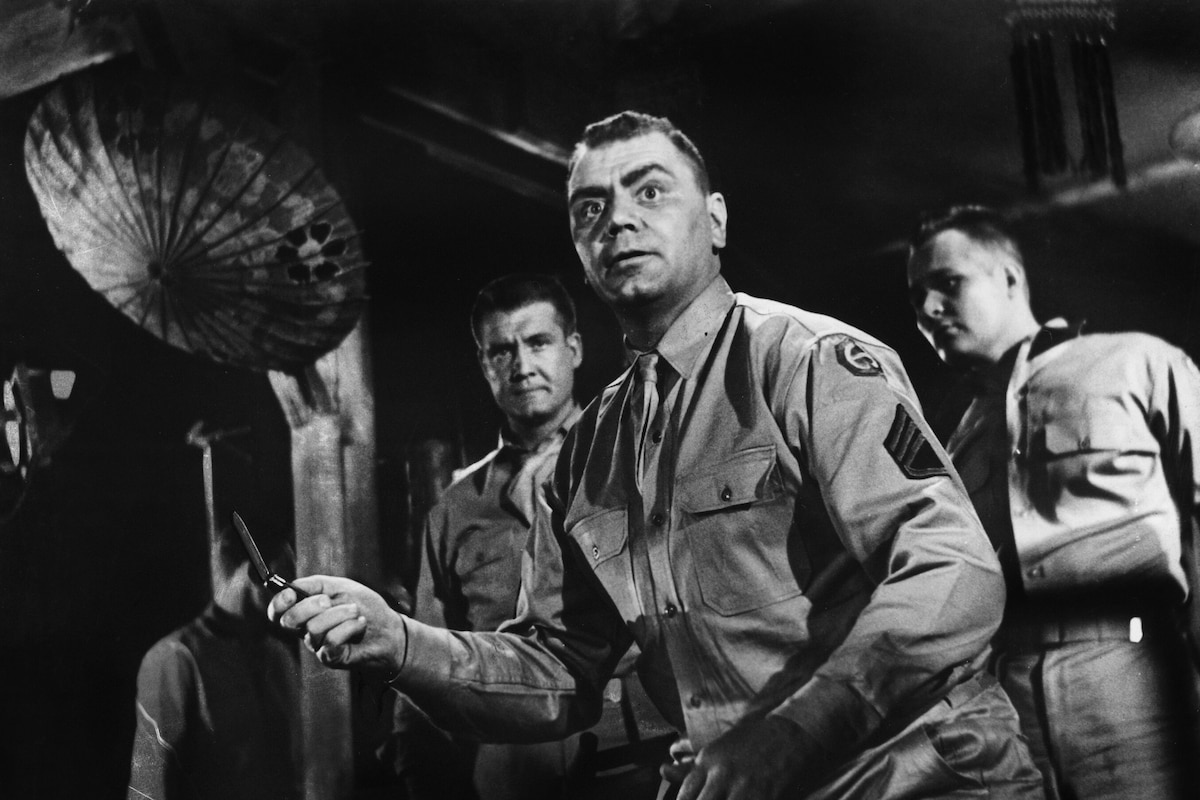
"The bawdy vulgarity and the outhouse vocabulary, the pros
and non-pros among its easy ladies, and the slambang
indictment of army brass have not been emasculated in the
transfer to the screen...Eyes will moisten and throats will
choke when Clift plays taps on an army bugle for his friend
Sinatra after the latter dies from the brutality
administered by Ernest Borgnine..." - Variety Movie
Guide (Prentice Hall).
"Much of the film's initial impact lay in the casting of
Deborah Kerr in a role far removed from her usual well-bred
style, and the comeback of Frank Sinatra in his first
dramatic part." - The Oxford Companion to Film
(Oxford University Press).
"As a production, it is Hollywood in good form, and
certainly took the public fancy as well as establishing
Sinatra as an acting force." - Halliwell's Film & Video
Guide (HarperPerennial).
"This is not a theme which one would expect Zinnemann to
approach in the hopeful, sympathetic mood of his earlier
films, but neither could one expect the negative shrug of
indifference with which he seems to have surrendered to its
hysteria." - Karel Reisz, Sight and Sound.
"...the movie succeeds by the smooth efficiency of Fred
Zinnemann's lean, intelligent direction, and by the
superlative casting. Montgomery Clift's bony, irregularly
handsome Prewitt is a hardhead, a limited man with a
one-track mind, who's intensely appealing; Clift has the
control to charm - almost to seduce - an audience without
ever stepping outside his inflexible, none-too-smart
character...This was the movie of its year..." - Pauline
Kael, 5001 Nights at the Movie (Henry Holt and
Company).
AWARDS & HONORS:
Academy Awards® for Best Picture, Supporting Actor
(Frank Sinatra), Supporting Actress (Donna Reed), Director,
Screenplay, Cinematography, Editing and Sound (John P.
Livadary). The eight awards were more than any other
picture had won since Gone with the Wind (1939).
Nominations for Best Actor (Burt Lancaster and Montgomery
Clift), Actress (Deborah Kerr), Musical Score, Costume
Design (Jean Louis).
Golden Globe Awards for Best Director, Supporting Actor
(Sinatra).
New York Film Critics Awards for Best Picture, Actor
(Lancaster) and Director
Directors Guild of America Award to Fred Zinnemann.
Writers Guild Award to Daniel Taradash for Best Written
American Drama.
Cannes Film Festival Special Award to Zinnemann.
Compiled by Rob Nixon & Jeff Stafford
The Critics Corner: FROM HERE TO ETERNITY
by Rob Nixon & Jeff Stafford | May 03, 2006
SIGN UP FOR OUR NEWSLETTERS

CONNECT WITH TCM