SYNOPSIS
Private Robert E. Lee Prewitt is a hardheaded individualist
who loves the Army, but stubbornly follows his own ethics.
When Prewitt is transferred to Honolulu's Schofield
Barracks just prior to World War II, his new commander,
Captain Holmes, subjects him to harsh treatment for his
refusal to use his boxing skills to bring glory to his
platoon. Prewitt is rejected by everyone on base except his
sergeant, Milt Warden, and the street-smart, rebellious
Private Maggio. The intertwining lives of the military men
form the central plot of the drama: Warden's affair with
Holmes' wife, Karen; Prewitt's love for Alma Lorene, an
embittered prostitute hoping for a better life; Maggio's
ultimately fatal feud with sadistic Sgt. "Fatso" Judson.
The conflicts come to a head on December 7, 1941, when the
base and the naval installation at Pearl Harbor are
attacked by the Japanese, forcing everyone to put aside
their individual desires and grievances to fight a common
enemy.
Director: Fred Zinnemann
Producer: Buddy Adler
Screenplay: Daniel Taradash, based on the novel by James
Jones
Cinematography: Burnett Guffey
Editing: William Lyon
Art Direction: Cary Odell
Set Design: Frank Tuttle
Music: George Duning
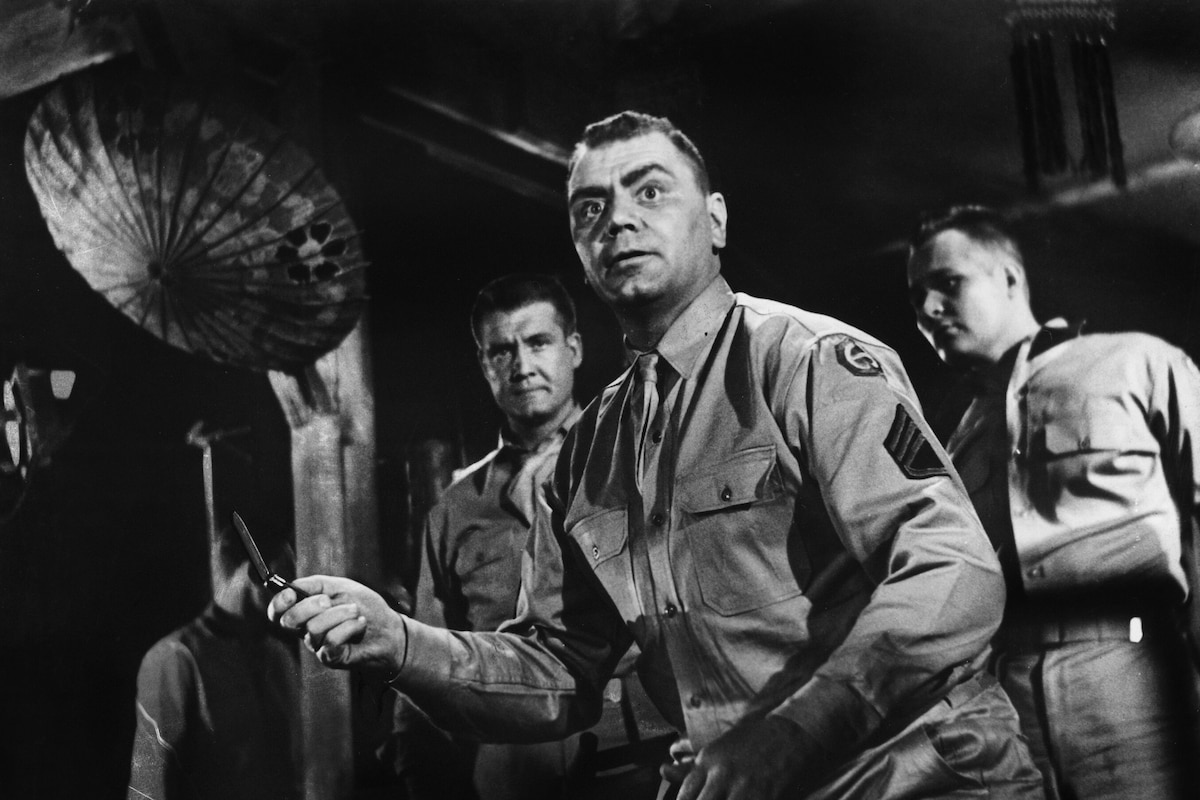
Cast: Burt Lancaster (Sgt. Milton Warden), Deborah Kerr
(Karen Holmes), Montgomery Clift (Robert E. Lee Prewitt),
Frank Sinatra (Angelo Maggio), Donna Reed (Alma Lorene),
Ernest Borgnine (Sgt. "Fatso" Judson).
BW-118m.
Why FROM HERE TO ETERNITY is Essential
James Jones' sprawling 800-page novel, From Here to
Eternity was the book no one thought could be filmed.
For one thing, it was a long and complex story that would
have taken hours of screen time to fully capture its
sprawling narrative. More daunting was its harsh language,
its frankness about sex and its portrait of Army life as a
brutalizing force that can crush a man's spirit. But after
paying $82,000 for the film rights, Columbia Pictures mogul
Harry Cohn was determined to complete the project, which
became known almost immediately throughout Hollywood as
"Cohn's Folly." Script after script was rejected until Cohn
at last found what he liked in an adaptation by Daniel
Taradash.
The first step was securing the assistance of the U.S.
Army, because no film about military life could be
effectively made at a reasonable cost without it. The
Pentagon's official position was to deny help to any
project based on Jones' highly critical book. But producer
Buddy Adler, an ex-officer himself, was able to win
cautious approval by agreeing to two important changes.
First, the brutal treatment handed out to Maggio by Fatso
could not be shown, and Fatso's behavior had to be seen as
a sadistic anomaly and not the result of Army policy as
depicted in Jones' book. Taradash and director Fred
Zinnemann didn't mind making that concession and felt that
Maggio's death scene in Prewitt's arms would be an even
better way to tell that part of the story. They were less
than pleased, however, with the second change. In the
novel, the villainous Capt. Holmes is promoted to major, a
plot point the filmmakers found to be appropriately ironic.
But they were forced to write a scene in which the captain
is called on the carpet by his superiors and given the
choice of resigning from service or facing a court martial.
It was, the director would write years later in Fred
Zinnemann: An Autobiography, "the worst moment in the
film, resembling a recruiting short."
From Here to
Eternity involved the casting, a process that provided
much advance buzz for an already eagerly awaited movie and
which frequently saw Harry Cohn and Fred Zinnemann at odds.
Happily for the film and its stars, Zinnemann triumphed
over the tyrannical studio boss and gathered one of the
most effective and celebrated casts ever assembled in
Hollywood. When the book was purchased in 1951, Columbia
announced it would be a vehicle for Broderick Crawford,
Glenn Ford and John Derek. Those names fell by the wayside
in the months it took to come up with a suitable script.
Burt Lancaster was then cast perfectly to type as Warden
a rugged man's man but also a lover who could capture a
woman's desires. There, however, the typecasting stopped.
Cohn, of course, wanted to use players already under
contract to Columbia, and he thought Aldo Ray would be
perfect as Prewitt. Zinnemann balked, and suggested
Montgomery Clift, who he had directed in The Search
(1948). Cohn thought this an idiotic idea; Clift was no
soldier, no boxer and probably a homosexual, he told
Zinnemann. That he turned out to be right on all counts
didn't deter the director, who seized on Jones' description
of Prewitt as a "deceptively slim young man." Cohn
relented.
Eli Wallach, known primarily for his stage work at the
time, was announced for the role of Maggio. But when Frank
Sinatra heard Wallach could not back down on his commitment
to do Tennessee Williams' play Camino Real on
Broadway, he set about on a relentless campaign for the
role. Hard as it may be to imagine today, Sinatra in 1953
was considered washed up. His movie career had faded after
a string of 1940s musicals in which he usually played
second banana to Gene Kelly. His private reputation
suffered from his stormy marriage to screen beauty Ava
Gardner and his much-publicized financial problems. And due
to the hemorrhaging of his vocal cords, Sinatra's singing
days were at least temporarily over. Sinatra barraged Cohn
with calls, letters, telegrams, even enlisting his wife's
clout. Finally Cohn gave in and agreed to give the singer a
shot at the part for a paltry $8,000 salary.
The casting of the female roles proved to be a somewhat
contentious affair. Joan Crawford was initially cast as
Karen, but depending on whose version you believe, she
backed out over either having to take second billing to
Lancaster or over her distaste for the costumes designed
for the character. Zinnemann quickly seized on the idea of
hiring British actress Deborah Kerr, who was usually cast
as prim and proper aristocrats, and hardly the image of a
smoldering sexpot (like Karen's character in the novel).
Likewise, Donna Reed had a wholesome, all-American image
totally counter to her role as Alma Lorene, a "dance-hall
hostess" in the film, which everyone knew was code for
"hooker."
The bold casting turned out to be a major coup for the
picture. The performances were almost universally hailed,
and the roles turned out to be lucky for all the actors.
Kerr broke out of a mold she had been trapped in, opening
up her career to a wider range. Sinatra won an Oscar®
and found himself back on top after his near-disastrous
slump. Although the role didn't do much to change Reed's
image permanently, the Oscar® she won for it validated her
talents and gave her the clout to launch, a few years
later, her successful, long-running TV series. As for
Clift, he spent long hours, obsessively learning the bugle,
military drill procedures and boxing (a skill he never
quite mastered). As a result, he received high critical
praise for his sensitive portrayal, getting so far into the
soul of Prewitt that his work seemed, in the words of a
Time magazine review, "behaving rather than acting,
an artless-seeming form of art...." Although he was already
into the downward spiral of his personal life that would
kill him at an early age, with From Here to
Eternity, Clift added another performance to a
legendary body of work that helped define the tortured
outsider anti-hero of the 1950s and influenced a generation
of actors to come.
by Rob Nixon
From Here to Eternity: The Essentials
by Rob Nixon | May 03, 2006
SIGN UP FOR OUR NEWSLETTERS

CONNECT WITH TCM