Probably the most famous off-camera Rogers-Astaire anecdote about Top Hat
is the infamous story of "The Dress." Rumors of the dancing team's hostility
toward each other probably stem from this incident. And as always, the truth depends
on who's telling the story.
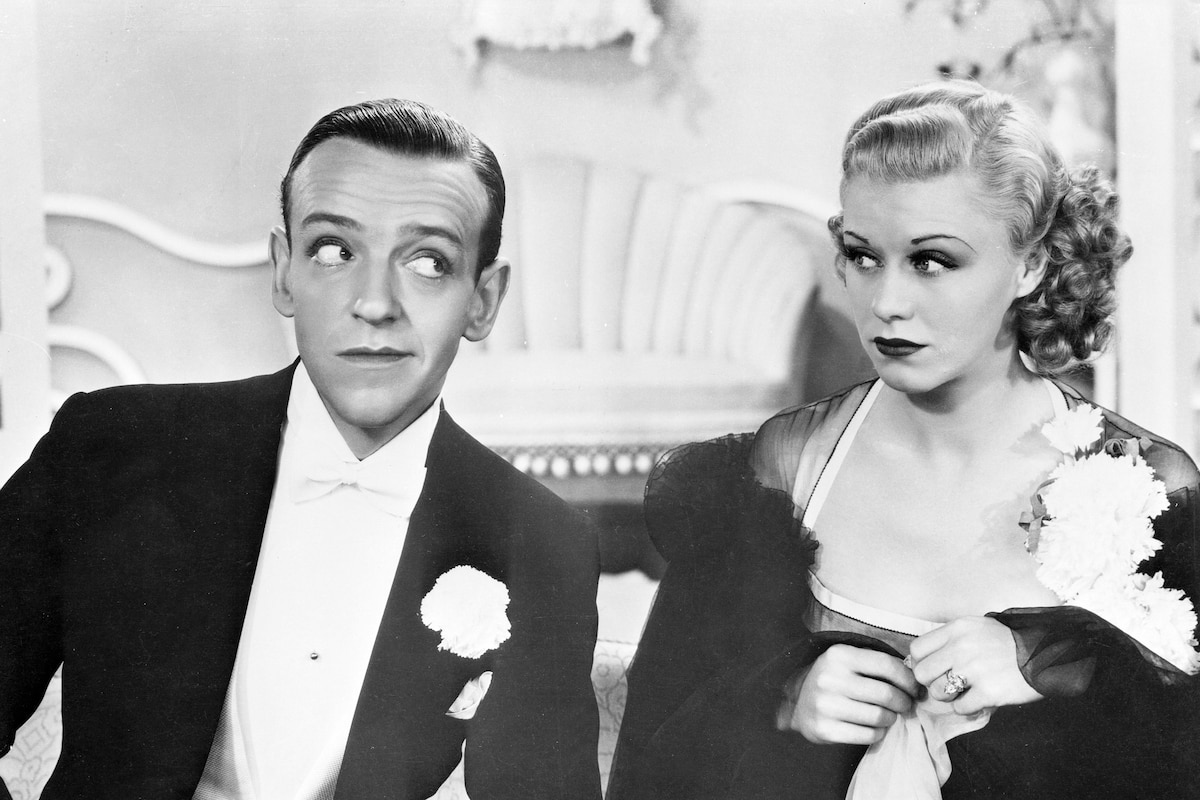
Ginger Rogers gives the most complete account, placing opposition to the costume
well before the feathers started flying. In her autobiography, Ginger:
My Story (HarperCollins), she describes how she told costume designer
Bernard Newman to make her a dress of pure blue, "like the blue you find in
paintings of Monet ...with myriads of ostrich feathers." When the completed
dress was brought to the set, the actress wrote, director Mark Sandrich came to
her dressing room with the suggestion that she wear the "much, much prettier"
white dress she wore in The Gay Divorcee (1934). Rogers was certain
that this 'request' also reflected Fred Astaire's opinion. She immediately telephoned
her mother, Lela Rogers, a tough, legendary stage mama, who stormed to the studio
to her daughter's defense. Mother and daughter stood firm, and when Ginger threatened
to walk off the picture if she couldn't use the gown, Sandrich allowed her to rehearse
in it, despite the fact that she would have to pretend to be wowed by a love song
sung by her openly hostile co-star. Matters grew worse when, during the dance, feathers
began to detach and fly all over the place, sticking to Astaire's skin and clothes.
(Despite all-night work by the wardrobe department to reinforce each feather individually, you can still see errant feathers floating through still shots from the scene.)
Rogers' book insisted only a few stray feathers came loose and that Sandrich and
Astaire aloofly but eventually conceded the dress's beauty and appropriateness for
the scene. Four days after the shoot, she said, Astaire sent her a gold feather
for her charm bracelet and a note that read "Dear feathers, I love ya! Fred."
Astaire told the story a little differently in his autobiography, Steps
in Time (Cooper Square Press). According to him, he thought the look of
the dress was "very nice" until the first time they rehearsed the dance
with Ginger in it. "Feathers started to fly as if a chicken had been attacked
by a coyote. ... They were floating around like millions of moths." Astaire
wrote that despite the hassle, the rushes revealed very little problem, everyone
had a good laugh about it, and it became a running joke among the cast and crew.
He and Hermes Pan even made up joke lyrics to the tune of "Cheek to Cheek":
"Feathers, I hate feathers/And I hate them so that I can hardly speak/And I
never find the happiness I seek/With those chicken feathers dancing cheek to cheek."
Despite downplaying his annoyance over the dress, Astaire was known to be a perfectionist and not averse to taking charge of certain aspects of the filming; he always lay down the law when he believed he was right. Although officially uncredited, it is
universally acknowledged he was the principal choreographer for the entire film
series. Hermes Pan was in charge of big production numbers, and when he and Astaire
worked out the other dances, Pan played Ginger. When the routine was all set, they
showed it to Rogers. Beyond the actual steps, however, Astaire also supervised every
other aspect of the development of a dance number from orchestration through final
shooting and editing. He was particularly adamant about how a number should be filmed.
He disliked interrupting the flow of the dance with unusual camera angles, cuts
to the face or feet of the dancer, or reaction shots of people watching. In this
film and throughout his career, he insisted on keeping the camera at eye level with
few changes in angles to focus attention on the dance rather than on camera technique.
The dances were rarely broken up into segments that could be filmed in small bits
at a time; as a result, multiple takes became arduous affairs that often lasted
well into the night. At times Rogers' shoes had to be changed frequently because
they would become stained with blood.
Astaire could also be a stickler where scripts were concerned. He hated the initial
draft of Top Hat, complaining to producer Pandro Berman that
there was no real story or plot. "As this book is supposed to have been written
for me with the intention of giving me a chance to do things that are more suited
to me I cannot see that my part embodies any of the necessary elements, except
to dance, dance, dance." He also strongly objected to two moments in the script
where Rogers was called upon to slap him in the face.
In an interview with Lee Server for the book Screenwriter: Words Become
Pictures (Main Street Press, 1987), screenwriter Allan Scott said Astaire
was "a helluva snob" who could be "perturbed very easily by the wrong
reference." Scott said he would deliberately put in "wrong" lines
for Astaire to spot and carp about in order to distract him from lines the writers
did not want to lose.
Allan Scott was not any kinder in his assessment of Ginger Rogers' script-analysis
abilities. He told Server he preferred to write for "stage actresses who took
their art seriously," such as Claudette Colbert or Greer Garson, and would
rewrite to accommodate their ideas and concerns. "There was a time with Ginger,
on the other hand, where it got to be a joke," Scott said. "She would
say, 'There's something radically wrong.' And you had to go down and see what you
could do." What Scott usually found was that Rogers was having trouble with
a line simply because she didn't get it, hadn't studied it, and she'd usually been
out "dancing and whatnot" the night before. Scott used the term "radically
wrong" to refer to Ginger for some time.
Astaire and Rogers frequently denied any major rivalry between them. But because
so much of the praise and attention for the quality of the pictures has been focused
on him, she was quick to point out she had plenty of input into the dance routines
and was known as the "button finder," a show biz term for the person who
can come up with just the right last word or finishing touch on a scene or number.
She also wasn't innocent of telling a deflating story or two about her co-star.
As she relates in her autobiography, Sandrich wanted a little something extra to
cap the film and told his two stars to break into a dance as they descended the
stairs at the end. They grumbled, preferring never just to start dancing without
rehearsal, but they tried it anyway. And as Fred pivoted Ginger around him, his
Top Hat came off and nearly plunged into the "canal"
built on the Venice set. Rogers said he yelled "no, no, no!" and kicked
the wall of the set hard - twice a reaction she thought uncharacteristically
heated of him until she realized the cause of his anger. He had neglected to put
his toupee on under the hat.
The elegant dances and sharp, funny script weren't all that made Top Hat
a hit with audiences and a blueprint for future Fred and Ginger pictures. A lot
of credit must also go to the spectacular Art Deco sets with their exaggerated perspectives
and gleaming, buffed dance floors. The BWS (Big White Set), as these concoctions
became known, was the work of RKO's much-praised art department, under the guidance
of Van Nest Polglase. For the Venice set, the studio decided to go farther out than
ever, adjoining two large sound stages with floors sheathed in red bakelite, winding
a canal through them, and spanning the whole thing with bridges. To make the white
sets look even brighter the water was dyed black. The interiors were equally incredible,
with heavily satined hotel rooms the size of train stations. Although credited for
the work and nominated for an Oscar, Polglase did not personally design the Top
Hat set. In fact, he was probably credited with work on a lot of RKO films
simply because of his title. He developed a serious drinking problem during his
tenure at RKO and the studio finally replaced him in the early forties. Carroll
Clark is probably the designer most responsible for the look of Top Hat
and subsequent Astaire-Rogers films, but Van Nest Polglase has become the name associated with that gleaming, over-the-top Deco image for which RKO was known in the 1930s.
As director of Top Hat and four other films in the series, Mark
Sandrich was another important force behind the camera, although he is rarely discussed
in the pantheon of American directors today. Screenwriter Allan Scott claimed Sandrich
"revolutionized the musical," changing it from the backstage type favored
in the early 30s by Warner Brothers (in which numbers are performed only as part
of a rehearsal or stage show) into a more integrated form, in which the songs are
part of the storyline. "If you look at the directors of musicals, his contribution
to the form is very underestimated," Scott said. On the set, however, Ginger
Rogers found him rather cold and cruel. She related the story of how he snapped
at her on the set one day to "take some dancing, singing, and acting lessons."
She said she finally had to have producer Pandro Berman intercede on her behalf,
but that Sandrich never accepted or liked her.
by Rob Nixon
Behind the Camera
by Rob Nixon | May 03, 2006
SIGN UP FOR OUR NEWSLETTERS

CONNECT WITH TCM