SYNOPSIS
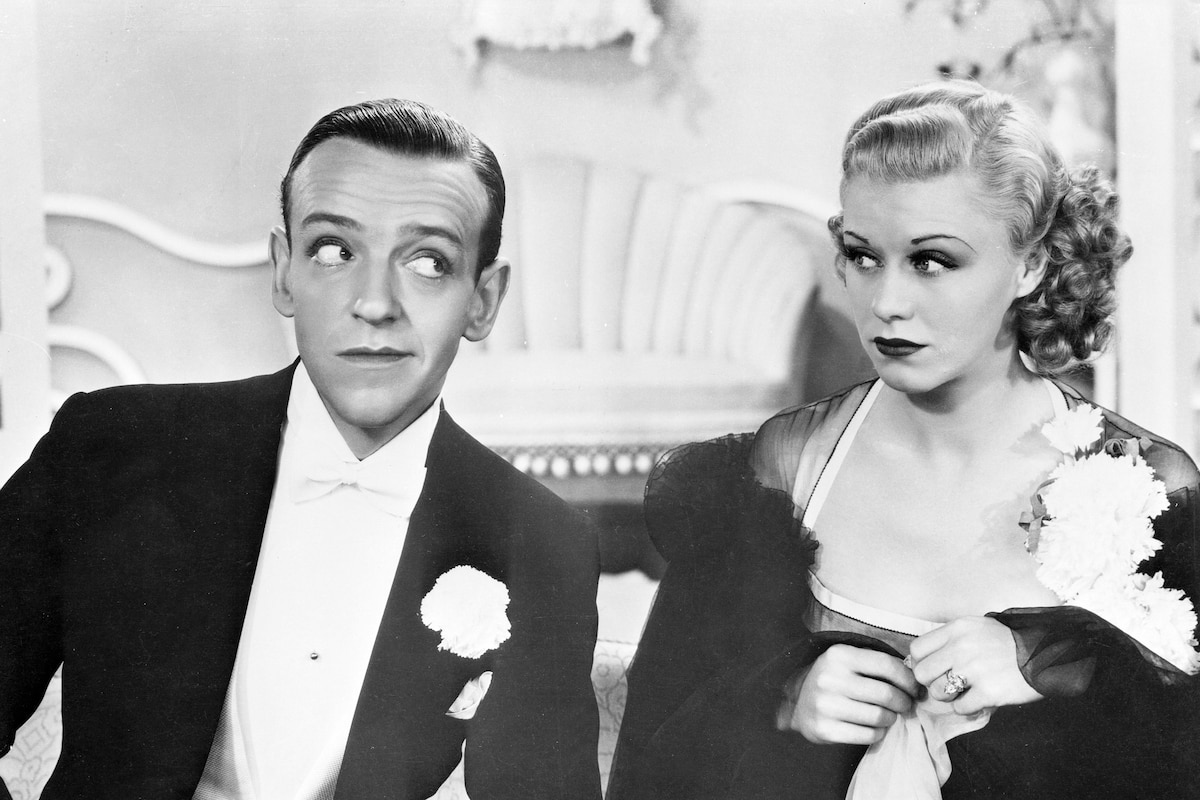
Jerry Travers (Fred Astaire) is an American dancer in
London, a high-spirited, dapper
man with a penchant for breaking into dance whenever the
urge strikes him. Having
already disrupted the stuffy men's club where he has gone
to meet his friend Horace (Edward Everett Horton), Jerry
next disturbs the sleep of fashion model Dale Tremont
(Ginger Rogers) by tap dancing in the hotel room above
hers. Dale storms up to complain, and Jerry falls for her.
Over the course of a few days, during which the two dance
under a park gazebo in a heavy downpour, she begins to fall
for him too. But a letter she receives from her friend
Madge (Helen Broderick) convinces her that Jerry (whose
name she doesn't know) is really Horace, Madge's husband,
so Dale takes off for Venice with her Italian dress
designer Alberto Beddini (Erik Rhodes). Romantic
complications ensue until Horace and Madge set everything
right and unite the two young lovers.
Director: Mark Sandrich
Producer: Pandro S. Berman
Screenplay: Dwight Taylor, Allan Scott, based on the play
by Alexander Farago and
Aladar Laszlo
Cinematography: David Abel
Editing: William Hamilton
Art Direction/Set Design: Van Nest Polglase, Carroll Clark,
Thomas Little
Music: Irving Berlin
Choreography: Hermes Pan, Fred Astaire (uncredited)
Cast: Fred Astaire (Jerry Travers), Ginger Rogers (Dale
Tremont), Edward Everett
Horton (Horace Hardwick), Helen Broderick (Madge Hardwick),
Erik Rhodes (Alberto
Beddini), Eric Blore (Bates).
BW-101m.
Why TOP HAT is Essential
While America was in the throes of the Great Depression,
Fred Astaire and Ginger
Rogers were doing what they did best inside movie theatres,
serving up a glittering,
tuneful helping of witty, debonair, escapist fun. It was a
formula for great commercial
success not just in those tough times but one that would
carry their appeal to this
day and into movie history flitting from London to
Venice, from New York to Paris;
done up in Top Hat, white tie and tails and
over-the-top evening
gowns; introducing one hit song after another by some of
the country's finest composers;
and, of course, dancing through impossibly elaborate and
romantic Art Deco sets.
Those would be the fairly consistent hallmarks of the nine
movies the duo made at
RKO in the 30s (they teamed once more, in 1949, for The
Barkleys of Broadway
at MGM). Critics and fans are divided about which of their
films is their personal
favorite, but just about everyone agrees that Top
Hat is certainly
the most characteristic, the most memorable, and the one
that set the tone for the
series. In fact, it set the tone for an entire era of movie
musicals. Not only did
it fully capture and develop all the elements audiences
would come to expect from
an Astaire-Rogers picture, it firmly established them as
one of the great movie
dance teams of all time.
As with so many great Hollywood stories, however, this
inspired pairing almost never
happened. It was not a likely teaming in the first place.
Rogers was an ambitious
Depression era actress who worked her way up from
vaudeville with aspirations toward
great dramatic parts, not frothy musicals. Astaire was one
of Broadway's biggest
stars in the 1920s, but when he made his debut in what was
virtually a walk-on (or
at least "dance-on") part in the Joan Crawford-Clark Gable
vehicle Dancing
Lady (1933), his physical features were criticized by
some critics who
said he was too skinny and slightly balding to be a leading
man. New York
Times film critic Bosley Crowther said Astaire's face
resembled a happy
Stan Laurel. MGM didn't know what to do with him after that
brief appearance, so
RKO picked him up for his next film Flying Down to
Rio (1933).
Many people think of that as an Astaire-Rogers picture, but
the actual stars were
Dolores del Rio and Gene Raymond (Rogers and Astaire were
billed fourth and fifth,
respectively, behind the now-forgotten Raul Roulien).
Furthermore, Rogers wouldn't
have been paired with Astaire if Dorothy Jordan, who was
cast in the role, hadn't
dropped out to marry producer Merian C. Cooper. So the two
got together after all,
and by the time of their pairing in Top Hat, their
early imperfections
were working in their favor. A quote attributed to
Katharine Hepburn defined the
benefit of their teaming - he gave her class, and she gave
him sex appeal.
For all the romance associated with their movies, the two
actually never kissed
until well into the series. Yet most audiences probably
remember a more passionate
on-screen connection between the two. That's because
Astaire preferred to play out
the romance and sexuality in dance. In picture after
picture, the elegant, smooth
Fred found himself smitten with the generally scornful
Ginger and always managed
to break down her resistance in at least one perfectly
seductive dance number. Top
Hat has such a number ("Cheek to Cheek"), but the
sexiest moment
occurs with the two in completely different rooms. He has
just woken her up with
loud tap dancing in the hotel room above hers. After a
stormy confrontation, she
returns to her bed, he sprinkles sand on the floor and
dances on it with soft, caressing
movements as she snuggles back to sleep.
Movies like Top Hat proved an instant hit, and
exhibitors began
demanding more pictures featuring the duo. After
Rio, producer Pandro Berman put together The Gay
Divorcee (1934), a film version of Astaire's stage hit,
The Gay Divorce, a title the censors found more
offensive for some reason. Astaire initially objected to
the choice of Rogers as his costar and gave in only when
Berman offered him ten percent of the profits.
Stories like that probably gave rise to the rumors that
Astaire and Rogers hated
each other and rarely spoke off camera. Both stars spent
years denying that impression,
but it has persisted. Although they were never close
friends and had their share
of difficulties (see "Behind the Camera"), the two seemed
to respect each
other's talents and often shared moments of joy and
satisfaction in working together.
Any animosity between them generally arose from career
concerns. Rogers had an increasingly busy career at RKO
apart from Astaire, and often had less time to work out
dance numbers the way her perfectionist co-star would have
preferred. And she often complained about being seen merely
as his dance partner. As for Astaire, he didn't object to
Rogers so much as the idea of being part of a team. He had
been coupled on stage
with his own sister Adele for many years, and as he
explained to his agent, Leland
Hayward, "I'd rather not make any more pictures for Radio
[RKO] if I have to
be teamed with one of those movie 'queens.' ...If I'm ever
to get anywhere on the
screen it will be as one not as two."
Nevertheless, Astaire couldn't argue with the success the
pairing brought to both
of them, and because he had a great deal of control over
the pictures' quality (he
did most of the choreography, uncredited, with the
assistance of Hermes Pan and
insisted on shooting all the dance numbers full-on with a
minimum of cuts), he was
able to come to terms, at least for a while, with being
part of a team. Top
Hat was the first film written specifically for the
pair, and the title
song and costume would become Astaire's signature.
by Rob Nixon
Top Hat: The Essentials
by Rob Nixon | May 03, 2006
SIGN UP FOR OUR NEWSLETTERS

CONNECT WITH TCM