Sam Peckinpah was born in 1926 in California and got a
master's degree in drama from USC. He worked as a
stagehand, first in theater then at a local TV station. He
broke into pictures as a dialogue director for Don Siegel,
then moved into television directing and writing, often on
Western series. He made his film debut with The Deadly
Companions (1961), a Western starring Maureen O'Hara
and Brian Keith.
After Ride the High Country, Peckinpah made 14 more
features. His behavior became more difficult and erratic as
the years went on, due to alcoholism and various chemical
dependencies, and his later pictures didn't achieve the
stature and success of his earlier work. He died of a
stroke in 1984, just a few months short of turning
60.
A man who seemed equally at home in a dinner jacket or
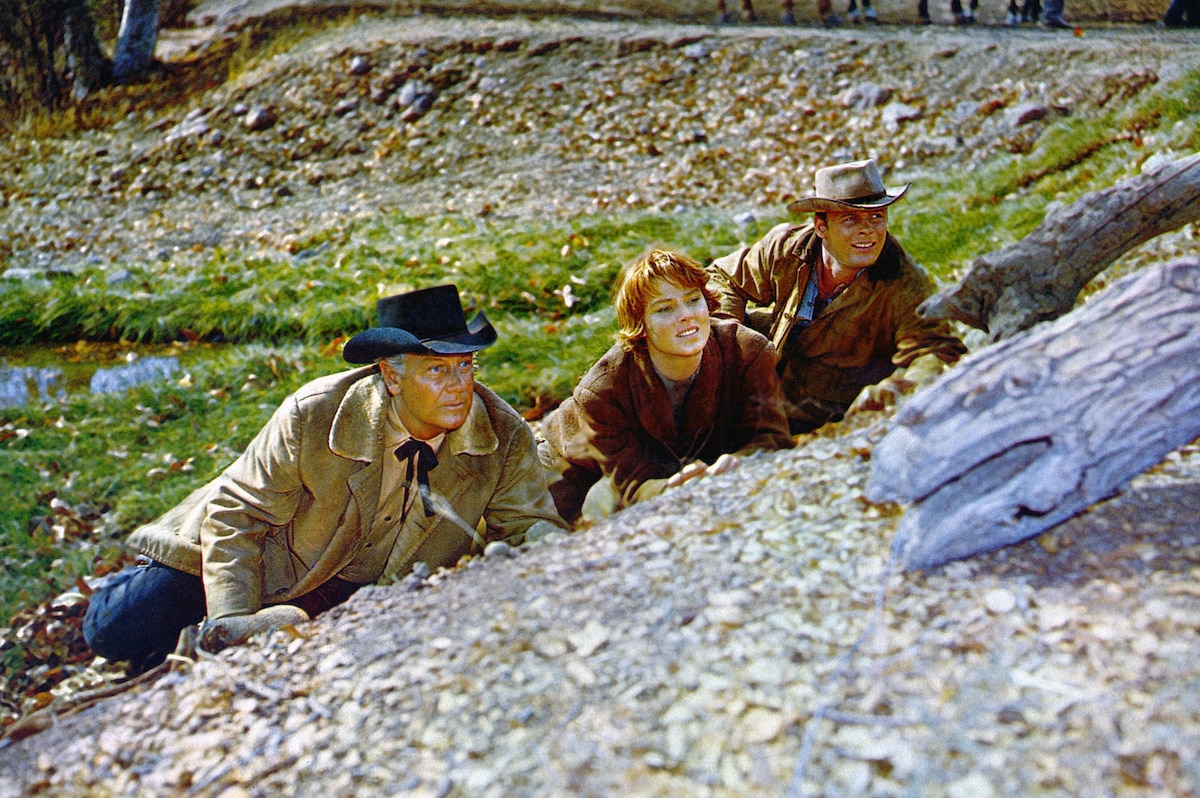
cutting up in a witty Preston Sturges comedy, Joel McCrea's
true life ambition was to be a cowboy. If he couldn't do
that, he would settle for playing one on screen. His
easy-going charm and clean-cut good looks earned him a
place as a popular leading man of the 1930s. He was equally
at home in dramas, comedies, and adventure films, and
played opposite some of the screen's most glamorous
actresses. In the 1940s, he was one of Hollywood's most
bankable stars and worked with many top directors.
Beginning in 1946, with enough clout by that time to call
the shots in his career, he went exclusively into Westerns,
turning in solid performances for notable directors and
making only one non-Western, an urban crime thriller, for
the remainder of his career. He was inducted into the Hall
of Great Western Performers of the National Cowboy and
Western Heritage Museum in 1969, seven years before his
last screen appearance and 21 years before his
death.
Like McCrea, Randolph Scott was a handsome, All-American
leading man of the 1930s who found his true calling in the
Western genre in the 1950s. Early in that decade, he
formed a partnership with veteran producer Harry Joe Brown.
Under the production company banner Ranown, he found new
success when other stars of his generation were slipping in
popularity. As a weathered, aging Western star, he became
one of the top box office draws of the decade, and his work
with director Budd Boetticher is critically important to
the history of the genre and its recognition as cinematic
art. Over the course of seven films between 1956 and 1960,
the two created an archetype of a solitary man. It was a
protagonist that was not always a "hero" or stereotypical
good guy, one who faced great odds and tough moral
dilemmas. Although generally considered mere
second-feature programmers in their day, these Westerns
(Ride Lonesome, 1959, Comanche Station, 1960,
etc.) were immensely popular and in recent years have
earned much critical re-evaluation and respect. Scott
retired after this movie and was inducted into the Hall of
Great Western Performers of the National Cowboy and Western
Heritage Museum in 1975, 12 years before his death.
Although she has appeared in many features and many
television appearances over the past 40 plus years,
Mariette Hartley is most often recognized as the female
partner to James Garner in a long-running series of ads for
Polaroid cameras. The two made such a good team in the
commercials that many people thought they were married in
real life.
Gravelly-voiced character actor Edgar Buchanan appeared in
countless Westerns during his nearly 40-year career. He
was the rascally Uncle Joe on the TV sitcom Petticoat
Junction in the 1960s.
Several of the supporting players became a stock company of
sorts for Peckinpah, working with him several times: R.G.
Armstrong (four pictures), L.Q. Jones (five), John Davis
Chandler (three), and Warren Oates (four, including the
starring role in Bring Me the Head of Alfredo
Garcia, 1974).
Shortly after completing this movie, James Drury took the
lead role in the long-running TV Western The
Virginian.
Lucien Ballard's film career spanned more than 50 years.
After an auspicious start as the cinematographer on several
Josef von Sternberg films in the early 30s, he shot many
Three Stooges comedies as well as some B Westerns over the
next decade. Some of his finest early work was uncredited:
Morocco (1930) and The Devil Is a Woman
(1935) with von Sternberg and Dietrich, Howard Hughes's
The Outlaw (1943), and the noir thriller
Laura (1944). He worked with Peckinpah on The
Wild Bunch (1969), The Ballad of Cable Hogue
(1970), Junior Bonner (1972), and The Getaway
(1972).
In 1944, Ballard married Merle Oberon. The actress's face
had been scarred in an auto accident several years earlier,
and Ballard invented a special light (nicknamed "Obie" in
her honor) to conceal her scars. It was mounted next to
the camera and lit the subject's face head on, reducing
unflattering lines and facial shadows. He used it to light
his wife in four films before their divorce in
1949.
Years later, Ballard was asked by film critic Leonard
Maltin about a striking close-up of McCrea near the
beginning of the picture. Ballard explained it was there
because they had to avoid the water towers and other
contemporary objects in the background of the Metro lot.
"Everything in this business is a compromise," Ballard
said. "Chances are we had to do it because of
necessity."
Screenwriter N.B. Stone was not helped at all by Ride
the High Country's critical acclaim. By most reports a
disoriented and barely functioning alcoholic, Stone's
script was completely rewritten by William Roberts, with
substantial additions and changes by Peckinpah. But
because his name was the sole credit on the picture, many
producers hired him. However, it quickly became evident
they could not get a coherent page out of him. According
to producer Richard Lyons, they would then call him and ask
how he ever got a decent script out of Stone for Ride
the High Country. "And I'd have to say, 'Well, it
wasn't easy.'"
Editor Frank Santillo began his career as an assistant to
montage specialist Slavko Vorkapich. He received editor
credit for the first time in 1954. Santillo worked with
Peckinpah two more times and earned an Academy Award for
his work on Grand Prix (1966).
The tents in the mining camp were made of material that had
been used for the ship sails in Mutiny on the Bounty
(1962).
Famous Quotes from RIDE THE HIGH COUNTRY
SAMPSON (Percy Helton): I must say, Mr. Judd, I expected a
much younger man.
JUDD (Joel McCrea): I used to be. We all used to be.
SAMPSON: The day of the Forty-niner is gone. The day of the
steady businessman has arrived.
JUDD: Boys nowadays. No pride, no self-respect. Plenty of
gall but no sand.
KNUDSEN (R.G. Armstrong): Levity in the young is like unto
a dry gourd with seeds rattling around.
WESTRUM (Randolph Scott): Like the fellow said, gold is
where you find it.
JUDD: If it's not yours, don't covet it.
WESTRUM: Don't worry, boy. The Lord's bounty may not be
for sale but the devil's is. If you can pay the price.
WESTRUM: Do you know what's on the back of a poor man when
he dies? The clothes of pride. They're not a bit warmer
to him dead than alive. Is that what you want, Steve?
JUDD: All I want is to enter my house justified.
ELSA (Mariette Hartley): According to my father, every
place outside this farm is a place of sin.
ELSA: Every single man is the wrong kind of man. Except
you.
WESTRUM: (noticing the hole in Judd's boot) Dandy
pair of boots you got here.
JUDD: Juan Fernandez made those boots for me in San Antone.
Special order. I had a hell of a time getting' him to put
that hole in there. A fine craftsman, Juan, but he never
understood the principle of ventilation.
WESTRUM: I remember Juan. Always felt the boot should
cover the foot.
JUDD: Short sighted.
ELSA: My father says there's only right and wrong, good and
evil. Nothing in between. It's not that simple, is it?
JUDD: No it isn't. It should be but it isn't.
WESTRUM: Don't worry about…about anything. I'll take care
of it, just like you would have.
JUDD: Hell, I know that. I always did. You just forgot it
for a while, that's all.
Compiled by Rob Nixon
Trivia & Fun Facts on RIDE THE HIGH COUNTRY
by Rob Nixon | May 03, 2006
SIGN UP FOR OUR NEWSLETTERS

CONNECT WITH TCM