Shooting began on Ride the High Country at the beginning of October 1961 in the Mammoth Lakes region of the High Sierras near Bishop, California. Peckinpah, insisting the background terrain had to change noticeably during the trek to and from the mountain mining town, had convinced the studio to let him shoot the riding sequences on location rather than on a back lot.
After four beautiful days in the mountains, the weather changed. Unseasonable snow made shooting impossible. Without even consulting Peckinpah, producer Richard Lyons and the studio pulled the plug on location shooting, and the director woke up one morning expecting to work but instead was forced to decamp. Mariette Hartley recalled, "Literally five miles down the road, the weather was clear. It just got him in the gut....he wanted it to be a true Western, and he didn't want to fake it." Peckinpah was so upset and angry, he rode in the bus with cast and crew rather than the car the studio provided for him.
The ironic thing was that the story called for snow in the mining camp scenes. On location in Bronson Canyon, in the middle of Hollywood's Griffith Park, director of photography Lucien Ballard suggested blowing liquid soap under pressure onto the miners' tents. The foam read perfectly as snow, but only lasted a few minutes under the intense heat, so the set had to be frequently "re-snowed."
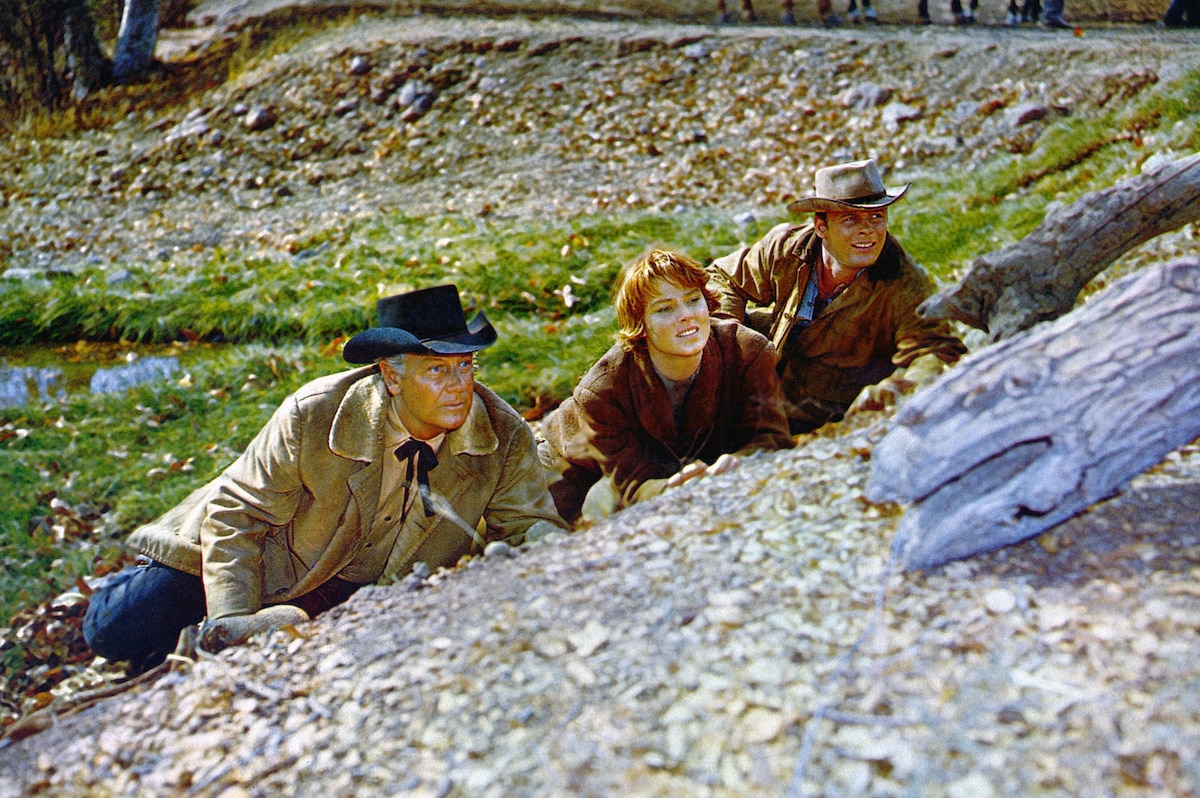
Much-acclaimed veteran cinematographer Ballard included a Chapman crane in the list of equipment he needed to shoot the film. He and Peckinpah put this to its most memorable use in the scene where McCrea rides ahead, leaving Scott and Starr behind to speculate on the possibility of stealing the gold. As the two ride on to join McCrea, the camera cranes up to follow them through the golden aspens in the brilliant autumn sun and picks all three up on the trail on the other side of the trees. It is one of the film's most beautiful and memorable shots.
Ride the High Country was shot on various locations in and around Los Angeles, including Malibu Canyon and the Twentieth Century Fox back lot. Smoke from fires raging in Topanga Canyon and Bel Air darkened much of the sky over the area, seriously complicating shooting.
One other location compromise reportedly involved cast and crew sneaking onto the set of MGM's epic How the West Was Won (1962) to film the confrontation scene between Scott and McCrea.
To emphasize the enmity between the Hammond brothers and the lawmen, Peckinpah kept all the actors playing the mining family away from the others, having them eat by themselves and do everything as a unit. He would continually remind them, "You hate everybody here!"
Peckinpah apparently took an inordinate interest in Mariette Hartley's costume, taking her into the bowels of the MGM costume department to find the right dress, then having the wardrobe department pad it until he thought the chest was sufficiently full. "Sam always liked breasts," Hartley said, adding that by the time he was done she was "literally walking at a tilt."
Peckinpah also liked to tease the naive, inexperienced Hartley. At one point, having been tipped off that Hartley had worn the wrong socks for a scene in which they would not even be seen, Peckinpah pretended to have a major fit, accusing her of ruining the shot. He also kept telling her that if she didn't perform to his liking, he would give her part to Joan Staley, another aspiring young actress of the time. But Hartley took the ribbing good-naturedly and had nothing but admiration and affection for her director.
By most accounts, Peckinpah had not yet developed the difficult behavior that was to plague his productions in later years. Hartley did note, however, that on the bus coming down from the Sierras, he started drinking and playing cards. At one point he snapped at her viciously. Having had an alcoholic father, she recognized the behavior at once but also said it was the only time she was aware that he drank during the production.
Many of the actors in Ride the High Country said they got on well with the director. L.Q. Jones said he and Peckinpah almost came to blows over how to do a scene, but in the end he always realized Peckinpah was right. James Drury said the cast of Ride the High Country was lucky to have worked with him when "he was a happy man. We knew him at his best and most likeable." Drury also praised him for being "innovative, imaginative, always anxious to work with actors on their characters" without over-directing. And he noted that Peckinpah, McCrea and Scott had a tremendous amount of respect for each other.
McCrea said that although he got along very well with Peckinpah, he didn't like the way the director treated the crew. Like John Ford, Peckinpah used to berate someone mercilessly if they made a mistake or failed to do what he wanted. Lyons said on this picture, Peckinpah began his practice of firing people for one mistake, such as a young sound boom operator who allowed the boom to creep into the shot. The harsh practice became such a habit that even Peckinpah acknowledged he was prone to it, giving Lyons a photo of himself signed "To Dick Lyons - Get rid of 'em - Sam Peckinpah."
Peckinpah, who tended to edit in his head as he went along, didn't shoot much extra coverage beyond the footage he knew he needed for each scene. After viewing the rushes, MGM management sent him a note: "Who do you think you are, John Ford?"
Shooting on Ride the High Country was completed in less than a month, ending in November. MGM's chief editor, Margaret Booth, disliked the daily rushes and thought the film would be impossible to cut. But studio production head Sol Siegel had had faith in Peckinpah and offered him the rare chance to make the first cut on the picture. Peckinpah went into intense editing sessions with veteran editor Frank Santillo, who Lyons said taught the director about editing. Santillo, however, also spoke of how impressed he was with Peckinpah's ideas and changes, bringing out character nuances and other hidden potentials by substituting different shots, trimming and refining. But before they could complete the cut, things took a downward turn.
Siegel was ousted in a feud with studio executive Joseph Vogel, who took over Siegel's job himself. After sleeping through a screening of the rough cut of the film, Vogel declared it the worst picture he had ever seen and barred Peckinpah from the studio.
Despite Vogel's interference, Lyons and Santillo set about cutting the film the way Peckinpah wanted, consulting with him covertly. They even got his input and approval for sound mixes by playing them to him over the phone. Vogel decided to ignore the picture; he thought it so bad that no amount of time or money could save it.
by Rob Nixon
Behind the Camera
by Rob Nixon | May 03, 2006
SIGN UP FOR OUR NEWSLETTERS

CONNECT WITH TCM