Producer Richard Lyons got his start in the B unit at Twentieth Century Fox. He caught the attention of producer Sol Siegel with a low-budget movie, The Sad Horse (1959). Siegel brought him over to MGM with the directive to produce a small Western (it was budgeted at $800,000), primarily to release in European markets to offset the expenses of big budget pictures, such as the studio's Mutiny on the Bounty (1962).
Lyons mentioned to his friend William S. Roberts, who had written the script for The Magnificent Seven (1960), that he needed a good script for his assignment. Roberts recommended one written several years earlier by a friend of his, N.B. Stone, Jr., about two aging lawmen who get one last chance in life, called Guns in the Afternoon (it was later released in Europe under this title). Roberts put Lyons in touch with Stone.
Lyons soon found out that Stone was an eccentric character, an alcoholic and agoraphobic who wouldn't work anywhere but his apartment and who would have huge memory lapses about what he had written and where he had put it. It was a struggle for Lyons to get the full script out of Stone, and after about two months, and much pressure from the studio, he got a 145-page script the producer described as "just awful." Roberts read the script, too, and feeling guilty that it was so bad, offered to do an uncredited rewrite. Although all anecdotal accounts credit Roberts with the major overhaul of Stone's script, the movie only carries Stone's name on the credits, a decision of the Screen Writers Guild. Many sources, including published versions of the shooting script, while correctly listing Peckinpah as an uncredited writer, also list the uncredited Robert Creighton Williams, author of about three dozen B Westerns since 1952, but make no mention of Roberts.
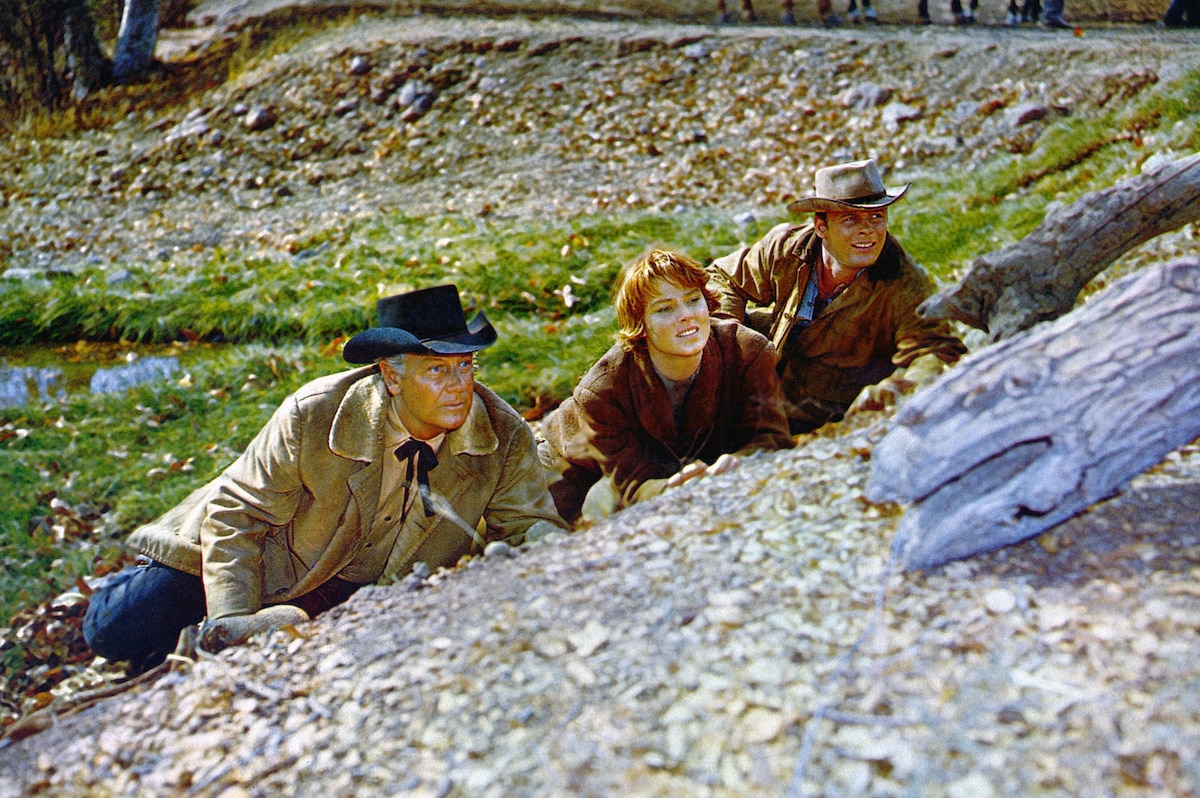
There was no doubt in Lyons's mind who should play the leads. Joel McCrea and Randolph Scott had spent more than a decade establishing themselves as iconic Western heroes. Lyons signed McCrea for the part of Gil Westrum, the former frontier lawman who has gone bad. Burt Kennedy, who had written many of the scripts for Scott's films with Budd Boetticher, interceded to get his commitment for the role of Steve Judd, the old marshal who is dedicated to doing his job with integrity and honesty. Very soon, however, McCrea decided the role went against the grain of his usual screen image and asked Lyons if Scott could be approached about switching parts. Burt Kennedy offered to function as intermediary; it turned out he had to do nothing since Scott was equally eager to switch, without knowing of McCrea's desire, so that he could play something other than the "straight, honest guy" for a change. According to McCrea, however, he approached Scott directly himself and found he was interested in swapping parts. (McCrea also claims that it was Scott who initiated the film and came to him about co-starring.)
There have been rumors that other directors were first considered for the project, including Budd Boetticher, who had directed a string of superlative Westerns with Randolph Scott in the 1950s and early 60s, and Burt Kennedy, Boetticher's screenwriter, who had recently made his directorial debut with the Western The Canadians (1961). There was also a rumor that director John Ford was the one that got Peckinpah the project. Lyons said he never considered anyone but Peckinpah to direct and chose him on the recommendation of a mutual contact at William Morris, the agency that represented both the producer and Peckinpah. Lyons watched a few episodes of the short-lived TV series The Westerner, created and directed by Peckinpah, and knew he had found his director.
Peckinpah had already proved himself a good fit for the genre with his direction of several other TV Westerns, including The Rifleman, Gunsmoke, and Zane Grey Theater. He was also no stranger to feature films, having been assistant and dialogue director for Don Siegel and director of one feature film, the Western The Deadly Companions (1961).
Peckinpah loved the script but said he would only direct if he could do rewrites. According to Lyons, Peckinpah's contributions sharpened and polished the story to "really bring out its brilliance." He worked three to four weeks on the script, giving the story much more impact, Lyons believed, by changing which character died at the end.
Peckinpah also tailored much of the character of Steve Judd (Joel McCrea) to reflect his own father. Judd's most memorable line, "I just want to enter my house justified," was a Bible-reference line he often heard his father say. On seeing the finished film, Peckinpah's sister cried, struck by how effectively and completely he had captured the essence of "the old man" on screen.
Peckinpah put a number of other details and impressions from his own life into the script. His ancestors were true Westerners, and there was a mountain named for the Peckinpahs near Coarse Gold, the real-life town where the two lawmen in the movie ride to retrieve a shipment of gold. In his childhood, Peckinpah had been taken by his grandfather to a town very much like the mining town in the movie. McCrea and Scott thought Peckinpah's rewrites were brilliant.
The question of billing was settled over a lunch at the Brown Derby, during which Scott won a coin toss to see who would be billed first.
With the two leads in place, it was up to Peckinpah to cast the rest of the picture, and for the second leads he wanted newcomers who were fresh and natural, rather than familiar players with previous film associations. The part of Heck, the brash young sidekick, went to Ron Starr, a former car salesman with only two movies to his credit.
Mariette Hartley, whose previous acting experience was only on stage and who came from a relatively sheltered background, later admitted she didn't even know who Joel McCrea was when she showed up to audition for the part of Elsa. Peckinpah kept Hartley all day, having her read with various actors auditioning for the role of Heck (including Wayne Rogers). Although she was flattered, she really didn't realize that meant she had the role.
Hartley's hair was cut short from playing Joan of Arc on stage in Chicago. For the screen test, the studio put her in a long wig, closely matching her natural red hair, that Deborah Kerr wore in Quo Vadis (1951). Peckinpah hated it. She used her own close-cropped look for the film.
For the other roles, Peckinpah cast a number of actors he had worked with on TV. Many of them such as Warren Oates and L. Q. Jones became part of Peckinpah's regular ensemble company, appearing frequently in his subsequent films.
R.G. Armstrong, cast as Elsa's stern fundamentalist father, was a regular on the TV series The Rifleman, but had quit to return to the theater.
Peckinpah originally offered the role of Billy Hammond, the young miner Elsa marries, to his friend Robert Culp, who wanted to break into movies. But Culp had his sights set on a leading man career and was afraid if he played Billy, "I would have wound up like Bruce Dern, playing crazies." He turned down the role to his eternal regret; Peckinpah never offered him another one. Instead, the role went to MGM contract player James Drury, who Peckinpah had also directed on television.
by Rob Nixon
The Big Idea
by Rob Nixon | May 03, 2006
SIGN UP FOR OUR NEWSLETTERS

CONNECT WITH TCM